

Modern Australian
Times Advertising

why Australia and New Zealand are safe from 'bank run' contagion

  • Written by John Hawkins, Senior Lecturer, Canberra School of Politics, Economics and Society, University of Canberra
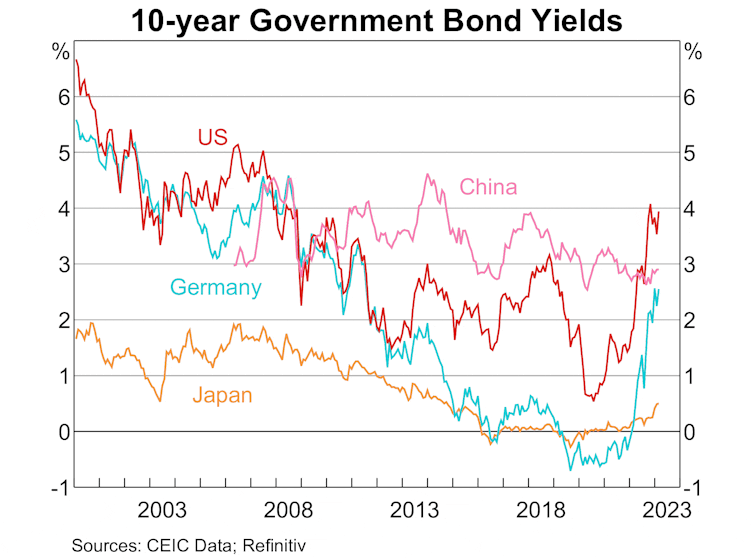
10-year government bond yields

There has been a lot of talk about the risk of financial contagion following the collapse of California’s Silicon Valley Bank. Perhaps too much talk.

While the frequency of bank runs in the past shows the power of emotions to move markets, there’s little reason to panic.

We’re not looking at anything like the circumstances that precipitated the global financial crisis of 2008. If you’ve got your savings in any bank or credit union in Australia or New Zealand, the greatest fear is fear itself.

Just two other US banks, the New York-based Signature Bank and First Republic in San Francisco, have been caught up in the trouble. Internationally, the only casualty is Credit Suisse in Switzerland, whose customers have been saved by loans offered from Switzerland’s central bank and takeover by Switzerland’s largest bank, UBS.

It is likely that until a few weeks ago you’d never heard of Silicon Valley Bank (or Signature or First Republic). But Credit Suisse, founded in 1856, is known around the world. It was regarded as one of 30 systemically important global banks.

What does its troubles have to do with Silicon Valley Bank? Not much, except that fear is contagious, and the bank already had problems that made it extra susceptible to panic.

Interest rates and bond debts

Apart from fear, the one common factor in these bank failures is the impact of higher interest rates on government bonds.

Bonds are a form of debt. Governments issue them to raise money in excess of their tax revenue. Bond buyers are paid regular fixed interest (known as a “coupon”) until the bond matures, when the issuer repays what the original buyer paid for the bond.

Banks like bonds, particularly in uncertain times. Even though they pay less interest than on other forms of debt, there’s an extremely low risk of default. Governments rarely go broke. They can always raise funds through taxation, or issuing more bonds, to meet their obligations.

Read more: We've just sold $15 billion 31-year bonds. What's a bond?

In the early months of COVID, as central banks slashed interest rates as much as possible to sustain economic activity, the already low rate of interest that governments paid on bonds dropped further. In some cases this meant bond yields were even negative. But they were still attractive to banks because of the low default risk compared to, say, lending money to companies facing tough times.

10-year government bond yields
Reserve Bank of Australia But then came 2022 and unexpected inflation, as economies recovered and Russia’s war on Ukraine pushed up global energy prices. In response, central banks began quickly pushing up interest rates. Bond interest rates rose too. The interest rate on a ten-year US treasury bond, for example, was about 1.5% in November 2021. A year later it was more than 4%. These higher yields on new bonds have lowered the value of existing bonds that pay less interest. Any bank wanting to sell those bonds (on a secondary market) must do so for less than what it paid. What happened with Silicon Valley Bank This is what happened with Silicon Valley Bank. The early stages of the pandemic were great for it. Deposits by customers, concentrated in northern California’s high-tech industry, tripled. The bank then invested heavily in US government bonds, intending to hold them until they matured. Then came inflation and the tech industry downturn, with many companies announcing layoffs. Customers started drawing down their deposits to pay their bills. To cover those withdrawals, the bank had to sell bonds at a loss. This reduced market confidence in the bank, leading to further withdrawals by depositors worried it might collapse. Fear of a collapse became a self-fulfilling prophecy. Customers queue outside a Silicon Valley Bank branch Wellesley, Massachusetts, March 13, 2023.
Customers queue outside a Silicon Valley Bank branch Wellesley, Massachusetts, March 13 2023. Steven Senne/AP

But the outcome of a classic “bank run” – with fear spreading through an interconnected financial system – was prevented by the US Federal Reserve stepping in to guarantee deposits.

What happened with Credit Suisse

So what has this to do with Credit Suisse? Like Silicon Valley Bank, which had poor risk controls, it too had specific problems indicative of poor management.

It has been implicated in providing banking services to corrupt and criminal clients. In June 2022 it was convicted in Switzerland’s Federal Criminal Court for failing to prevent money-laundering by cocaine trafficker.

In short, Credit Suisse was a disaster waiting for a catalyst. The collapse of Silicon Valley Bank, and the talk of a global banking crisis, was enough to send already jittery customers to the exit. Credit Suisse’s largest shareholder, Saudi National Bank, then bluntly and publicly refused to contribute more capital.

Read more: The European Central Bank seems to have got away with raising interest rates in the middle of a banking crisis – here's why

Stronger in Australia and New Zealand

In my view, the chances of any bank in Australia and New Zealand following this trajectory is effectively zero.

There’s a lot of crossover between the two countries’ financial sectors and the principal banking regulators, the Australian Prudential Regulation Authority and the Reserve Bank of New Zealand. To prevent bank runs developing, the RBNZ and APRA set minimum levels of liquid assets that can be quickly converted to cash to cover withdrawals.

It is almost a century since any depositor in an Australian bank lost even a portion of their money.

This not to say there haven’t been crises. For example, in 1979 the Bank of Adelaide faced collapse. The RBA organised massive loans from other banks. It was then taken over by ANZ Bank. Depositors kept their savings.

In 1990 the troubled State Bank of Victoria was taken over by the Commonwealth Bank of Australia (then still owned by the Commonwealth government). Again, depositors didn’t lose.

Read more: Worst bank turmoil since 2008 means Federal Reserve is damned if it does and damned if it doesn't in decision over interest rates

In the very unlikely event a bank did fail, Australian depositors are also protected by a federal government deposit insurance scheme called the Financial Claims Scheme. This was set up during the global financial crisis to protect customers of banks, credit unions, building societies and general insurers. It guarantees that every depositor with up to $250,000 will get their money.

The NZ government has a similar scheme in the works, with legislation expected to become law later in 2023.

Authors: John Hawkins, Senior Lecturer, Canberra School of Politics, Economics and Society, University of Canberra


Read more https://theconversation.com/credit-suisse-is-an-anomaly-why-australia-and-new-zealand-are-safe-from-bank-run-contagion-202126

What People Mean by “Alternative Doctor” And Why Expectations Around Care Are Changing

When people search for an “alternative doctor,” they’re usually looking for something specific, even if they haven’t fully defined it yet. I...

Why Does My Power Keep Tripping? Common Causes Explained by Electricians Sydney

The electrical system is the lifeblood of your home, powering everything from your phones to cooking utensils and more. But from time to time, your po...

Interstate Car Transporter Urges Buyers to Book Early

As the conflict in the Middle East continues to put increasing pressure on local fuel supply, Australian transport companies are experiencing increasi...

Digital Minimalism for Business Owners: Fewer Tools, Better Systems

Be honest. How many apps are open right now? One for scheduling, another for invoices, a third for customer notes, plus a spreadsheet someone email...

The Importance Of Proactive NDIS Renewal Preparation For Sustaining Your Provider Business

Your NDIS renewal notice is not a signal to start preparing. By the time it arrives, preparation should already be well underway. For new providers, s...

Why Fire Extinguisher Testing in Sydney Is Becoming a Records Game, Not Only a Maintenance Job

A fire extinguisher used to feel like one of the simpler parts of building safety. It hung on the wall, wore a service tag, and sat there quietly unle...

The Switchboard Upgrade Question Every Melbourne Renovator Should Ask Before the Walls Close Up

Renovations have a funny way of making people think on surfaces first. Splashback, stone, joinery, tapware, paint. Fair enough too. That is the exciti...

Winter Sanitation Gaps in Parramatta Kitchens: A Hidden Pest Risk

Winter brings a host of changes to our homes, from the chill in the air to the cozy warmth indoors. However, this season also introduces sanitation ch...

When to Seek Advice from Employment Lawyers in Melbourne

Australian employment law is detailed and, at times, complex, with rights and obligations that aren't always obvious to employees or employers witho...

7 Benefits of Professional Gutter Cleaning for Australian Homeowners

Gutters aren't exactly glamorous. They sit up there on the edge of your roof, doing their job quietly - until they stop working. Clogged, overflowing ...

Pipe Floats Strengthening Pipeline Performance In Demanding Environments

Pipelines often travel through environments that are anything but predictable, water currents shift, terrain changes, and materials keep moving unde...

Why Ceiling Fans Are Essential For Comfort, Efficiency, And Modern Living

Creating a comfortable indoor environment is not just about temperature; it is about how air moves, how a room feels, and how efficiently energy is ...

Why Duct Cleaning In Melbourne Is A Smart Investment For Healthier Living Spaces

Behind your walls, ceilings, and vents lies a network quietly working every day to keep your home comfortable. Yet over time, this system can become...

Disability Service Providers Supporting Inclusive And Independent Living

Finding the right support system can feel like assembling a puzzle where every piece must fit just right. For individuals and families navigating di...

A Beginner's Guide to Owning a Caravan in Australia

Owning a caravan opens up a style of travel that's hard to match for freedom and flexibility. However, for those just starting out, the process of c...

Preparing Your Air Conditioner for Summer: What Most Homeowners Overlook

As temperatures rise, many homeowners switch on their air conditioning for the first time in months — only to find it’s not performing the way i...

What Actually Adds Value to Properties in Newcastle

Newcastle has seen steady growth over the past few years, with more buyers looking beyond Sydney for lifestyle, space, and long-term value. As dema...

What is Design and Build in Construction?

Imagine you’re about to start a new construction project, maybe it’s a custom home or a commercial building. You’ve got the idea, the land, an...
















