

I realised the fat-tailed dunnart was under threat. Here's how I got the species officially listed
- Written by: Emily Scicluna, Research Associate – Thylacine Integrated Genomic Restoration Research Laboratory, University of Melbourne, The University of Melbourne
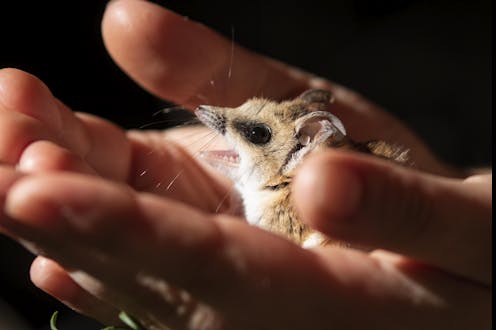
Saving endangered species is an uphill battle in Australia, the mammal extinction capital of the world. But the first step, threatened species listing, can be confusing, tedious and time-consuming.
To demystify the rigorous (yet arduous) process for listing threatened species, we describe the experience of listing fat-tailed dunnarts in Victoria.
This feisty little predator stores fat in its tail, much like a camel’s hump. For too long it was considered common, but evidence shows the species is in decline and needs help to recover.
Threatened species listing affords extra protection, but there are no guarantees. We need to keep the pressure on policy-makers and public servants to ensure our most vulnerable species receive the protection they deserve.
A shameful record of extinction
Australia has the highest mammal extinction rate in the world. We have lost 39 land mammals since European settlement. That’s a rate of about one to two mammal species per decade since the first post-1788 Australian mammal extinction, probably in the 1840s.
In total, 67 animals and 37 plants are declared extinct under the federal Environment Protection and Biodiversity Conservation Act 1999 (EPBC Act). That includes 39 mammals, 22 birds, four frogs, one reptile and one earthworm.
A further 499 animals and 1,374 plants are listed as threatened with extinction.
Threatened species listing gives the conservation status legal standing and mandates actions to secure species populations, allowing eventual removal from the list. This may include developing a recovery plan that stipulates actions to reduce threats (such as habitat loss, predation, or competition with invasive species) or to increase populations (such as captive breeding and translocations).
Listing also triggers environmental laws. Proposed developments that might harm or otherwise impact threatened species or their habitat should be referred for assessment under the EPBC Act. The development may be stopped entirely (although this rarely happens), modified to reduce potential impacts, or offsets may be required to compensate by helping the species at another location.
Cause for confusion
A species at risk of extinction may be listed as threatened under either state or federal legislation. However, there are several aspects of the listing process that may cause confusion.
The International Union for Conservation of Nature (IUCN) Red List of Threatened Species has five criteria:
- A: population size reduction
- B: geographic range (declining area or extent)
- C: small population size and decline
- D: very small or restricted population
- E: quantitative analysis (reflecting the population’s viability).
Each criterion has specific thresholds that a species must fall below to be considered threatened. However, a species only needs to meet one of the five criteria to be eligible for listing as threatened.
The catch-all term “threatened” includes different levels of extinction risk, from vulnerable through to endangered, critically endangered, extinct in the wild, and finally, extinct. The risk of extinction increases with each step.
For example, a species is classified as vulnerable if it has suffered a 30% reduction in population size over ten years or three generations. If the decline was 50% or more, it is classified as endangered, and critically endangered if the decline was greater than 80%.
Similarly, a species is vulnerable if its entire population consists of less than 1,000 adults, endangered if it is fewer than 250 adults, and critically endangered if less than 50 adults.
To further complicate matters, every state and territory, and the Commonwealth, has its own threatened species legislation. This means a species can potentially be listed as threatened in one jurisdiction but not in another.
For example, koalas are listed as threatened under the federal EPBC Act (due to drastic declines in NSW, Queensland and the ACT) but not under Victoria’s Flora and Fauna Guarantee Act. So a species can be threatened in one state but not in another, and can be threatened at the state level but not at a national level.
Finally, someone (or usually a group of people) must take the time and effort to formally nominate a species as threatened. While anyone can nominate a species for listing, the nominator must provide compelling evidence that the species satisfies at least one of the IUCN criteria.
This is not a trivial undertaking, so the official lists of threatened species are almost certainly an underestimate of the true number of species that are threatened. But this is exactly what I did.

Listing the fat-tailed dunnart
Early in my PhD candidature (in February 2018), my goal was to use fat-tailed dunnarts as a model species for some of their more endangered relatives, such as the Tasmanian devil or eastern quoll.
The fat-tailed dunnart is a small, carnivorous, nocturnal marsupial that weighs around 15 grams (about the size of three grapes). They are incredibly cute, ferocious predators (of insects, that is) who store energy reserves in their tail, much like a camel’s hump.
The species is widely distributed across southern and central Australia in a range of habitats. In Victoria, they are largely confined to grasslands and open woodlands.
When I began my PhD research, fat-tailed dunnarts were assumed to be “common”, based on historical records. But no-one was really looking for them. So when I set out to find them, I couldn’t.
My main study site was at the Werribee Western Treatment Plant. In the early 1970s, 700 fat-tailed dunnart were trapped there over four years. Using the same methods, with double the survey effort, I found none.
In the intervening 43 years, 75% of suitable dunnart habitat at this site had been cleared. When I extended my search further west into Victoria’s grasslands, fat-tailed dunnarts were still present but only in very low numbers. As the last remaining small mammal in Victoria’s grasslands, this was highly concerning.
Over time I realised that this species was a threatened species in its own right.
Gathering the evidence
In 2019, I began to pursue statutory listing and protection for fat-tailed dunnarts in Victoria under the Flora and Fauna Guarantee Act. So what did that involve?
I needed to provide the following:
Species description, life history, generation length, habitat, and distribution. Basically, everything there is to know about the species. Generation length is crucial: if a species has slow reproductive rates, it will be more difficult to recover from population crashes.
Key threats. I needed to provide evidence that fat-tailed dunnarts were experiencing habitat loss (conversion of grasslands to crops), being heavily preyed upon by invasive species (mostly by rats) and that the remaining populations were becoming geographically isolated, therefore restricting gene flow.
Evidence of decline. This is where it gets really tricky. I needed to provide evidence that fat-tailed dunnarts met at least one of the five IUCN criteria mentioned above. This was challenging because there were no long-term survey datasets available for fat-tailed dunnarts. How do you show a decline when no one knew what the original populations were?
I was able to garner enough data and evidence from my PhD research, the Atlas of Living Australia, and compiling incidental recordings of this species from other surveys to convince the Scientific Advisory Committee to support the nomination of the fat-tailed dunnart.
Specifically, I was able to show that the Victorian population had declined by more than 60% from 2000-09 to 2010-19. This satisfied the threshold for population decline (criterion A) of at least 30% over the past 10 years (vulnerable).
I was also able to demonstrate that fat-tailed dunnarts now only occupied 1,427 square kilometres in Victoria, meeting the threshold for vulnerable under criterion B (geographic range). I satisfied not one, but two IUCN criteria.
Protecting the dunnart
Once the vulnerable listing is formally ratified, planning decisions that involve clearing potential fat-tailed dunnart habitat need to consider the species. At least that’s the idea. In practice, legislative protection does not always translate to on-ground protection.
Loopholes, offsets, ministerial discretion and findings of “low to moderate impact” mean projects that clear threatened species habitat go ahead more often than not.
Despite promising signals and intent from the federal government, threatened species habitat continues to be cleared at alarming rates, pushing species towards the brink of extinction. The process for listing threatened species is rigorous - as it should be - but it is a means to an end.
Unless threatened species laws are enforced and strengthened, the effort required to have a species listed as threatened will be in vain.
Read more: Australia's next government must tackle our collapsing ecosystems and extinction crisis
Authors: Emily Scicluna, Research Associate – Thylacine Integrated Genomic Restoration Research Laboratory, University of Melbourne, The University of Melbourne


















