

could someone take ownership of a planet or a moon?
- Written by: Melissa de Zwart, Professor, Adelaide Law School, University of Adelaide
This is an article from I’ve Always Wondered, a series where readers send in questions they’d like an expert to answer. Send your question to alwayswondered@theconversation.edu.au
I have always wondered, in a distant future when humanity is able to settle permanently on a distant body (such as planet, moon or rocky body), are there any current legal frameworks that could be applied as a precedent for such individuals to “take ownership” of that body and its resources? – Daniel, Croydon, Australia
Despite regular excited talk, human “settlement” of another planet, the Moon or an asteroid may still be many years away. Physicist Andrew Coates sees major challenges in Elon Musk’s public plans to colonise Mars.
But mining of space resources is a realistic possibility – and several nations are already investing in extraction operations in space.
We currently have five space law treaties which cover many key issues about the use, exploitation and protection of space. These treaties deal with ensuring that no nation claims sovereignty over a celestial body.
However they do not provide any clear guidelines for extracting resources in the absence of that sovereignty – that is, extracting resources from an asteroid or body that is not “owned”.
Read more: Sorry Elon Musk, but it's now clear that colonising Mars is unlikely – and a bad idea
The moon flag was symbolic
Humanity first walked on the Moon in 1969.
The historic landing of Apollo 11 and Neil Armstrong’s first moon walk are remembered for Armstrong’s deliberate choice of words – “that’s one small step for a man, one giant leap for mankind” – as well as the symbolic planting of an American flag on the surface of the Moon.
The choice of flags for this occasion was carefully planned. The relevant NASA appropriations bill provided that the planting of the flag was “intended as a symbolic gesture of national pride in achievement” and “not to be construed as a declaration of national appropriation by claim of sovereignty”.
In total, twelve men have walked on the Moon, all of them American and the last of these was as long ago as 1972. None of these acts have been interpreted as an act of settlement or claim of US sovereignty.
Astronaut Gene Cernan described his 1972 moon visit as like “being on God’s front porch”.Since this time, the popularity of space exploration has waxed and waned, due to the prohibitive cost of space programs.
However, recent developments in space flight have drastically cut the cost of space vehicles. This has resulted in a renewed interest in exploring more permanent settlements on Mars or other celestial bodies.
Read more: Five reasons India, China and other nations plan to travel to the Moon
Space law treaties
Let’s look at the five existing space law treaties that would apply if humanity were to establish a base on Mars or the Moon.
The first of these, the Outer Space Treaty (1967) provides that:
Outer space, including the Moon and other celestial bodies, is not subject to national appropriation by claim of sovereignty, by means of use or occupation, or by any other means.
This fundamental principle of “non-appropriation” prevents any nation from claiming sovereignty over the Moon or any other celestial body.
The other space treaties deal with:
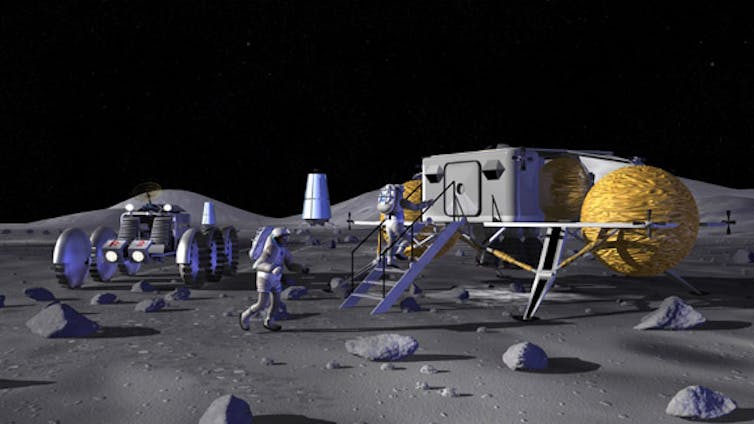 Would you like to live on the Moon? This is what it might look like.
NASA
Would you like to live on the Moon? This is what it might look like.
NASA
These treaties (like the Antarctic Treaty with respect to the management and use of Antarctica) represent the international law that applies to outer space.
The Moon Agreement provides the most extensive protection of the Moon environment, and includes specific rules relating to potential activities on the Moon and other celestial bodies.
However, Australia is one of the very few countries which has acceded to the treaty – only 18 parties have acceded to or ratified this treaty (compared to the Outer Space Treaty, which has 107 members).
The Moon Agreement is therefore not considered to reflect customary international law – this means that its terms are not considered to reflect existing rules and norms of international space law. China, the United States and Russia are not members of this treaty, and neither are United Arab Emirates and Luxembourg (countries that do have clear space mining interests).
Taking resources without ownership
Despite the fact that nations may not claim sovereignty over a celestial body, the international treaties leave open the scope for states and private firms to use and mine celestial bodies without asserting ownership of the entire asteroid or planet.
In other words, you can extract and own resources without asserting sovereignty over the entire planet.
At the moment, in the absence of any clear laws regulating resource extraction, it is a case of first in, best dressed.
Corporations are now preparing operations to explore and utilise space resources, such as platinum, helium-3 (a potential fuel source) and water.
Various states, including the United States, Luxembourg and the United Arab Emirates have begun authorising resource exploration and extraction operations and conveying rights under their respective laws to their nationals with respect to the ownership of those natural resources.
Read more: A sports car and a glitter ball are now in space – what does that say about us as humans?
Some states have argued that the Outer Space Treaty requires benefit-sharing of the materials extracted from space mining, as detailed by the Moon Agreement. However, even that agreement foreshadows the development of a further international regime to govern the exploitation of natural resources of the Moon, but such a regime has never been agreed on.
So while there is no ability for states to claim sovereignty over space, there is still scope for exploitation of its resources.
Authors: Melissa de Zwart, Professor, Adelaide Law School, University of Adelaide


















