

A dive into the deep past reveals Indigenous burning helped suppress bushfires 10,000 years ago
- Written by Alan N Williams, Associate Investigator, ARC Centre of Excellence for Australian Biodiversity and Heritage, UNSW Sydney
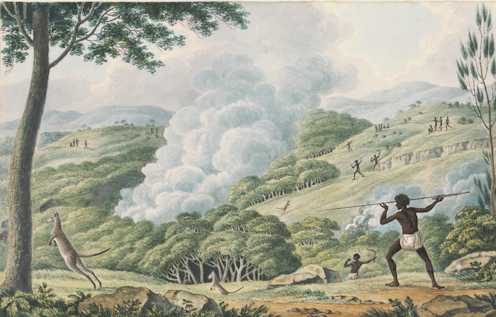
Indigenous Australians have conducted cultural burning for at least ten millenia and the practice helped reduce bushfire risk in the past, our new research shows.
The study provides more evidence of the very long history of cultural burning in southeast Australia. While the burning was probably not specifically used to manage bushfires, our data suggest it nonetheless reduced fire extremes.
Indigenous cultural burning involves applying frequent, small and low-intensity or “cool” fires to clean out grasses and undergrowth. But the scientific evidence for when in history Indigenous Australians used cultural burning, and what they were seeking to achieve, is unclear.
Our findings suggest Indigenous cultural burning in the past may have helped reduce the intensity of bushfires. These findings are important because evidence suggests cultural burning can assist modern land management as climate change worsens.
When did cultural burning start in Australia?
Some experts suggest cultural burning was adopted in the Pleistocene period, about 50,000 to 10,000 years ago.
Increases in charcoal in sediments have been linked to the arrival of humans, and subsequent vegetation change, on the Atherton Tablelands in northeast Queensland from about 45,000 years ago.
However, similar changes occurred on some Pacific Islands at times when humans were not present. This has cast doubt on whether past fires in Australia were the result of human activity.
Another point of view suggests cultural burning was adopted only in the last few thousand years.
Some current cultural burning programs in Australia were only established or re-established in the second half of the 20th Century. But they mostly take place in arid and tropical environments, and it’s not certain whether they can be readily applied to temperate regions.
Our research sought to shed light on when cultural burning in southeast Australia began, and what effect it had. We focused on a site in the Illawarra region of New South Wales. In particular, we examined sediments from the bed of Lake Courijdah in the Thirlmere Lakes National Park, which holds a unique record into the past.
A spotlight on charcoal
Sediments in Lake Courijdah cover two time periods: one before Aboriginal people are thought to have arrived in Australia, and one after.
The older sediments, from about 135,000 to 105,000 years ago, included a period known as the Last Interglacial. This climatic period was very similar to today’s and would have produced similar environmental conditions. Importantly, humans were not present at this time.
Above this layer were deposits dating to the last 18,000 years, extending from the end of a cool and probably arid period known as the Last Glacial Maximum up to about 500 years ago.
It’s well-documented that in this time period, Indigenous people were living across the Sydney Basin, including the Illawarra region.
From these sediments, we examined the accumulation of charcoal – a common method used to determine the frequency and relative size of bushfires. We also used a new method known as “Fourier Transform Infrared spectroscopy”. It determines bushfire severity based on the chemical composition of the charcoal produced.
Using this new method is important. Recent research by our UNSW lab showed how traditional charcoal techniques may mask evidence of human fire use (in the form of cool fires).
Our results
So what did we find? During both periods, climatic change was the main driver of fire activity. This suggests human-caused climate change will continue to influence overall fire conditions in future.
But we found a marked difference between the two time periods when looking at the severity of fire. Despite significant climatic change over the last 18,000 years, fire severity remained lower, when compared to the earlier period without humans.
As such, we conclude that Indigenous cultural burning practices undertaken around Thirlmere Lakes from about 10,000 years ago may have suppressed extreme wildfires.
Cultural burning in the region may have begun earlier than this. However, data from before 10,000 years ago is variable – probably as a result of sea-level change – so we can’t say for sure.
Indigenous people using cultural burning were probably not focused on wildfire suppression. Early explorer records, and even more recent work, suggests burning improved hunting prospects and the diversity of resources. However, cultural burning nonetheless appears to have reduced wildfires in this case.
Looking ahead
El Niño conditions are predicted to return to Australia this year. Inevitably, thoughts return to the massive Black Summer bushfire season of 2019-2020 and how to prevent such disasters in future.
Our findings suggest when it comes to future fire management in eastern Australia, traditional practices by Indigenous people should be taken into account in policy and decision-making.
Adopting cultural burning as part of our toolkit is likely to minimise wildfires and help keep people safe.
Read more: What to expect when you’re expecting an El Niño (the answer might surprise you)
Authors: Alan N Williams, Associate Investigator, ARC Centre of Excellence for Australian Biodiversity and Heritage, UNSW Sydney

















