

Drone seeding and E-seeds sound exciting, but ecosystem restoration needs practical solutions
- Written by: Simone Pedrini, Lecturer in ecological restoration, Curtin University
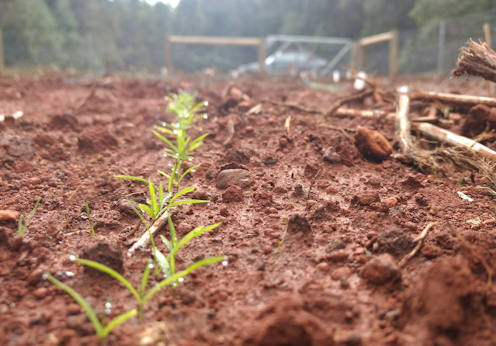
A drone drops a small wooden projectile with three spiral tails and a seed mounted on the tip. It gently lands on the bare ground and sits there, exposed to the elements, until it rains. Then, the moisture penetrates the wood fibres, and the spiral tails start twisting, slowly pushing the seed into the ground, where it will germinate.
The design of this incredible depth-seeking seed carrier, recently published in Nature, was inspired by the self-burying mechanism of a few grass species, such as those of the genus Erodium.
According to the authors, these seed carriers, also known as E-seeds, can be built in various sizes for different species and dropped by aeroplanes or drones to restore degraded ecosystems.
This bio-inspired engineering marvel has received a vast and well-deserved share of attention and praise.
But, from a restoration practitioner’s point of view, it has logistical issues that can greatly limit its application at scale.
Unproven ‘game-changers’
E-seeds are the latest of many technologies presented as restoration “game-changers”.
Numerous private companies have entered the market with revolutionary devices (mostly drones), claiming to restore ecosystems by planting billions of trees. Yet, to date, there is little evidence of their efficacy.
This fascination with shiny technological gadgets might divert scarce resources from practical, on-the-ground solutions that will seriously affect our ability to restore degraded ecosystems globally.
A vast portion of the world’s ecosystem has been damaged or destroyed due to human activities. Global initiatives, such as the UN Decade for Ecosystem Restoration and the Bonn Challenge, promote international cooperation to restore 350 million hectares by 2030.
For decades, scientists and practitioners have been working on solutions to support and accelerate the recovery of degraded ecosystems.
Read more: Restoring forests often falls to landholders. Here's how to do it cheaply and well
Most seeds fail
Often, the first step for initiating the natural recovery of terrestrial ecosystems is to establish native vegetation. Tree planting is a common approach, but it can be expensive on a large scale. Direct seeding is faster and cheaper, but also riskier.
For a start, seeds need to reach the right place in the soil to germinate and grow.
If seeds are scattered (seed broadcasting) on the soil surface by hand, tractor or drone, they can be blown off by the wind or eaten by animals. Even if they germinate, the seedling can dry up and die. As a result, most seeds will not become a plant.
This is why seed penetration in the soil is the key to improving a seed’s chance of success. Generally, the bigger a seed is, the deeper it can go. This is often achieved using precision seeders, similar to those used in agriculture. These machines open up the soil, deposit the seed at a precise depth, and cover it. The E-seed can achieve a similar result, ideally making seed broadcasting as effective as precision seeding.
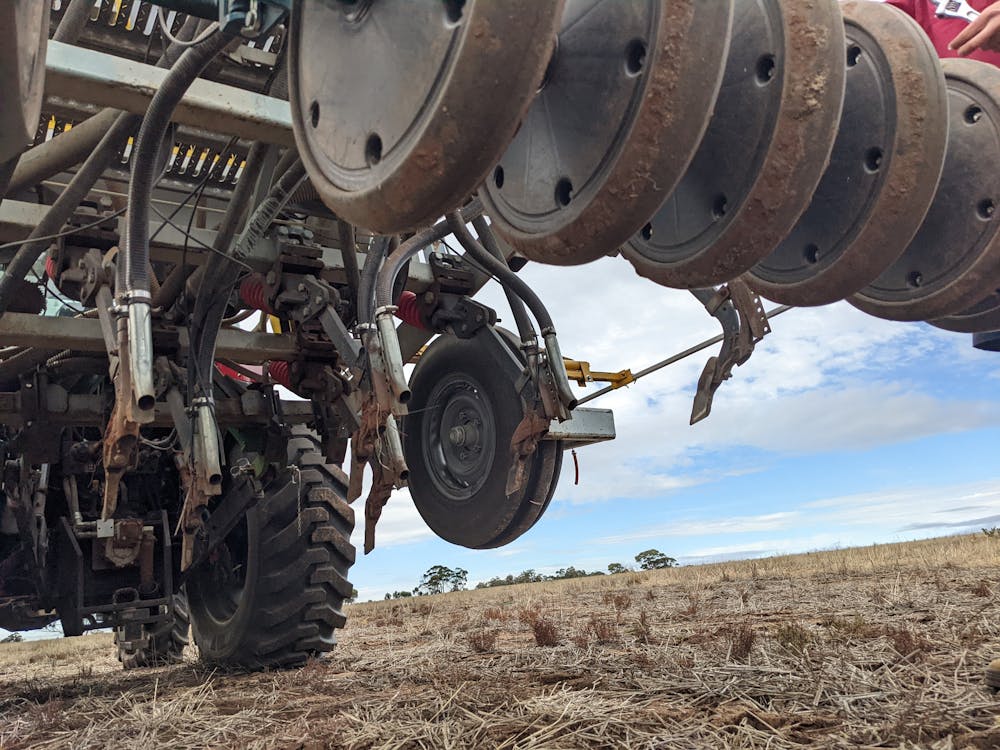
Unfortunately, this approach presents two problems: scalability and logistics. First, it’s unlikely that the multi-step process needed to manufacture E-seeds can be scaled to the many billions of seeds across thousands of species we need to restore entire ecosystems.
Second, the tails of the E-seeds could easily get tangled with each other, either clogging the seed delivery mechanism or being released in clumps. The authors solved this problem by dividing the seeding box into compartments containing a single E-seed. This stopped the seed from clumping but greatly reduced the number of seeds that could be delivered on each drone flight.
This clumping seeds issue is also common when dealing with native species, such as the grasses that inspired the design of the E-seed. A simpler, less technological solution currently used in restoration is to actually remove the tails.
This reduces the seed volume for storage and delivery, and improves the seed flow through seeding equipment. In some cases, the removal of appendages could also improve seed germination.
Such approaches are not as spectacular as E-seeds dropped from drones. Still, in most scenarios, they are the most cost-effective way to reintroduce native vegetation to a degraded site at scale.
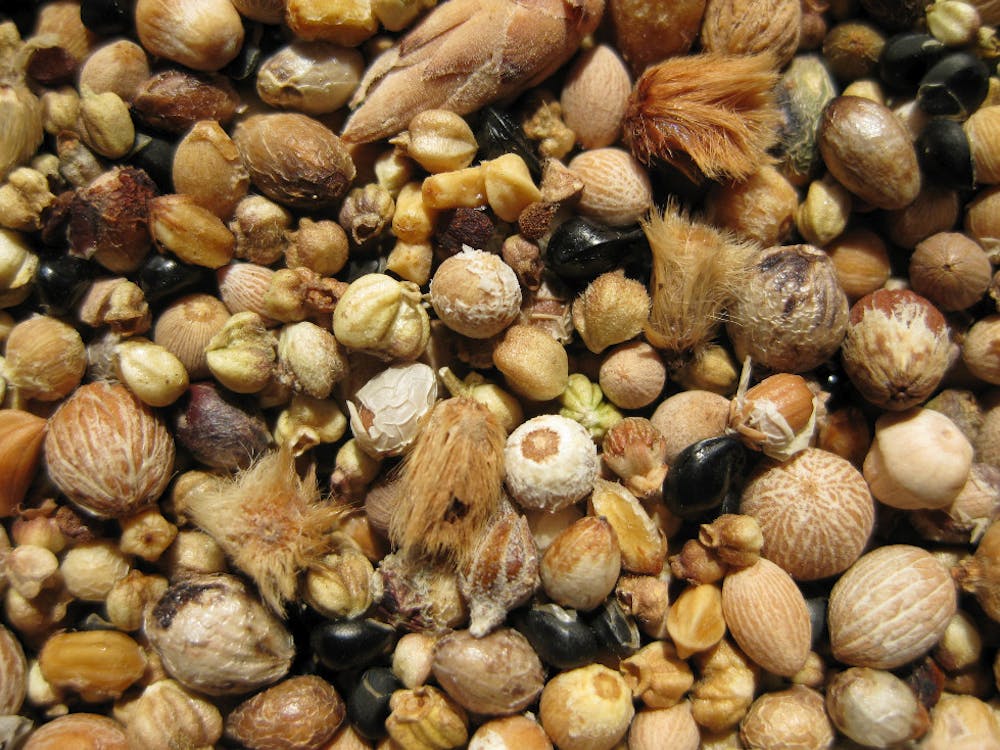 Native seed mix of Western Australian species.
Kingsley Dixon, Author provided
Native seed mix of Western Australian species.
Kingsley Dixon, Author provided
Effective, not flamboyant
Ecological restoration is an incredibly complex activity that goes beyond vegetation establishment.
It must consider the complex and dynamic interactions of organisms and their environment, while accounting for social and economic implications for local communities. Therefore, we must approach ecosystem restoration holistically and not get carried away by the lure of shiny technologies.
Funders with limited appreciation of restoration’s ecological and practical complexities are keen to embrace and invest in charismatic, yet often unproven technologies.
For example, a start-up focused on drone seeding raised a A$200 million investment, double the amount the Australian federal government has dedicated to the environmental restoration fund over four years. But science is yet to demonstrate if drone seeding can work at scale to rebuild Australia’s degraded landscapes and ecosystems.
We should welcome any attempt to improve the success of ecological restoration, and promote the implementation of novel technologies.
But new technologies must prove their worth and practicality. We should focus on the most effective ways to restore native ecosystems, not the most flamboyant.
Read more: Australia could 'green' its degraded landscapes for just 6% of what we spend on defence
Authors: Simone Pedrini, Lecturer in ecological restoration, Curtin University


















