

Australia wants to build a laser that can stop a tank. Here's why 'directed energy weapons' are on the military wishlist
- Written by: Sean O'Byrne, Associate Professor, Deputy Head of School (Research), School of Engineering and Information Technology, UNSW Canberra, UNSW Sydney
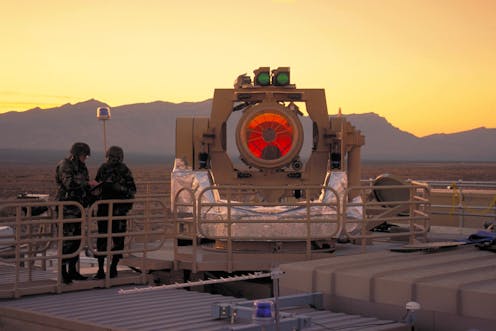
“God mode”, for those who aren’t gamers, is a mode of operation (or cheat) built into some types of games based around shooting things. In God mode you are invulnerable to damage and you never run out of ammunition.
There’s no God mode in real life, of course, but the world’s military organisations are very interested in weapons that promise something like it: lasers and other “directed energy weapons”. The US government, for example, is spending nearly US$1 billion per year on directed energy projects.
Australia is not immune to the appeal. The 2020 Force Structure Plan called for a directed energy weapon system “capable of defeating armoured vehicles up to and including main battle tanks”.
In March this year, Deputy Prime Minister Richard Marles launched Australian startup AIM Defence’s new directed energy testing range on the outskirts of Melbourne. In April, the Defence Science and Technology group announced a A$13 million deal with British defence technology company QinetiQ to develop a prototype defensive laser.
And directed energy technology is a priority in the new A$3.4 billion Advanced Strategic Capabilities Accelerator (ASCA) program.
What is directed energy?
A directed energy weapon concentrates large amounts of electromagnetic energy on a remote target. This energy might be in the form of light (a laser), but microwaves or radio waves can also be used.
In the interest of brevity, we’ll concentrate on laser-based directed energy weapons here, but much of the argument also applies to the other types.
Depending on how much energy is focused on the target, these weapons can damage the delicate electronic systems that control devices and the people who operate them, or melt or burn sturdier hardware.
Because electromagnetic waves travel at the speed of light, they are much faster than even the fastest traditional weapons. Take a hypersonic missile travelling at ten times the speed of sound towards a target 10 kilometres away. It would have moved only about 10 centimetres by the time the directed light energy from a high-power laser would have reached the target.
What’s more, because these weapons project light rather than munitions, they will never run out of ammunition. This also means ammunition does not have to be manufactured in a factory and transported to the weapon.
Directed energy is not affected by gravity like missiles and bullets are, so it travels in a straight line. This makes aiming and targeting easier and more reliable.
And because directed energy weapons cause damage by heating up a target area, they have less potential to hit nearby objects or send shrapnel flying.
So why doesn’t everyone use directed energy weapons?
Although directed energy weapons have all these advantages over conventional weapons, useful ones have proven difficult to build.
One problem faced by laser weapons is the huge amount of power required to destroy useful targets such as missiles. To destroy something of this size requires lasers with hundreds of kilowatts or even megawatts of power. And these devices are only around 20% efficient, so we would require five times as much power to run the device itself.
We are well into megawatt territory here – that’s the kind of power consumed by a small town. For this reason, even portable directed energy devices are very large. (It’s only recently that the US has been able to make a relatively low-power 50kW laser compact enough to fit on an armoured vehicle, although devices operating at powers up to 300kW have been developed.)
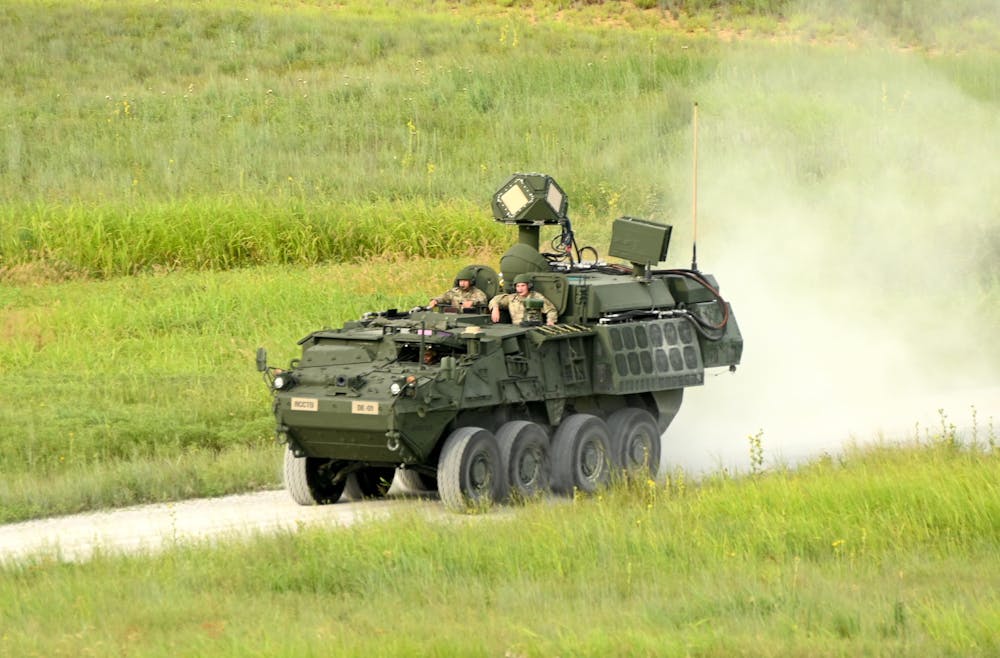
Also, all that heat needs to be removed from the delicate optical equipment that produces the light very rapidly, or it will damage the laser itself. This has proved difficult, though laser technologies with more efficient heat transfer have gradually increased the amount of light energy that can reliably be produced.
Another side effect of dealing with such large amounts of energy is that any imperfections in the optical systems used to focus and direct the light can easily cause catastrophic damage to the laser system.
Nor is it easy to focus a laser on a spot the size of a 10 cent piece tens of kilometres away, through atmospheric turbulence and dust or rain. Add to this the difficulty of holding the energy in the same location on a fast-moving target for tens of seconds, and the practical difficulties become apparent.
Having said this, technologies to overcome all of these obstacles continue to improve.
Directed energy weapons will need a whole industry
But suppose all the technical problems of directed energy weapons are overcome. Even then, to manufacture them in quantity we will face significant supply chain and infrastructure challenges.
There are companies in Australia with the expertise to make such devices. However, to develop and mass-produce directed energy weapons requires an industrial capacity for the fabrication of the necessary laser diodes and high-quality optics, which does not exist in Australia.
To have a “sovereign capability” – being able to produce these weapons without relying on inputs from overseas – we will need to develop such industries.
Read more: The defence review fails to address the third revolution in warfare: artificial intelligence
This is a time-consuming and expensive national infrastructure investment. In peacetime, it is relatively easy to acquire the raw materials for a directed energy weapon from overseas, but in a large-scale conflict countries that are able to produce these devices will likely be producing them for their own needs.
The potential military advantages of directed energy weapons, and the consequences of an adversary having them, mean Australia and many other countries will maintain an interest in developing them. But as recent policy decisions about nuclear submarines have shown, it is no easy task to quickly develop an industrial capability in technologies that our industrial base has until now largely ignored.
Authors: Sean O'Byrne, Associate Professor, Deputy Head of School (Research), School of Engineering and Information Technology, UNSW Canberra, UNSW Sydney


















