

Modern Australian
The Times

Who owned this Stone Age jewellery? New forensic tools offer an unprecedented answer

  • Written by Michelle Langley, Associate Professor of Archaeology, Griffith University
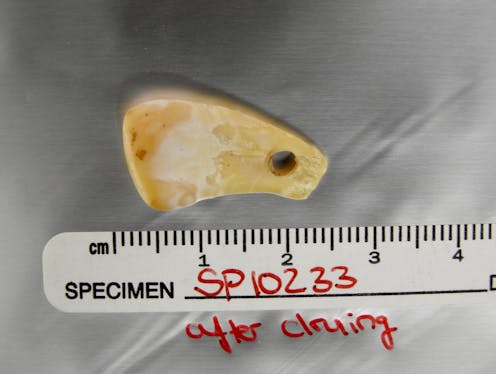
Who owned this Stone Age jewellery? New forensic tools offer an unprecedented answer

An international team of researchers has recovered DNA from the owner of a deer-tooth pendant that was buried inside a remote Siberian cave for tens of thousands of years.

In research published in Nature, Elena Essel of the Max Planck Institute for Evolutionary Anthropology in Germany and colleagues detail how they developed a new technique to extract DNA left behind on an artefact.

In much the same way police solve crimes using “touch DNA” – DNA recovered from skin cells or trace bodily fluids left behind when somebody touches an object – archaeologists will now be able to recover genetic traces of ancient humans from the artefacts they left behind.

These traces will reveal the biological sex and genetic ancestry of the individual who once held or wore a particular artefact, allowing archaeologists to link genetic and cultural evidence as they attempt to unravel the deep past.

Prehistoric artefacts and touch DNA

When archaeologists find artefacts such as tools and ornaments at a site, it’s not easy to work out who used them.

Until now, we have had to rely on finding artefacts in “direct association” with buried people. That is, we could only link an individual to an ornament if we found them buried wearing it.

Even then, this funerary association isn’t always a guide to what happened in life. The dead are buried with things their community think they should have, which may not have been theirs when they were alive.

This new method of ancient DNA extraction provides a more direct way of determining who used specific items in everyday life.
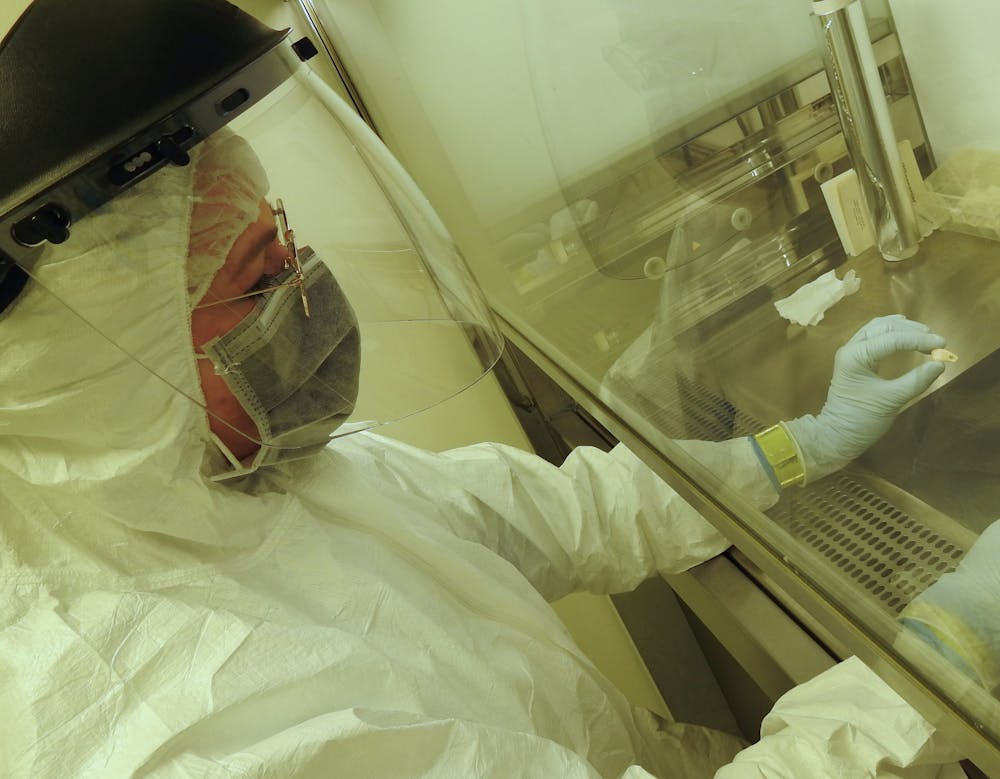
A photo of a woman in clean-room gear holding a small bone object inside a perspex box.
Elena Essel working on the pierced deer tooth discovered at Denisova Cave. Max Planck Institute for Evolutionary Anthropology

The method can only be used for artefacts made from bone or tooth as these materials are porous and can soak up human DNA from repeated contact with bodily fluids (sweat, blood, saliva). Luckily, the bones and teeth of animals (and sometimes humans) were widely used throughout the past to create everyday tools, sacred items, and personal adornment.

These osseous artefacts were held in the hand or worn against the body for extended periods, resulting in sweat and other fluids soaking into their surfaces over time. As a result, the artefact records the genetic information of the wearer.

Through experimentation with different techniques, Essel and her team found a way to recover that DNA record in a form that is intact enough to be read.

Is this yours?

Using this new method of DNA extraction, the researchers were able to extract a wealth of archaeological information from a single tooth pendant recovered from the famous archaeological site of Denisova Cave in Siberia.

The cave, tucked away in the foothills of the Altai mountains, has fascinated researchers for decades as its past inhabitants included not only Homo sapiens but also Neanderthals and another enigmatic extinct human species known as Denisovans.

A photo of the entrance to a cave in a tree-covered hill.
Over the millennia, Denisova Cave has been inhabited by Homo sapiens as well as our extinct cousins the Neanderthals and Denisovans. Richard G. Roberts

First, they were able to extract the DNA of the animal the tooth belonged to, a wapiti deer (Cervus canadensis).

They were then able to extract human DNA from the pores of the tooth and deduce that this DNA had come from a female individual whose ancestry is most similar to ancient people found further east in Siberia and with Native Americans.

They were also able to use the DNA data to estimate the date of the pendant’s creation, somewhere between 19,000 and 25,000 years ago. This date fits with previous radiocarbon dating of the layer of the cave floor sediment in which the artefact was found.

DNA found in soil, or “environmental DNA”, can also inform our understanding of who used an archaeological site such as Denisova Cave.

Without the extraction and analysis of the human DNA held in the tooth, archaeologists would have been able to tell what animal it had come from and how old it was. However, we could never have guessed the owner of this ornament. Now we can identify a specific individual.

Using the additional DNA information attached to individual artefacts, archaeologists will be able to create an understanding of past societies with a level of detail never before possible.

Read more: Dirty secrets: sediment DNA reveals a 300,000-year timeline of ancient and modern humans living in Siberia

Authors: Michelle Langley, Associate Professor of Archaeology, Griffith University

Read more https://theconversation.com/who-owned-this-stone-age-jewellery-new-forensic-tools-offer-an-unprecedented-answer-204797

Road Signs: Understanding Their Role in Clear and Effective Signage

Effective signage and display hardware can help businesses communicate information, promote products and organise customer or visitor movement. Road...

Bottle Label Printing: Key Factors to Consider Before Your Next Packaging Run

Effective packaging begins with understanding the product, bottle material, artwork and production requirements when planning bottle label printing. H...

Planning a Long-Distance Move With Interstate Movers Melbourne

Moving between states involves more planning than a typical local relocation. Along with packing and transporting household belongings, you need to...

Understanding the Role of an I/O Controller in Industrial Automation

Modern industrial systems depend on accurate communication between sensors, machines and control systems. An I/O controller can help manage this commu...

How the Right Mining Hose Supports Demanding Operations

Mining environments place considerable demands on equipment used for material transfer, water management and processing. Hoses operating in these co...

Simple Ideas for Making Social Gatherings More Memorable

We have all been to those parties where everyone just stands around the kitchen island, staring at their phones, waiting for someone else to make a mo...

Outdoor Wall Lights: Improving Exterior Lighting Around Your Home

Lighting can influence how a room looks, feels and functions, so the right fitting should be selected according to both appearance and practical req...

Commercial Office Cleaning: Combining Routine Office Cleaning With Melbourne Service

Keeping a workplace clean requires a service that can accommodate everyday tasks as well as the particular needs of the business. Professional comme...

Caravan Sales in Queensland: How to Find the Right Caravan for Sale QLD

Caravan ownership is about more than having somewhere to sleep while travelling. For many Queenslanders, it is one of the best ways to explore regio...

What Sir Walter Buffalo Turf Actually Costs in 2026 (And Why Quotes Vary So Much)

Two quotes landed on a Hills District homeowner's kitchen table last spring for the exact same 80-square-metre backyard. One said $12 a metre. The o...

Nearly 1,300 NSW Hospital Beds Are Occupied By People Who Are Ready To Go Home

1,276 people in NSW hospitals have been medically cleared for discharge but remain in hospital because they're still waiting for NDIS or aged care sup...

National Survey Launched to Measure Operational Impacts of Federal NDIS Policy Reforms

The effects of recent NDIS reforms are beginning to move beyond policy papers and into day to day service delivery. A new national survey is asking ...

Beyond the Nappy Cake: Baby Shower Gifts That Get Used

What new Australian parents unwrap, keep, and quietly thank you for months later. Six weeks after my daughter was born, I did an audit of the baby sh...

Parent-Advocates Are Reshaping Frontline Disability Service Delivery

Parents have always been part of the disability sector. They advocate, coordinate services, challenge decisions and often become the person holding ev...

Vista Cruises Enters "Two-Flagship Era" as Vista Aurora Completes Inaugural Voyage

Vista Aurora Sets Sail along the Yangtze. (Photo courtesy of the company)YICHANG, China — August 5, 2026 — Vista Aurora, a high-end interprovinc...

A Digital Preparation Checklist For International Medical Conferences

An international medical conference compresses many responsibilities into a few days. A delegate may need to present research, move between venues, ...

The Growing Popularity of Lab Grown Diamonds in Sydney and Hong Kong

The diamond industry has changed significantly in recent years as more buyers seek ethical, affordable, and sustainable alternatives to mined diamon...

Modern AI SEO Agency vs Traditional SEO: What’s the Difference

Search engine optimisation has changed dramatically over the past few years. Search engines have become smarter, user behaviour has evolved, and bus...

















