

Despairing about climate change? These 4 charts on the unstoppable growth of solar may change your mind
- Written by: Andrew Blakers, Professor of Engineering, Australian National University
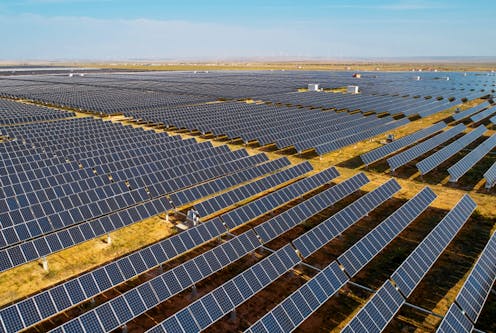
Last year, the world built more new solar capacity than every other power source combined.
Solar is now growing much faster than any other energy technology in history. How fast? Fast enough to completely displace fossil fuels from the entire global economy before 2050.
The rise and rise of cheap solar is our best hope for rapidly mitigating climate change.
Total solar capacity tipped over 1 terawatt (1,000 gigawatts) for the first time last year. The sector is growing at around 20% a year. If this continues, we’ll hit 6 terawatts around 2031. In capacity terms, that would be larger than the combined total of coal, gas, nuclear and hydro.
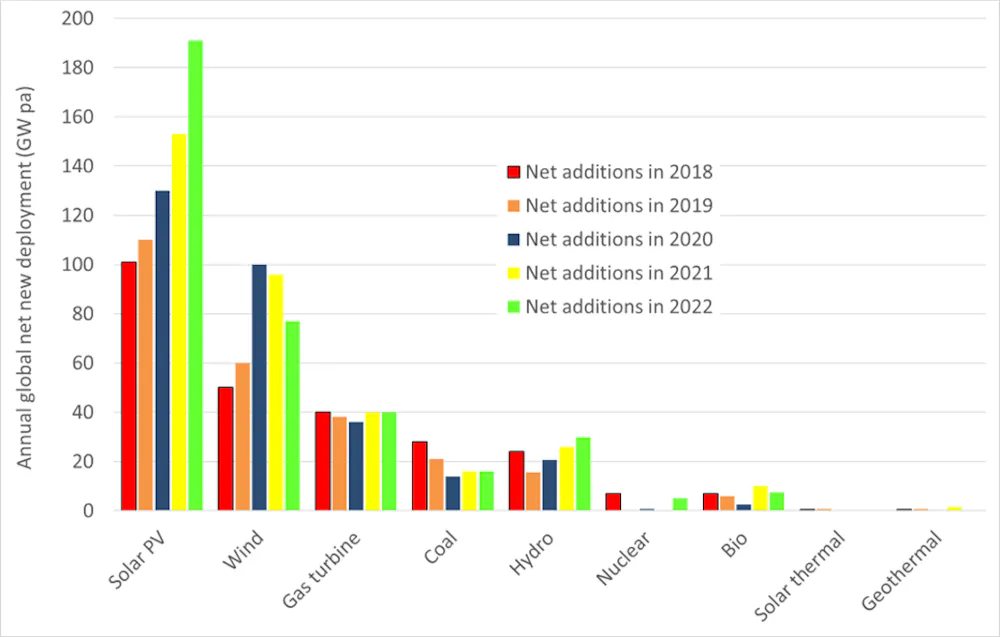
Fewer and fewer new fossil fuel power stations are now being built. As the rest of the global fleet age, most will retire by mid-century.
Australia is finding the path
It might surprise you to learn that Australia is a global renewable energy pathfinder. Most solar panels use Australian-developed PERC technology, for instance.
All the leading countries for per capita solar and wind generation are in Europe – except Australia. In Australia, 99% of new generation capacity is now solar and wind because it is cheap.
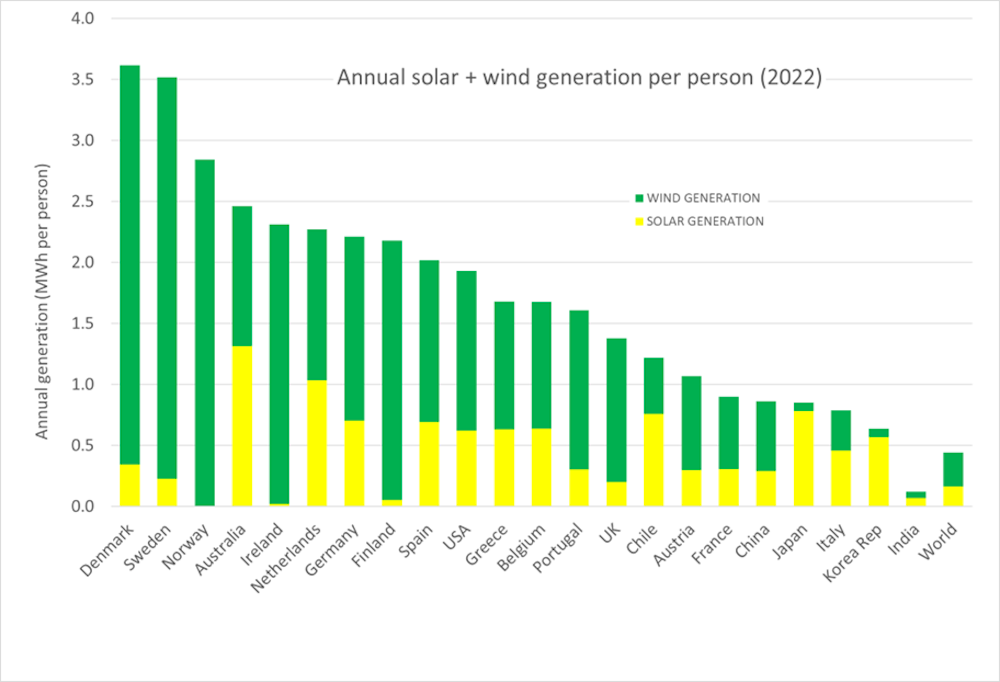 Highest per capita solar and wind generation in 2022.
Ember, CC BY
Highest per capita solar and wind generation in 2022.
Ember, CC BY
But unlike European countries, Australia cannot share electricity across national boundaries.
Instead, we have to cope with rapidly increasing levels of solar and wind by sharing it across state boundaries. This is proving to be relatively straightforward. Solar and wind have reached a share of 31% of the national electricity market, while the grid remains stable.
Already, three states or territories are at very high penetration of renewables. The ACT has built or bought enough renewables to cover 100% of its use. Tasmania, too, is at 100% renewable power, thanks to hydro and wind, and is aiming to double this to export to other states. And South Australia will soon become the world’s first gigawatt-scale grid to run on renewables. Currently, it’s sourcing around 70% of its power from solar and wind.
This matters because of Australia’s location. Like 80% of the world’s population, we live at low to moderate latitudes where there is plentiful sunshine, even in winter. That means the methods we pioneer or test can be readily adopted by nearly everyone else.
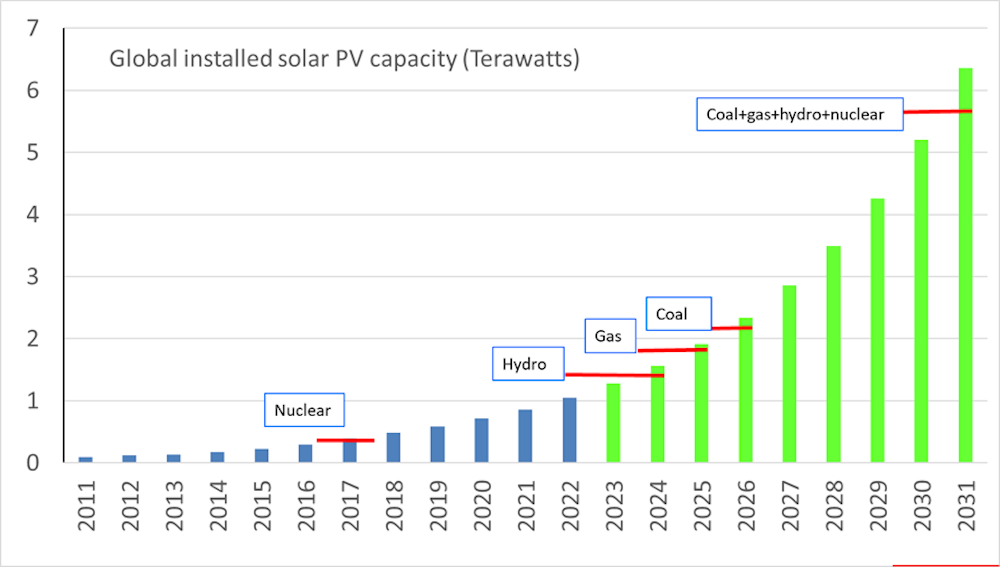 Global solar generation capacity, assuming continued 20% growth rate in annual deployment.
IRENA, GEM, CC BY
Global solar generation capacity, assuming continued 20% growth rate in annual deployment.
IRENA, GEM, CC BY
Where will the era of ubiquitous solar take us?
Solar capacity has been growing at 20% a year for decades.
Elimination of fossil fuels from the global economy is straightforward: electrify everything using clean electricity from solar and wind. This includes:
- electric vehicles replacing conventional vehicles
- electric heat pumps replacing gas space and water heaters in homes and businesses
- electric furnaces replacing gas burners in factories
- electrolysis of water producing green hydrogen for the chemical industry, allowing for clean production of ammonia, metals, plastics and synthetic aviation fuel.
To run our homes, industries and vehicles with electricity, we’ll need to double electricity production. Why not more? Because electricity is usually much more efficient at producing an energy outcome. For example, 85% of the petrol you put into your car is wasted as heat.
In countries with a significant chemical industry, electricity production might need to triple.
If these trends continue, by mid-century we will be in a very different – and better – energy world.
Many developing countries – including population giants such as Indonesia, India, China and Nigeria – could catch up with Europe or Australia for per capita energy consumption. Given electricity consumption is strongly correlated with affluence, access to cheap electricity will be a major boon for many nations.
But is it possible?
By 2050, Earth will have a population of about 10 billion people. To supply everyone with enough electricity to live a good life, we’ll need about 200 billion megawatt-hours per year (equal to 200,000 terawatt-hours per year).
Let’s assume that solar does the heavy lifting for decarbonisation, completing two-thirds of the task with the remaining one-third left to wind, hydro and everything else put together. Is it possible?
Yes. If sustained, solar’s growth rate of 20% per year is easily fast enough to reach 80 terawatts of installed capacity in 2050 - enough to provide 130,000 terawatt-hours per year and (with help from wind) to entirely decarbonise an affluent world.
That would see global electricity consumption reach 20 megawatt-hours per person per year – double Australia’s current consumption per person.
As well as eliminating most greenhouse emissions, we will also get rid of car exhausts, smokestacks, urban smog, coal mines, ash dumps, oil spills, oil-related warfare and gas fracking.
The main short-term bottlenecks are likely to be building enough transmission lines – and ensuring we have enough engineers and installers.
 Current per capita electricity consumption in 2022.
Our World in Data, CC BY
Current per capita electricity consumption in 2022.
Our World in Data, CC BY
We have the space and the raw materials
Long term, there are practically no constraints on vast deployment of solar.
The sun will shine for billions more years. Raw materials for solar panels are abundant – silicon from sand and common metals like steel. There are no toxic metals or no critical materials like cobalt in them, and they are highly recyclable. Energy storage is now a solved problem.
Most countries have vastly more solar and wind resources than needed to be energy self-sufficient. This, in turn, will boost their resilience in the face of war, pandemics and the changing climate.
Densely populated regions without much free land such as Japan, Europe and the northeastern United States have enormous offshore wind resources, while Indonesia and west Africa have enormous offshore solar resources – picture solar farms floating on calm tropical seas.
We have plenty of space. Eighty terawatts of solar translates to 8 kilowatts per person. This is the size of a typical Australian rooftop solar system, which is usually shared by a family rather than an individual.
The required area of solar panel is about five square metres per kilowatt (40 square metres total for 8 kilowatts). Some of the panels will be on house roofs. Others will be on ground-mounted solar trackers and operated alongside agriculture. Some crops and grass like the partial shade given by panels. Other options include floating on lakes and seas.
For our energy intensive lives in Australia, we’ll need perhaps 15 kilowatts of solar and wind per person, which run reliably for 30 years and can then be dissembled and recycled.
In the 1950s, nuclear energy advocates talked of a future when energy was too cheap to meter. That didn’t happen with nuclear. But solar offers cheap, unlimited energy, available forever with minimal resource, environmental and social constraints.
Authors: Andrew Blakers, Professor of Engineering, Australian National University


















