

5 experts on Labour’s big pre-election calls
- Written by: Richard Shaw, Professor of Politics, Massey University
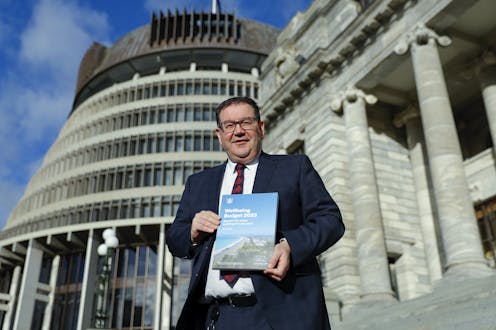
Grant Robertson’s sixth budget was an exercise in threading various needles. Much of its substance had already been foreshadowed, and to begin with the mood music was suitably sober.
But by the time the finance minister had finished speaking, a surprising number of variously-sized rabbits had been pulled from the budget hat – some intended to have an immediate impact (the expansion of support for early childhood education and public transport) and others with a longer time horizon (investments in rail and other forms of infrastructure).
For a “no frills” budget, it was surprisingly frilly.
Today was also about drawing a narrative line under the kind of recent events – not least the Stuart Nash and Meka Whaitiri imbroglios – that have allowed the National Party to play the phrase “coalition of chaos” on high rotate.
It was also an important milestone on the road to the October 14 general election in Aotearoa New Zealand. Robertson’s job today was to convey the sense of a government which, following a challenging three years, still has focus, energy, competence and new policies.
His policy rhetoric may not have soared quite as high as some would have liked. But the announcements regarding new science hubs, support for the game development industry and the extension of electric vehicle (and other forms of) infrastructure will have placated at least some of those who like their governments to have ideas.
Robertson’s speech also contained a clear message for Māori voters (and Te Paati Māori). With additional support for Whānau Ora, Māori medium schools, Māori housing, repairs to whānau-owned homes in cyclone effected areas (read Meka Whaitiri’s seat of Ikaroa-Rāwhiti), and new spending on te reo revitalisation and Te Matatini, the finance minister made the case for Māori to stick with (or come over to) Labour.
The budget continues the incremental, pragmatic tack taken since Chris Hipkins moved into the ninth floor of the Beehive. But this comes with risks for Labour.
The collapse of the electoral alliance Jacinda Ardern constructed in 2020 means there are fewer voters in the centre than there were three years ago. The combined projected support for parties other than Labour and National hovered around 30% in one recent poll.
The general election will be won or lost in the margins. Labour strategists will be happy enough if today’s budget helps pull a few percentage points of support their way, and strengthens the party’s hand should it be part of discussions over the formation of the next government. Robertson will be hoping he released just enough rabbits today to get them there.
Conservative and non-inflationary
Many people were looking for three things from a budget focused on “bread and butter issues”: infrastructure investment, cost of living assistance, and changes in taxes and benefits.
The government recently announced $941 million in funding for rebuilding after Cyclone Gabrielle. This was bolstered in the budget by a $6 billion commitment over three years for a National Resilience Plan.
But the government has faced a delicate balancing act between addressing the acute effects of a rising cost of living, and ensuring that any additional support is not overly inflationary. The budget included relatively modest moves to reduce cost-of-living pressures, including an extension and increase of childcare subsidies. Prescription co-payments have also been scrapped.
Read more: Australia vs New Zealand. You can tell a lot about a country by the way it budgets
The government had already ruled out significant tax changes, including new taxes on wealth or capital gains. Instead, it chose to align the trustee tax rate to the top personal tax rate. This alignment tidies up the tax system a little, but is unlikely to make a huge difference to most taxpayers, or to the government’s coffers.
Perhaps most surprisingly, anticipated changes to Working for Families were not announced – these may instead be an election sweetener later this year.
From an economic perspective, the “no-frills budget” was definitely as advertised. It was conservative and non-inflationary. We can take comfort that means little risk of further increases in the price of bread or butter.
Slow-acting medicine for health
With each budget we can expect a boost in support for health. This year is no exception. There is significant new spending, with $2.6 billion allocated over two years to respond to inflationary and other cost pressures on the health system – the costs of meeting ever increasing demand, for example.
This new funding should account for some of the inflationary pressures but it’s unlikely to be adequate. Too many people are missing out on treatment and there is a significant level of unmet need in the community for secondary healthcare and other health services.
There has been no measurement of this in any systematic way and we really don’t know how many people suffering in the community are in need of an elective procedure and have been denied access or are being treated by their GP instead.
Today’s budget includes $1 billion allocated to health sector staffing and wages. This is very important but it is coming very late in the day. Funding for 500 new nurses has also been provided. This will take time to deliver on.
The big win is $618 million to eradicate pharmacy co-payments. No one should face a financial barrier to accessing prescribed medicines. It is very good that the government has followed the evidence showing cost barriers are prohibitive for many. That said, a bold government would also have allocated funds to scrap patient charges to see a GP as well.
Money back in family pockets
When the government set its second set of short-term child poverty targets in 2021, it did so with an assumption of a steady year-on-year march towards its long-term ten-year targets. The child poverty projections for two key targets that can be measured show little progress.
Indeed, this is one of the first budgets since reporting began to show a short-term projected increase in one of those key measures – the proportion of children living in households with disposable income below 50% of the median income (before housing costs).
Read more: New Zealand's childcare is among the most expensive in the world. But tax rebates are not the answer
The big policy announcements in this budget, however, are ones that are likely to decrease material hardship – the third key poverty indicator, and one where projections aren’t modelled – by putting money back into the pockets of families.
The extension of 20 “free” early childhood education (ECE) hours to include children aged two is a welcome and greatly needed extension of family policy supports. So is the raised income eligibility threshold for childcare assistance for lower-income families with young children announced at the end of last year. Both bring New Zealand closer to “gold standard” approaches to early childcare policy in other developed countries.
Not only is access to high-quality and affordable ECE important for child development and wellbeing, it has the potential extra impact of increasing incomes – by helping parents who want to work, but for whom high ECE costs were a barrier.
While a welcome and needed extension to policy supports for families, this is not a targeted policy aimed at the lowest income families. It will, however, still help relieve hardship for middle- and low-income families. We should expect this to show up in lower rates of material hardship in the future, as families put money previously spent on childcare into meeting their other everyday needs.
Back to the future on resilience
The budget reflects a highly constrained spending model that focuses almost entirely on addressing our infrastructure needs in a reactive rather than proactive way.
Our infrastructure is rapidly ageing while we face the threat of more frequent and intense storms brought on by the effects of climate change. Over the past year, major weather events have shown the cracks in many systems and the extreme costs of repairing our infrastructure.
While a “no frills” budget may sound good at a time of high inflation, many of those “frills” are likely to be necessary investments in urban services and infrastructure. The government has been clear that spending on infrastructure would focus on rebuilding and restoring infrastructure hit hard by recent extreme weather events.
To that end, the budget allocates $71 billion over the next five years towards new and existing infrastructure programmes, an additional $1 billion flood and cyclone recovery package, and $6 billion for a National Resilience Plan. But this focuses almost entirely on getting us back to where we were before the storms. It doesn’t seem to ask whether that was ever the smart place to be to begin with.
By only focusing on repairing our existing infrastructure, we’re falling behind on doing what’s necessary to ensure we’re less vulnerable to the next big storm. These measures should include: investments in innovative stormwater systems and green infrastructure, alternative local transport modes like dedicated bus lanes and busways, expanding existing rail services, and making our power network less vulnerable by burying power lines and investing in microgrids.
While the budget doesn’t make any bold leaps towards infrastructure resiliency, there is some good news, especially for those struggling most with the cost of living: free public transport fares for children aged five to 12, and permanent half-price fares for people under 25.
Additional funding is going to maintain public transport services and boost bus driver wages, to the Clean Car Discount Scheme, and for expanding electric vehicle charging infrastructure. All good news, as is the $100 million allocated to a new infrastructure delivery agency.
In many ways, however, the budget is an exercise in kicking the can down the road. Recent events have shown that our infrastructure faces new and unprecedented pressure. We can either spend the money now to improve it, or continue to pay increasing repair bills into the future.
Authors: Richard Shaw, Professor of Politics, Massey University


















