

a case study in how restoring habitat is a win-win for forests and farmers
- Written by: Sofía López-Cubillos, Postdoctoral research fellow, The University of Melbourne
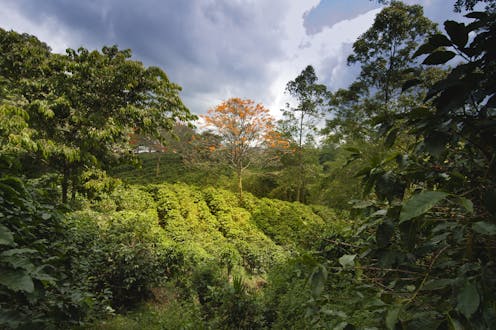
Bees are crucial for producing many of our beloved foods and beverages. Coffee is one crop that benefits from bee pollination.
Unfortunately, pollinator numbers are falling worldwide. Many are facing extinction. This decline is due in part to ever-expanding farmland covered by a single kind of crop plant – agricultural monocultures.
Restoring pollinators’ habitat is essential, both to stop their decline and to maintain food production. Calls for large-scale restoration, such as the UN Decade of Restoration, are ambitious and may compete with other land uses. In addition, restoration often has an upfront cost, while its benefits could take time to obtain.
However, our new research shows that coffee farmers who restore patches of forest across their properties can nearly double their profits with just a 15% increase in natural habitat over five years. The benefits, a result of higher pollinator numbers, continue to increase for both farmers and forest over the long term (40 years). This is the first study that assessed such benefits in the long term and at a large scale.
Read more: How the birds and the bees help coffee plants
Finding a sweet spot
Planting trees without planning that takes all factors into account may lead to poor conservation or economic outcomes. For instance, tree planting in unsuitable arid areas of China ultimately led to further environmental degradation, although the aim was to combat desertification.
For our study, we set up two clear objectives:
- to maximise coffee profitability
- to maximise restoration of forest that pollinators could use.
We used Costa Rica as a case study because of the wealth of information on pollination services for coffee in this region. One study found forest-based pollinators increased coffee yields by 20% within 1 kilometre of forest. So the presence of a healthy population of pollinators has a big impact on farmers’ revenue.
Read more: Boosting bee diversity can help stabilise crop production – new research
A common practice to increase profits is to expand cropland by clearing forest. Therefore, restoring coffee lands to forest may involve trade-offs. To account for this, we considered two different planning contexts:
- only restoration and no agricultural expansion
- a mix of restoration and agricultural expansion.
We also compared multiple scenarios to assess the trade-offs between focusing solely on coffee profitability (objective one) versus giving more priority to restoring habitat for bees (objective two), and everything in between. Our mathematical modelling then selected the best locations to restore habitat (or expand agriculture) for each scenario.
There was a sweet spot between both objectives when practising only restoration. We found coffee farms can increase economic benefits by 98% after five years by increasing forest area by 15%. After 40 years, the economic benefits increase by about 109% with a 19% increase in forest area.
We also found that if farmers restore habitat without expanding agriculture, profits are steadier. When farmers restore and expand at the same time, this adds an element of volatility.
Read more: Restoring forests often falls to landholders. Here's how to do it cheaply and well
Small or big patches?
We found restoring many small patches throughout the farmed area maximised pollination services. Bees can only travel fairly short distances, ranging from 40 metres to 3 kilometres. Dispersed forest patches allowed the bees to reach more coffee plants.
However, while smaller patches are generally suitable for pollinators, other species have different needs. Restoring large areas is important for species that travel longer distances, such as the jaguar (Panthera onca), or for forest specialists that need dense forest to thrive.
However, having only a big patch of restored forest in an area of farmland may isolate species that have a large home range. In contrast, restoring small patches of land can provide important corridors for mammals.
In our study, we found other solutions that restored a mix of big and small patches at the same time. These solutions can still can deliver good economic and restoration outcomes. Having a mix is important because it allows biodiversity conservation and farming to co-exist.
Ideally, farmers who have large patches restored on their land would receive financial compensation. This could make up for the farmers’ upfront and ongoing costs, such as sapling cost and labour to maintain plants throughout some years. At the same time, neighbouring farms will benefit from bees travelling to and pollinating their crops, even if habitat isn’t restored on this land.
Importantly, these findings support solutions for farmers with different environmental outlooks. Some farmers may be generally supportive of conservation, leading to more proactive restoration actions and no clearing of forest. Other farmers may place a high importance on expanding agricultural production to improve their livelihoods.
Our study takes into account both contexts. Our findings show strategic habitat restoration for pollinators produces win-win outcomes for farming and the environment in both cases.
Authors: Sofía López-Cubillos, Postdoctoral research fellow, The University of Melbourne


















