

Why the WA government is wrong to play identity politics with dingoes
- Written by: Bradley Smith, Senior Lecturer in Psychology, CQUniversity Australia
Australia’s Commonwealth Coat of Arms depicts two iconic native animals – the kangaroo and the emu. Both are unquestionably fair dinkum Aussies, unique to this continent and having lived here for a very long time. A “very long time”, according to Australian legislation (the EPBC Act 1999), is any species having been present since before the year 1400.
But in Western Australia, under the state’s Biodiversity Conservation Act 2016, no native animal is guaranteed protection. The Act includes a caveat whereby the relevant minister may determine that a native species is in fact, not.
Read more: Dingoes do bark: why most dingo facts you think you know are wrong
This week, WA’s environment minister Stephen Dawson did just that, declaring that from January 1, 2019, the dingo, Australia’s native canine, will no longer be classified as native fauna.
The dingo does meet the federal government’s criterion, having lived in Australia as a wild canid for an estimated 5,000 years. But under the planned changes in WA, the dingo will lose its current listing as “unprotected fauna”, and will from next year be considered indistinguishable from either the common domestic dog or feral dogs.
What is a species anyway?
According to the biological species concept, a species is a group that has the ability to interbreed and produce viable, fertile offspring. Dingoes, dogs and other canids do interbreed (or “hybridise”), and indeed this is one of the key reasons why the pure dingo is listed as vulnerable by the International Union for the Conservation of Nature.
But this ability to hybridise is also one of the main justifications cited by the WA government in its decision to revoke the dingo’s citizenship (the fact sheet has since been removed from the website, but can be accessed here). The rationale is that if dingoes and dogs are technically the same species, why should dingoes get special treatment?
However, the biological species concept is problematic when applied to canids. If you lump dingoes and dogs together because they readily interbreed, then logically we must do the same for wolves, coyotes, jackals or other canids that can also interbreed (and have done for millenia).
It’s hard to imagine anyone seriously suggesting that a grey wolf and a pug are the same species. This suggests that this criterion alone is insufficient to solve the conundrum. Indeed, there are at least 32 different species concepts, clearly illustrating the difficulty of defining a single rule by which all organisms should abide.
Despite this, a recent paper that argues the biological species concept should be applied to dingoes, was cited as supporting evidence by the WA government. Adopting this narrow interpretation of taxonomy is perhaps somewhat premature. It ignores other investigations that provide evidence to the contrary. Given the contention around defining species, it seems unwise to determine the species status of dingoes independently of other, more comprehensive evidence and argument.
Distinguishing dingoes
All canids share similarities, but their differences are also many and marked. The dingo can be distinguished from other dogs in various ways: their appearance, anatomy, behaviour, their role in ecosystems, and their genetics (their evolutionary history and degree of relatedness to other species). Dingoes seem to be largely devoid of many of the signs of domestication.
It is therefore reasonable for the dingo to be considered separately from wolves and domestic dogs, while also acknowledging that they all occupy the same broad species classification, Canis lupus.
Having lived in Australia as free-living, wild populations for around 5,000 years almost exclusively under the forces of natural selection, and separately from any other dog lineage until European arrival, there is no notion of the dingo as a domestic animal gone feral. To classify dingoes as nothing more than “feral domestic dogs” expunges their unique, long and quintessentially wild history. Dingoes are not ecologically interchangeable with any other type of dog, either wild or domesticated.
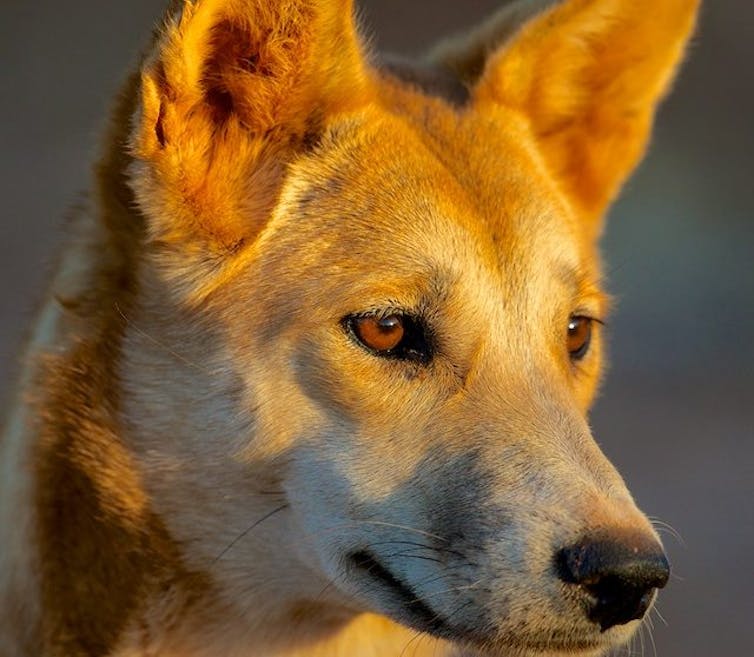 Australia’s dingo is a recognisable species.
Angus Emmott
Australia’s dingo is a recognisable species.
Angus Emmott
Labelling the dingo as a feral domestic dog changes their legal status and removes any current obligations for developing appropriate management plans. This demotion of status could lead to intensified lethal control. Indeed, control may even be legally mandated.
In the absence of thylacines, mainland Tasmanian devils, and other apex predators, the ecological role that the dingo plays in the Australian landscape is vital. Dingoes help to control kangaroo and feral goat populations, and in some cases foxes and cats as well.
Read more: Why do dingoes attack people, and how can we prevent it?
Given WA’s remoteness, it remains one of the few bastions of pure dingoes, and as such it presents an opportunity to seek ways to protect them rather than pave the way for their removal. The WA government’s decision also sets a dangerous precedent for the management of dingoes, and indeed other contentious native wildlife, elsewhere in Australia.
How we choose to classify plants and animals might sound like dry science. But it has genuine implications for policy, management and conservation. Our scientific naming systems are vital for helping to organise and understand the rich biological diversity with which we share the planet, but it is important to remember that these systems are informed not just by biology but also by our values.
In this case, economic and political interests appear to have been favoured over wildlife preservation, and given Australia’s unenviable conservation record this is deeply concerning.
Authors: Bradley Smith, Senior Lecturer in Psychology, CQUniversity Australia


















