

How NZ's own law helped Australia win the Manuka Honey trademark war
- Written by: David Jefferson, Senior Lecturer Above the Bar, University of Canterbury
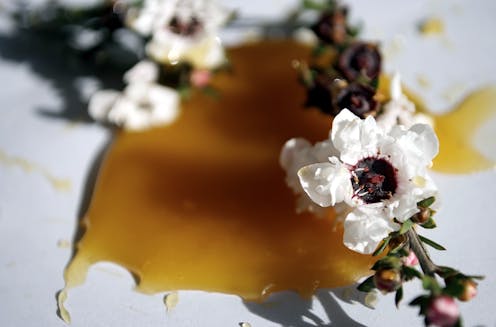
The recent decision in “one of the most complex and long running” trademark cases in New Zealand was a loss for the country’s mānuka honey producers. But it also served to highlight just how ill-equipped our laws are for protecting Māori taonga (treasures) and mātauranga Māori (traditional knowledge).
The case, decided by the Intellectual Property Office of New Zealand (IPONZ), centred on whether the term “Manuka Honey” could be registered by the Mānuka Honey Appellation Society as a certification trademark in Aotearoa New Zealand. The society represents a group of New Zealand producers.
Registration would have allowed the society to exclusively use the Manuka Honey name (without the tohutō or macron over the “a”) when marketing honey made from the nectar of the mānuka (Leptospermum scoparium) plant. Honey producers in Australia opposed any such move.
Certification marks are a type of trademark where the owner independently certifies that their goods possess certain defined characteristics. The marks enable owners to commercialise products that are sourced from specific geographical areas or produced using particular methods.
If it had been successful, the society would have only allowed New Zealand-based producers to use the trademark on their products.
The question of distinctiveness
The mānuka case dates back to 2015, when New Zealand honey producers lodged an application for the Manuka Honey trademark. The Australian Manuka Honey Association opposed the application, arguing the proposed trademark was merely descriptive and not distinctive.
In other words, the Australian producers claimed the trademark simply described honey sourced from the nectar of the mānuka tree. This is important, because one of the key requirements to receive a certification trademark in New Zealand is that the mark must distinguish the goods of one producer from those of another.
Read more: Mānuka honey: who really owns the name and the knowledge
The distinctiveness test involves assessing whether the “average consumer” would regard the certification mark as a normal way of designating characteristics of the goods in question.
IPONZ concluded that the average consumer would not find the proposed Manuka Honey mark to be distinctive. This was largely because this term was already used extensively by both New Zealand and Australian honey producers before the application was lodged.
Mānuka as taonga
Although mānuka is a kupu (word) sourced from te reo Māori, the Leptospermum plant is also native to Australia, where it is commonly known as “tea tree”. Some scientists believe that Leptospermum scoparium likely originated in Australia and travelled to New Zealand before the last ice age, probably with the assistance of birds.
Today, over 80 different Leptospermum species grow in Australia. All of these can provide a honey source.
Although Australian Leptospermum scoparium is the same species as mānuka in Aotearoa, there are differences between the plants, the honey produced from them and their cultural significance.
Mānuka, as both kupu and plant, is regarded as a taonga by Māori. Significant mātauranga Māori exists in relation to mānuka. Māori have long used the plant for various purposes, including in medical treatments, the fabrication of objects such as waka, and for cosmetic reasons.
Much of the knowledge about the unique characteristics of mānuka is directly derived from mātauranga Māori. However, Māori rarely, if ever, benefit from the commercialisation of mānuka honey, especially by overseas businesses.
Limitations of New Zealand IP law
The mānuka case reveals some of the gaps in the intellectual property system in Aotearoa, especially in relation to the protection of taonga plants and mātauranga Māori.
Assistant Commissioner of Trade Marks Natasha Alley said she “carefully considered” the taonga status of mānuka, in addition to tikanga Māori and Te Tiriti o Waitangi/Treaty of Waitangi in deciding the case. Alley also acknowledged the “critical importance” of Māori intellectual property rights.
But she concluded that these factors did not outweigh the “clear provisions” of the Trade Marks Act which does not require IPONZ to consider the taonga status of kupu or plants, or the existence of mātauranga Māori, when evaluating certification mark applications.
Protection of taonga and mātauranga Māori
The need to provide legal protection for taonga and mātauranga Māori – including through the intellectual property system – has been long discussed in Aotearoa. The 1991 Wai 262 claim asked the Waitangi Tribunal to redress Crown laws and policies that denied Māori control over taonga, in violation of Te Tiriti.
In 2011, the Waitangi Tribunal issued a report containing specific recommendations about how New Zealand intellectual property laws should be reformed to ensure that taonga and mātauranga are protected.
Although the Wai 262 report was published a dozen years ago, some of its recommendations remain unfulfilled. For instance, the law does not provide any form of protection for mātauranga Māori specifically. The government is considering a number of reforms to respond to Wai 262 concerns, but these will take years to fully implement.
In the meantime, mānuka producers in New Zealand could consider alternative certification trademarks or forms of cultural branding to distinguish their products from Australian-made Leptospermum honey.
While any new certification marks would need to pass the distinctiveness test, they should also require businesses that market mānuka to meet culturally appropriate standards, especially where mātauranga is involved.
Kiwis may have lost the naming battle, but it may still be possible to win over consumers who are looking for products that embody the uniquely bicultural character of Aotearoa.
Authors: David Jefferson, Senior Lecturer Above the Bar, University of Canterbury


















