

New Zealand needs to up its biosecurity game to protect the country from the next devastating pest threat
- Written by: Angela (Ang) McGaughran, Senior Lecturer in Population Genomics, University of Waikato
Climate change is increasing the risk of plant-destroying insects, diseases and invasive weeds entering Aotearoa New Zealand. Border security is not enough to protect us from the next biosecurity threat – it’s time to be proactive in preventing the risks.
As New Zealanders, our natural world is important for our wellbeing and our sense of identity. It is also important economically and for food production.
With a total economic cost of pests estimated at NZ$9.2 billion in 2020 (2.9% of GDP), biosecurity is a major component of our annual budget.
Most of New Zealand’s biosecurity detection is concentrated at the border – monitoring ships and cargo coming into New Zealand. But this approach does not take into account pests that arrive by other ways.
A number of pest species, such as myrtle rust, are wind-blown. We miss their pending arrival because we are typically focused on what is already here.
New Zealand needs to be more proactive to biosecurity threats. This means developing new monitoring tools, and utilising new technologies like environmental DNA (or “eDNA”, the DNA that is left behind as organisms pass through an environment) to better inform our baseline data.
We also need to sequence the genomes for species that aren’t represented in our databases. This will enable faster identification of dangerous interlopers.
Learning from the fall armyworm
The fall armyworm highlights why we urgently need to develop proactive biosecurity responses and tools.
We knew for some time the fall armyworm was heading to New Zealand (most likely from Australia) – which it did in February 2022. It quickly established and began to decimate crops.
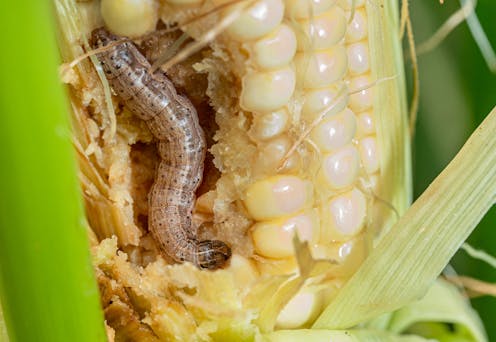
Unfortunately for New Zealand’s agricultural sector, the fall armyworm is a highly adaptable pest. The moths fly extremely well and the caterpillars feed on around 350 different plant species, with a preference for crops like maize and sweetcorn.
Read more: What a warmer, wetter world means for insects, and for what they eat
And they’re voracious. The caterpillars gather in armies to decimate all plants in their path. Northland growers report picking crop plants and hearing the caterpillars fall from them en masse. The fall armyworm is now widespread in the north of the North Island and has also reached the South Island.
There was a missed opportunity in proactive management before the fall armyworm arrived. This was perhaps due to the prevalent belief that it wouldn’t be able to overwinter in New Zealand (it can and did!).
But we also failed to prevent the fall armyworm’s arrival because there has been a general reticence to put money towards something that isn’t a problem yet. Particularly absent in our response was the use of genomic tools to predict the pest’s invasive potential before arrival, and then to rapidly identify its incursion pathway once here.
Carried by the wind
A number of scientists believe the fall armyworm was carried over on the wind from Australia. This theory could be confirmed using genomic data to identify the global population with which the New Zealand samples share most ancestry. It would also be easy to ascertain whether the South Island incursion came from the North Island or via a separate wind event from Australia.
Why is it important to understand where the pest has come from? Origin determines genomic signatures and understanding these in a pest may give us a better idea of how likely it is to survive in certain conditions. We could, for example, see if it carried particular genetic variants that show insecticide resistance or an ability to survive colder temperatures.
Meanwhile, understanding incursion pathways could facilitate the rapid blocking of particular trade routes or the identification of ideal sites for pheromone trapping to intercept flight pathways into the country for wind-blown organisms.
The initial plan to eradicate fall armyworm has now been abandoned. In April 2023, New Zealand moved to management of the pest.
Looking to the next threat
Our reactive response strategy is set to become a bigger issue, with incursions from more pests expected as the country continues to warm as a consequence of climate change.
The next pests likely to infiltrate New Zealand include two Australian insects – the Queensland fruit fly and painted apple moth – as well as the brown marmorated stink bug, a native to Asia.
The Queensland fruit fly and the painted apple moth both pose a risk to fruit crops, with the moth also enjoying native species like kōwhai and karaka. The brown marmorated stink bug infests houses to shelter from the cold and releases a foul scent when disturbed. Each of these three pests is regularly intercepted at the New Zealand border.
Read more: Lessons on how to effectively tackle insect invasions
We learn nothing from failed invasions right now, but we could use genome sequencing to search for signatures in the genome that help us to understand and better predict establishment outcomes.
And, when a pest does arrive - because it can, and it will - we could move more quickly before it gets a foothold with genomics in our biosecurity toolbox. We could more rapidly detect the pest, determine where it came from and understand the genetic arsenal it brings with it. This would help us determine the best approaches to mitigate any environmental damage.
These methods are there for the taking. Similar methods are already applied in conservation contexts. Sometimes we even eventually use them for pests. But almost always, we do this reactively once eradication efforts have already been abandoned.
If we want to prevent the next big pest threat to New Zealand, then it is long past time to invest in the prevention rather than the cure.
Authors: Angela (Ang) McGaughran, Senior Lecturer in Population Genomics, University of Waikato


















