

How we're using the Vietnamese ethnic savings scheme 'Hụi' to buy back our cultural heritage
- Written by: James Nguyen, Lecturer in Fine Arts, Monash University
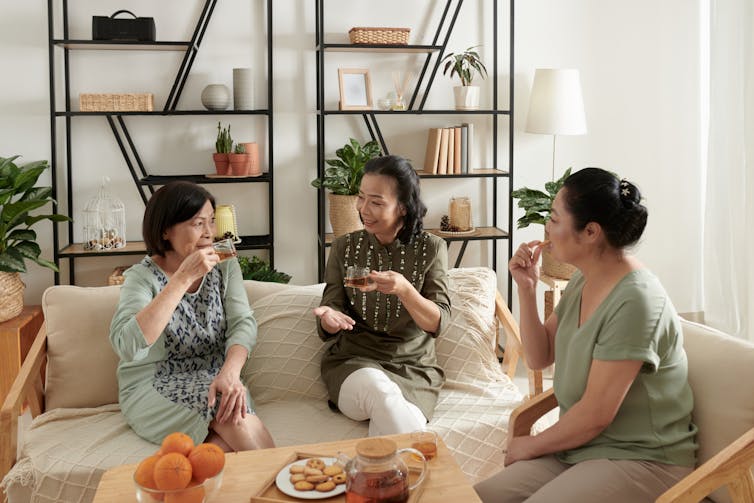
Hụi is a constant but often hidden feature of life for many Vietnamese-Australians.
This clandestine loan-savings scheme was a way for low-income Vietnamese refugees to buy their first family car, start a small business or make a home deposit. In Vietnam, Hụi is also called Họ, Phường or Biêu.
These activities had existed for centuries before being recorded in 19th-century colonial texts. They survive today in rural areas and overseas diaspora communities who have struggled to secure bank loans and legal credit.
It is interesting that multiple cultures across the Moana-Pacific use the term “Hui” to describe a collective gathering or negotiation.
The Chinese character 會 (Huì) denotes a longhouse where meetings and secret societies take place. In Hawaiian, Hui stands for a club, community partnership or extended family. Similarly for Māori, Hui represents a meeting, congregation or conference.
With rising cost of living and housing unaffordability, it feels particularly relevant to understand how so many Vietnamese refugees, arriving with almost nothing, managed to join the property market during the historically high interest rates and property booms of the 1980s and 2000s.
Vietnamese diaspora
The Fall of Saigon in 1975 coincided with the lifting of the White Australia Policy and a Fraser government that accepted over 70,000 South-East Asian refugees.
With this mass intake, fragmented resettlement programs and unreliable social and legal services compounded the realities of post-traumatic stress and poverty. The outer suburbs where our families could afford to live – Cabramatta, Footscray, Richmond, and Inala – quickly gained a reputation for gang violence, becoming infamous as the drug-riddled Vietnamese ghettos of the eastern seaboard.
Despite these obstacles, our families managed to secure new wealth by playing Hụi.
Read more: War's physical toll can last for generations, as it has for the children of the Vietnam War
Collective sharing
This narrative is not some miraculous journey of refugee achievement. Instead, it involves the under-acknowledged privileges of class within the diaspora.
A portion of Vietnamese refugees who had the resources to escape war were from the highly educated professional middle class or the entrepreneurial merchant class.
Class affiliations meant people could reconnect through well-established social networks to form tightly regulated Hụi clubs wherever we resettled.
These small groups of between 20 to 40 members would individually scrape together a monthly payment, often around $500, to hand over to a Chủ Hụi: the Hụi Boss in charge of collecting and managing the operation.

Monthly payments could range anywhere between $200 and $5,000, depending on the risk tolerance and income bracket of each club.
If a Hụi member urgently needed cash for a family emergency, or to quickly secure a house deposit, they would competitively bid for the cash pool. The higher their bid, the less they would take home. The winner was the person with the highest bid.
For example, if your bid of $65 wins at a $500 per month club, then every other member in the club will only pay you $500 less $65. In this case, it would be $435 per member for your month.
In a club of 30 members, your winning $65 bid grants you a one-time take-home amount of $13,050 from a possible $15,000.
Members can only ever “win” once per cycle. Eventually, over a cycle of 30 months – one month per member – everyone has a turn at taking home the cash pool.
These collective savings schemes were risky, with no legal recourse if members decided to Dựt Hụi, or “do a runner”.
To discourage breaking Hụi, clubs regularly administered retaliatory punishment through organised crime and gang violence.
Today, our aunties still play Hụi. Maintaining their social, class and wealth networks, they now fund regular plastic surgeries, overseas holidays and home renovations. Within a few short decades, our Hụi families have re-entered the middle class.
But, as artists, we believe Hụi is more than the property market.
Intrinsically collective and self-determined, Hụi encourages unexpected forms of cultural agency and mobilisation beyond institutional permission or containment.
Playing the Đông Sơn Drum
Learning from ongoing strategies and calls for the repatriation and reclamation of ceremonial objects by First Nations leaders, our art project RE:SOUNDING aims to access cultural instruments and reintroduce their sounds and musical traditions to the broader Vietnamese community.
The Đông Sơn Drum is an ancient ceremonial instrument woven into the mythology and identity of Vietnamese people. These drums are held in colonial museums and ethnographic collections the world over. Those remaining in Vietnam are similarly preserved in institutional silence.
 Đông Sơn Drum, ca. 500 BCE–300 CE.
The Metropolitan Museum of Art
Đông Sơn Drum, ca. 500 BCE–300 CE.
The Metropolitan Museum of Art
Over the past six years, we have been seeking permission from multiple museums to record sounds from these drums. However, it was only when various family members drew from their Hụi takings that we were finally afforded access. We had the quick cash to purchase a Đông Sơn drum when it came up at a local estate auction.
The reluctance of museums to let us even touch our ceremonial instruments meant our only option was to draw from Hụi to buy back this cultural asset.
RE:SOUNDING has since played and made accessible the Đông Sơn Drum to audiences at Footscray Community Arts Centre, the Australian War Memorial, the Sydney Opera House and currently MÌNH at the Fairfield City Museum and Art Gallery.
The capacity to reclaim culture through social forms of rematriation, beyond institutional forms of repatriation, demonstrates how Hụi facilitates both economic and cultural participation.
Having helped many Vietnamese refugees to enter the property market, Hụi now offers us a way to reclaim our cultural inheritance without seeking permission and approval from museums that had stolen these objects in the first place.
Read more: What an exhibition by artists of the Vietnamese diaspora says about home and belonging
Authors: James Nguyen, Lecturer in Fine Arts, Monash University


















