

How Ronald Reagan led the 1960 actors' strike – and then became an anti-union president
- Written by: Prudence Flowers, Senior Lecturer in US History, College of Humanities, Arts, and Social Sciences, Flinders University
Production on US film and television sets has ground to a halt as Hollywood actors have joined writers in walking off sets. At issue are residuals (or royalties), streaming services and the use of artificial intelligence.
The last time there was a “double strike” was 1960, when future United States President Ronald Reagan was head of the powerful Screen Actors Guild (SAG).
Reagan made his film debut in 1937. He was a quintessential B-movie star of the Hollywood Golden Age, acting in low-budget “second feature” movies.
Over his career he churned out over 50 films, appearing in Westerns, thrillers, war films and romantic comedies, as well as famously co-starring with a monkey called Bonzo.
In the 1930s and 1940s, Reagan was a self-proclaimed “New Deal Liberal” and a proud supporter of President Franklin Delano Roosevelt.
Reagan became a SAG member within a month of moving to Hollywood. In 1941, his then wife Jane Wyman, a member of the union’s board of directors, suggested him for a vacancy on the board.
Reagan was nominated for the SAG presidency by movie star Gene Kelly. He would go on to serve two stints as union head, from 1947–1952 and 1959–1960.
The year he first became SAG president he was part of the Second Red Scare, an anticommunist witch hunt that saw Americans fired, jailed and blacklisted over accusations of communist affiliation.

Hollywood – seen as rife with communist activity – was targeted amid fears it might produce socialist propaganda.
Reagan was fiercely anti-communist. In 1947, he appeared as a “friendly” witness for Congress, blaming industrial unrest and strikes in Hollywood on “subversive” elements.
Classified documents subsequently revealed Reagan was a confidential informant for the FBI. When he became president of SAG he provided FBI agents with dozens of actor’s files.
Leading the strike
Much like today, in the early 1950s a major issue facing Hollywood actors were residuals. During his first tenure as SAG president, Reagan was lauded within the industry when he helped secure the first residual payments for television actors.
With movie attendance plummeting and films increasingly aired on television, film actors also wanted residuals. They faced strong opposition from the movie studios.
In 1959, after negotiations ground to a halt, Reagan was asked to return as SAG president. He called for a strike in February 1960.
Actors walked off sets in March, joining the Writers Guild of America, which had been on strike since early January 1960. The actors’ strike lasted six weeks, paling in comparison to the 21-week writers’ strike.
Reagan ultimately won an agreement that residuals would be paid to actors for films produced from 1960. He also won a lump sum payment for the union of US$2.65 million, used to create SAG’s first pension and health plan for members.
Reagan was cheered by SAG members when the deal was ratified. It was approved by an overwhelming majority of members, although some Golden Age stars saw it as a betrayal.
Reagan resigned from the SAG presidency two months after the strike concluded. Unbeknown to most in the industry, he had a significant conflict of interest, working as both an actor and a producer.
Read more: Actors are demanding that Hollywood catch up with technological changes in a sequel to a 1960 strike
A shift to the right
While Reagan had been a registered Democrat, over the course of the 1950s his ideological views moved rightward.
He saw no tension between these beliefs and his role leading the 1960 strike, exhibiting the flexible pragmatism scholars later identified with his time in the White House.
In the 1964 presidential election, he campaigned vigorously for Republican Barry Goldwater, a staunch conservative rejected by party moderates.
Goldwater opposed taxation and the social welfare state, voted against the Civil Rights Act on libertarian grounds, and viewed nuclear weapons as part of tactical warfare. Lyndon Johnson, his opponent, summarised the views of Democrats and many Republicans when he jibed of Goldwater, “In your guts you know he’s nuts”. Johnson defeated Goldwater in a landslide.
Yet 1964 proved to be the beginning, rather than the end, of the modern American right.
One of Reagan’s televised fundraising speeches for Goldwater, titled A Time for Choosing, catapulted him onto the national stage as the new conservative heir apparent.
Despite having no political experience, Reagan was approached by a group of influential businessmen to run as the Republican candidate for Governor of California. His last acting roles were in 1965.
Reagan’s conservative gubernatorial campaign was sharply critical of the counterculture and student protests, emphasising law and order. He won decisively and served two terms, from 1967–1975.
An anti-union president
From the mid-1970s, Reagan had his eyes firmly set on the White House. He articulated a politics that incorporated economic conservatism, hawkish anticommunism and moral traditionalism, including opposition to legal abortion. He also described “big labor” as a major problem for the US.
Reagan’s polish, charisma and sunny optimism made once politically extreme views palatable and attractive to ordinary Americans.
After a hard fought but failed bid for the Republican nomination in 1976, Reagan won the 1980 presidential election, easily defeating Democratic incumbent Jimmy Carter.
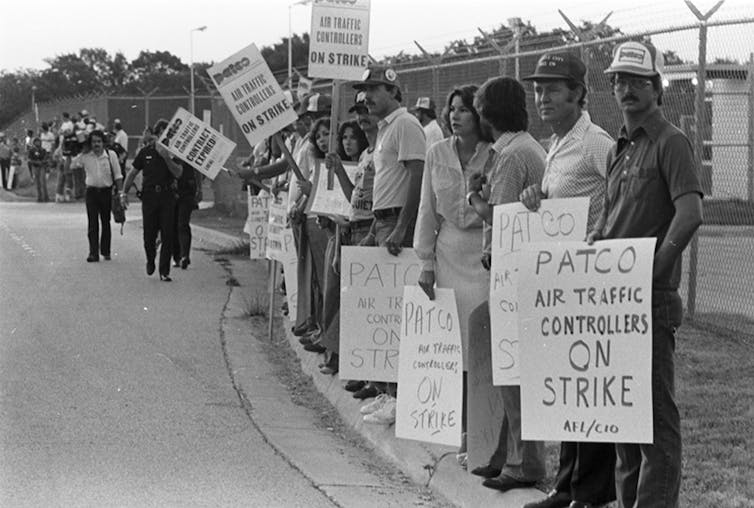
After leading the actors’ strike 21 years earlier, in August 1981, in office just six months, Reagan fired 11,500 striking air traffic controllers.
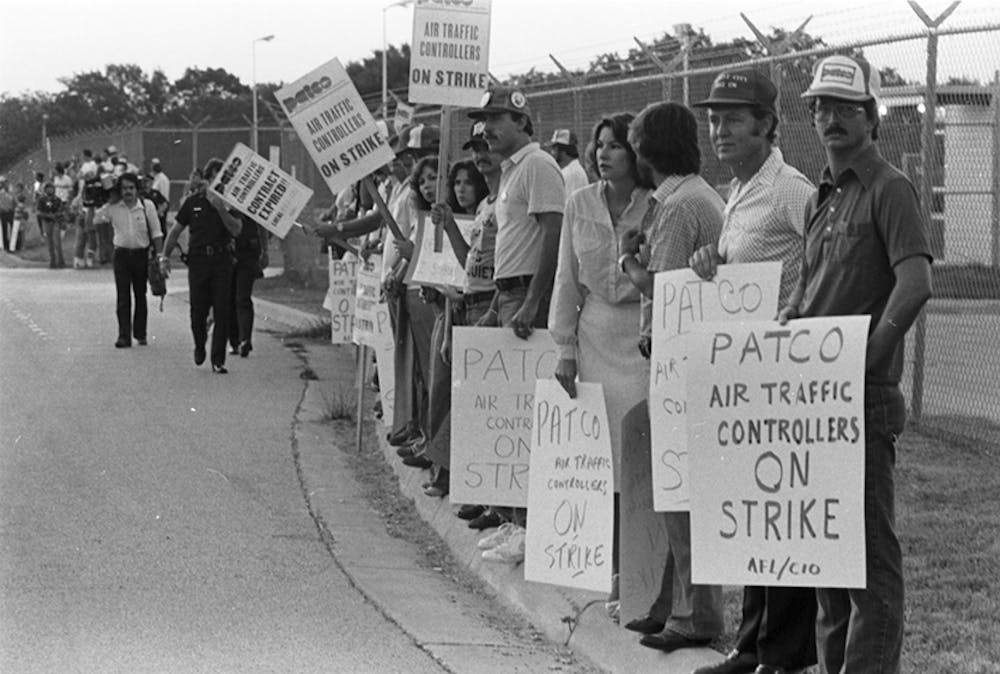 In 1981 Reagan fired 11,500 striking air traffic controllers.
University of Texas at Arlington Libraries, Fort Worth Star-Telegram Collection, CC BY-NC
In 1981 Reagan fired 11,500 striking air traffic controllers.
University of Texas at Arlington Libraries, Fort Worth Star-Telegram Collection, CC BY-NC
He barred them from working in their old jobs or anywhere in the Federal Aviation Administration for the rest of their lives. His administration also formally decertified their union, the Professional Air Traffic Controllers Organization (PATCO).
Reagan’s response to the PATCO strike was unprecedented in the post-World War II period. It had a chilling effect on the fortunes of unions and working conditions, contributing to ongoing wage stagnation and the loss of various forms of leave and entitlements.
Reagan is the only union leader to serve as US President. Paradoxically, he was also one of the most aggressively anti-union presidents of the 20th century.
Read more: How Reagan's notions of a 'good society' resonate with Trump supporters today
Authors: Prudence Flowers, Senior Lecturer in US History, College of Humanities, Arts, and Social Sciences, Flinders University


















