

Strong political leaders are electoral gold – but the trick is in them knowing when to stand down
- Written by Mark Kenny, Professor, Australian Studies Institute, Australian National University
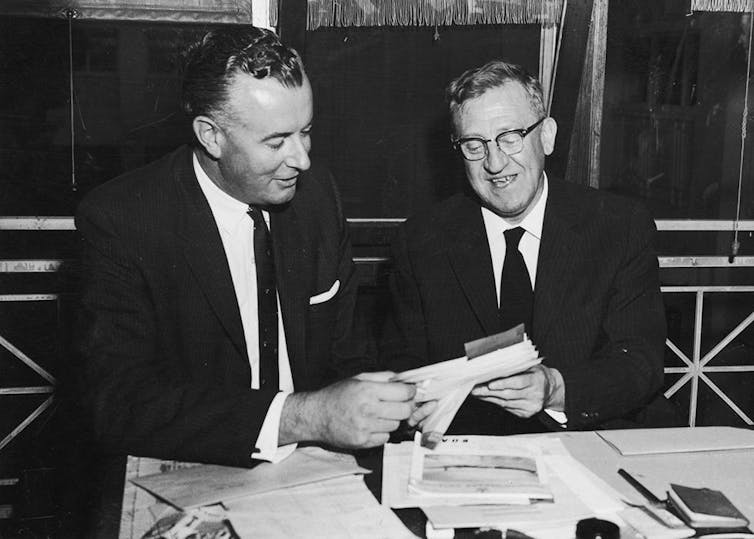
March this year marked the 60th anniversary of a famous “gotcha” moment in 1963, when Labor leader Arthur Calwell and his deputy, Gough Whitlam, were photographed outside the Hotel Kingston in Canberra.
They were waiting for their party’s federal conference to settle a key election policy.
Inside, delegates – six from each state – deliberated. The photographs and their hostile treatment in The Daily Telegraph the next day by journalist Alan Reid were damaging. Reid decried Calwell’s “night watch” as “a sad commentary on the decline in status of Labor’s parliamentary leadership”.
The man coveting the prime ministership appeared to lack authority within his own party. Liberal Prime Minister Robert Menzies exploited the incident even before one of his backbenchers coined a phrase that would enter the political lexicon, Labor’s “36 faceless men”. In point of fact, one of the delegates had been a woman, Tasmanian Phyllis Benjamin.
Hardly charismatic, the unfashionable Calwell could ill afford the slight. By the time Whitlam finally crashed through to win the 1972 election, Labor’s presentation had been more carefully calibrated to emphasise a party united behind its dominant, inspiring leader.
Since then, this has been the norm. Leaders of the major parties invariably attempt to project strength, insight and control.
Just weeks before the 2007 election campaign, Labor’s Kevin Rudd unilaterally decreed that he alone would appoint his ministry, rather than the caucus. As The Sydney Morning Herald reported:
With polls showing Labor heading for a landslide win at the looming federal election, Mr Rudd said he would overturn the century-old practice of caucus and factions choosing the faces and the leader allocating portfolios.
Rudd’s election slogan, unveiled weeks later, would stress this resolve: “New Leadership”.
An ever-narrowing focus on leaders is sometimes lamented as the presidentialisation of Australian politics. In other words, the shift of power from party members and cabinets to leaders exercising unfettered authority from the top.
In 1996, after Labor’s 13-year run, an exhausted Paul Keating ran (unsuccessfully) on the last metric in which he held an advantage. His one-word slogan: “Leadership”.
In state and federal governments, strong leader-centric marketing is seen as essential for re-election. This has had noticeable effects such as the development of cult-like followings for premiers – think Daniel Andrews in Victoria and Mark McGowan in Western Australia – and a not-unrelated tendency of premiers and prime ministers to cling on, remaining in the job long after it is in their party’s interests.
Some succumb to their own propaganda. In 2018, Scott Morrison rehearsed what would become a penchant for unilateral declarations by all but publicly sacking the chief executive of Australia Post, Christine Holgate, for what The Guardian Australia’s Katharine Murphy called Holgate’s “sins against the pub test”. Three years later, it would emerge Morrison had taken his infallible leadership prerogative so seriously he had secretly acquired a raft of cabinet portfolios.
A perverse advantage of the strong leader model is that replacing that leader can give a tired government a whole new look. Yet it is an opportunity for renewal more often missed in practice, largely because said changeover has to be initiated by the incumbent leader rather than the party.
Rudd’s momentum towards office in 2007 may well have been slowed had John Howard agreed to hand over to his treasurer, Peter Costello.
Rudd had an advantage over the 11-year PM of being new and young. But up against a newly installed Prime Minister Costello, the race may have been closer.
Labor’s Steve Bracks had even shown Howard the way, rocking politics mid-way through 2007 by stepping down voluntarily as Victorian premier.
Howard, though, simply could not let go. He told his confidant, Alexander Downer, that if his cabinet colleagues insisted, he would cede the reins, but he would also make their insistence known to voters. His colleagues read that as a threat and backed off.
The Coalition was roundly defeated at the 2007 election. Howard lost his seat.
Andrews may or may not provide Victorian Labor with this option. Over nine years as premier, he has become such a dominant figure that the Liberal opposition has descended into division and dysfunction. Even within Labor, no clear alternative to Andrews exists, although his deputy, Jacinta Allen, is the most likely.
Yet his dominance has led to high public exposure and probably helped polarise Victorian voters – especially during the pandemic. Few Victorians can name other senior government figures. On social media, evaluation of the premier is routinely reduced to the most simplistic of binaries via the competing hashtags, #DictatorDan or #IStandWithDan.
Polls show the premier’s support is now declining, suggesting even long-time backers believe he is approaching his “best-by date”, as one former enthusiast put it.
Read more: Victoria's Labor Party plunges in a Morgan poll after Commonwealth Games axed
A Resolve Political Monitor survey conducted for The Age and reported on August 17 found support for Labor softening – although it is still well ahead of the Liberal opposition – and charted a falling “likeability rating” for Andrews also.
Pollster Jim Reed told The Age it was the first time the premier had gone into negative territory with more people disliking him than liking. His rating was minus seven compared to his Liberal counterpart, John Pesutto, on minus nine.
Andrews still leads Pesutto easily on the preferred premier rating, 44% to 29%, but even this was Andrews’ lowest such rating in two years. This may be due to a series of controversies including the costly decision to scrap the 2026 Commonwealth Games.
December 2024 will mark a decade in office for the Labor premier, and therefore the halfway point of the term. (Elections in the garden state are held every four years, on the last Saturday in November, with the next one due in 2026.)
Could this be the point at which Andrews calls time? History suggests if a government is to change leader, it is best done well ahead of an election, giving the replacement time to build a relationship with voters.
Would such a switch allow Victorian Labor to refresh in office, rather than the usual term or more in opposition following a defeat?
These are the considerations some will be making. However, dominant leaders can be hard to dislodge.
There are exceptions. In 2020, as WA skirted COVID by closing its borders, McGowan’s approval rating reached the highest recorded by any premier, at 91% according to one poll.
Yet he surrendered the WA premiership earlier this year, having led Labor to its most electorally dominant position in its history.
Read more: Mark McGowan quits in his own time, after dominating Western Australian politics
In doing so he followed the example of a previous WA Labor leader, Geoff Gallop, who became premier in 2001 and relinquished the post in 2006, less than a year after securing a second term.
Mostly, though, leaders have to be endured long past their popular high-water mark, because, well, they’re irreplaceable. Just ask them.
Authors: Mark Kenny, Professor, Australian Studies Institute, Australian National University

















