

Does private health insurance cut public hospital waiting lists? We found it barely makes a dent
- Written by Yuting Zhang, Professor of Health Economics, The University of Melbourne
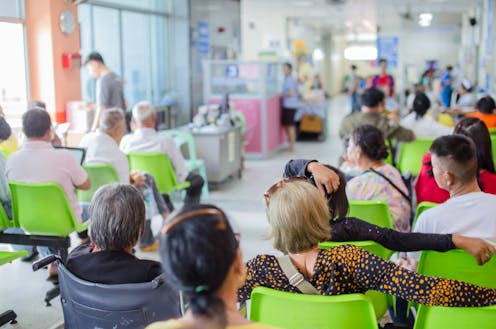
The more people take up private health insurance, the less pressure on the public hospital system, including shorter waiting lists for surgery. That’s one of the key messages we’ve been hearing from government and the private health insurance industry in recent years.
Governments encourage us to buy private hospital cover. They tempt us with carrots – for instance, with subsidised premiums. With higher-income earners, the government uses sticks – buy private cover or pay the Medicare Levy Surcharge. These are just some of the billion-dollar strategies aimed to shift more of us who can afford it into the private system.
But what if private health insurance doesn’t have any meaningful impact on public hospital waiting lists after all?
That’s what we found in our recent research. Our analysis suggests if an extra 65,000 people buy private health insurance, public hospital waiting lists barely shift from the average 69 days. Waiting lists are an average just eight hours shorter.
In other words, we’ve used hospital admission and waiting-list data to show private health insurance doesn’t make much difference.
What we did
Our work looked at data from 2014-2018 on hospital admissions and waiting lists for elective surgery in Victoria.
The data covered all Victorians who were admitted as an inpatient in all hospitals in the state (both public and private) and those registered on the waiting list for elective surgeries in the state’s public hospitals.
That included waiting times for surgeries where people are admitted to public hospitals (as an inpatient). We didn’t include people waiting to see specialist doctors as an outpatient.
The data was linked at the patient level, meaning we could track what happened to individuals on the waiting list.
We then examined the impact of more people buying private health insurance on waiting times for surgeries in the state’s public hospitals.
We did this by looking at the uptake of private health insurance in different areas of Victoria, according to socioeconomic status. After adjusting for patient characteristics that may affect waiting times, these differences in insurance uptake allowed us to identify how this changed waiting times.

What we found
In our sample, on average 44% of people in Victoria had private health insurance. This is close to the national average of 45%.
We found that increasing the average private health insurance take-up from 44% to 45% in Victoria would reduce waiting times in public hospitals by an average 0.34 days (or about eight hours).
This increase of one percentage point is equivalent to 65,000 more people in Victoria (based on 2018 population data) taking up (and using) private health insurance.
The effects vary slightly by surgical specialty. For instance, private health insurance made a bigger reduction to waiting times for knee replacements, than for cancer surgery, compared to the average. But again, the difference only came down to a few hours.
Someone’s age also made a slight difference, but again by only a few hours compared to the average wait.
Given the common situation facing public and private hospitals across all states and territories, and similar private health insurance take-up in many states, our findings are likely to apply outside Victoria.
Read more: Getting an initial specialists' appointment is the hidden waitlist
Why doesn’t it reduce waiting lists?
While our research did not address this directly, there may be several reasons why private health insurance does not free up resources in the public system to reduce waiting lists:
people might buy health insurance and not use it, preferring to have free treatment in the public system rather than risk out-of-pocket costs in the private system
specialists may not be willing to spend more time in the public system, instead favouring working in private hospitals
there’s a growing need for public hospital services that may not be available in the private system, such as complex neurosurgery and some forms of cancer treatment.
Why is this important?
Government policies designed to get more of us to buy private health insurance involve a significant sum of public spending.
Each year, the Australian government spends about $A6.7 billion in private health insurance rebates to reduce premiums.
In the 2020-21 financial year, Medicare combined with state and territory government expenditure provided almost $6.1 billion to fund services provided in private hospitals.
There might be an argument for this public spending if the end result was to substantially take pressure off public hospitals and thereby reduce waiting times for treatment in public hospitals.
But the considerable effort it takes to encourage more people to sign up for private health insurance, coupled with the small effect on waiting lists we’ve shown, means this strategy is neither practical nor effective.
Given the substantial costs of subsidising private health insurance and private hospitals, public money might be better directed to public hospitals and primary care.
In addition, people buying private health insurance can skip the waiting times for elective surgery to receive speedier care. These people are often financially well off, implying unequal access to health care.
What’s next?
The Australian government is currently reviewing private health insurance.
So now is a good time for reforms to optimise the overall efficiency of the health-care system (both public and private) and improve population health while saving taxpayer money. We also need policies to ensure equitable access to care as a priority.
When it comes to reducing hospital waiting lists, we’ve shown we cannot rely on increased rates of private health insurance coverage to do the heavy lifting.
Read more: Do you really need private health insurance? Here's what you need to know before deciding
Authors: Yuting Zhang, Professor of Health Economics, The University of Melbourne

















