

Cuts and restructures send alarm through South Australia's arts sector
- Written by: Jo Caust, Associate Professor and Principal Fellow (Hon), University of Melbourne
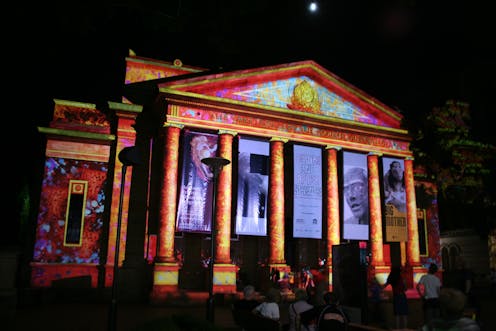
South Australia’s Coalition government, elected in March 2018 after 16 years of Labor rule, has alarmed the state’s arts industry with major changes to the way the arts are structured and funded in South Australia.
The key structural change is that Arts SA, the body that administered, funded and advised about the arts, has been essentially downgraded to the role of a policy adviser. As part of the change, the head of Arts SA (a Labor government appointee) was dismissed.
In the recent state budget, the government announced cuts totalling $31.9 million over the next four years, including $18.5 million from organisations and programs and $13.4 million from Arts SA.
In July, the responsibility for several arts organisations was also given to other government departments. Various youth arts organisations, including theatre companies, are now under the Department of Education. Other organisations such as the South Australian Film Corporation, the Adelaide Film Festival and the Jam Factory are now the responsibility of the Department of Industry and Skills Development.
Read more: Beyond bulldust, benchmarks and numbers: what matters in Australian culture
How did we get here?
The arts have long been championed in SA, but in recent years the sector has started to stagnate. For several decades from the 1970s, Adelaide wore the mantle of the “Athens of the South”. The Adelaide Festival was regarded as the major arts festival in the Southern Hemisphere and the state led the way in establishing arts infrastructure as an essential part of government.
The arts in South Australia continued to enjoy bipartisan support for the next 20 or so years. The arts were usually under the control of the premier and led by a senior public servant, Len Amadio.
Changes began in the early 1990s. Premier John Bannon divested the arts from his own portfolio and from then on the arts were usually part of another minister’s portfolio. Gradually the arts fell down the political status pole and experienced both cuts and/or benign neglect.
Over the decade from 2008 to 2018 there was a perception that the arts had lost their political capital in the context of the state. Aside from the main arts festivals and the major cultural institutions such as the Adelaide Festival Centre Trust, other arts activities and organisations were generally ignored.
Worrying signs
In the lead-up to the state election, the Liberal Party promised that a Liberal government would develop a state arts plan as well as establish the position of a commissioner for cultural development. But the recent funding cuts and restructures suggest that, as the SA Arts Industry Council has said, the government is not listening to the arts community nor taking it seriously.
The Liberal Party also announced a vision for a National Aboriginal Arts and Cultural Gallery housing both contemporary Aboriginal art and traditional artefacts, instead of a new Contemporary Art Gallery at the old hospital site. This has been confirmed by $60 million committed in the budget.
While a National Aboriginal Gallery is a welcome idea, it seems there was limited consultation about the proposal with either the Aboriginal community or the arts community. The announcement also appears to abandon the concept of a new contemporary art gallery as hoped for by the Art Gallery of South Australia.
Read more: With support for arts funding declining, Australia must get better at valuing culture
The small to medium arts sector in South Australia was damaged by the changes in 2014-16 introduced by George Brandis, then federal arts minister. The impact of this period is still being felt by many. While other states have been consolidating and strengthening their arts and creative sector (such as Creative Victoria and Create New South Wales), the South Australian government appears to be in a process of deconstruction.
Many questions are now being raised about the relationship between the state Coalition government and the arts sector, particularly how the complexity of the arts will be understood and represented to government.
Arts SA’s function and effectiveness may have seemed to suffer from organisational paralysis and lack of effective strategic leadership for a long time. In addition, it could be said that the arts sector has suffered under a cloud of benign political neglect for several years.
Perhaps the changes that are occurring are a way to move the sector forward to another model of administration and structural framing that is not wholly dependent on economic outcomes. This could be a positive move, but at present there is no sign that the new government is moving towards another model. For example, while there is talk of an arts plan, no plan is seemingly in development. Meanwhile the cuts to the sector over the next four years are likely to inflict a great deal of damage on an already vulnerable sector.
Authors: Jo Caust, Associate Professor and Principal Fellow (Hon), University of Melbourne


















