

How do I know if a rental house is mouldy before I sign the lease? 12 things to check
- Written by: Rebecca Bentley, Professor of Social Epidemiology and Director of the Centre of Research Excellence in Healthy Housing at the Melbourne School of Population and Global Health, The University of Melbourne
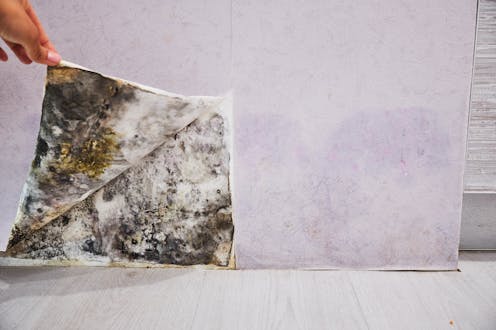
Although most Australian states require homes be free of mould before they are rented out, seasoned renters know that’s not always the case. In fact, an alarming number of tenants report discovering mould after they’ve moved into a rental property.
But how can you tell? Based on our research and practical experience in the field, these are 12 questions worth considering before you sign a residential tenancy agreement.
1. Have you asked the agent or landlord directly?
Enquire upfront if there’s a history of mould in the property. Tell the agent or landlord if a household member has a chronic condition, such as asthma or an allergy, which could be exacerbated by mould exposure. It’s worth a shot.
2. Can you see any mould?
This sounds obvious but there’s an art to spotting the clues. Carpets retain a history of mould damage. If you’re allowed and without causing damage, carefully inspect under carpet in a corner in areas that could be prone to water coming in (such as near a bathroom, external wall or window).
Single-glazed windows often experience condensation, so check windows closely. Mould problems tend to show up most significantly on the south-facing side of the house, and can sometimes be spotted on fly screens or the exterior face of blinds and curtains.

3. Are there damp smells in any room?
Check if the agent or landlord has attempted to mask odours with air fresheners or incense.
4. Has the place been recently repainted, re-carpeted or given a new floor?
If so, ask the agent why and if any mould was found in the process.
 This wall was repainted with white enamel paint. But after cabinetry was removed, you can see concealed mould growth in unpainted areas.
Ryan Oirbans. Copyright Restoration Industry Consultants, Author provided (no reuse)
This wall was repainted with white enamel paint. But after cabinetry was removed, you can see concealed mould growth in unpainted areas.
Ryan Oirbans. Copyright Restoration Industry Consultants, Author provided (no reuse)
5. Do exhaust fans in the kitchen and bathroom work well?
Make sure you understand where these fans release the ventilated air and moisture. You don’t want this to be the roof space (above the ceiling but below the roof) unless there are roof vents.
 Mould can grow inside an air conditioner. Tenants can’t access this area to clean it and it would need servicing by a technician.
Photograph by Ryan Oirbans. Copyright Restoration Industry Consultants, Author provided (no reuse)
Mould can grow inside an air conditioner. Tenants can’t access this area to clean it and it would need servicing by a technician.
Photograph by Ryan Oirbans. Copyright Restoration Industry Consultants, Author provided (no reuse)
6. Do the gutters leak?
Look at the roof and try to find the valley gutters (these are the things between two planes of the roof and help direct rainwater down to the normal gutters).
If a downpipe is not located near a valley, there is a risk the gutter could overflow. Look for water damage to roofs and eaves or sagging gutters.
 The underside of this roof is mouldy, thanks to bathroom exhaust condensing on the surface.
Photograph by Ryan Oirbans. Copyright Restoration Industry Consultants, Author provided (no reuse)
The underside of this roof is mouldy, thanks to bathroom exhaust condensing on the surface.
Photograph by Ryan Oirbans. Copyright Restoration Industry Consultants, Author provided (no reuse)
7. Are there water stains on the walls, floor, windows or ceiling?
Check the frames and around the windows closely. Look under the kitchen and bathroom sinks for stains, blistering melamine or swelling particle board.
See if there’s swelling or peeling on the walls and skirting board on the shared wall between the shower and the adjoining room. Peeling or swelling could indicate a failed waterproofing membrane.
External walls in contact with the ground have the highest risk of rising damp, and south-facing walls tend to get the least sunlight.
 Check inside vanity cabinets for mould or damp.
Photograph by Ryan Oirbans. Copyright Restoration Industry Consultants, Author provided (no reuse)
Check inside vanity cabinets for mould or damp.
Photograph by Ryan Oirbans. Copyright Restoration Industry Consultants, Author provided (no reuse)
8. Is the property well ventilated?
Are there fly screens so you can leave windows open? Is there anything making it hard to get fresh air? For example, do windows face a noisy main road? This means they are likely to remain closed.
9. Is the home humid?
Find out as much as you can about glazing, insulation and orientation. Is the home humid? You can find out with a thermo-hygrometer, a device often sold in hardware stores that reads temperature and relative humidity. In older houses with poor insulation, you can usually try to maintain the interior at 65% relative humidity with the help of a dehumidifier.
Are there any evaporative coolers in the home? These machines keep the room cool by evaporating water, but they add moisture to the air. Ask the agent if they can switch on any evaporative coolers to see if your sinuses feel irritated when you are near a vent.
10. Are tiles cracked, lifted, uneven or loose?
This can suggest water damage underneath, especially in the shower (or areas near the shower).
11. Have you checked behind any furniture pushed up against walls?
Having furniture pushed up like this can prevent walls from drying out. Look behind furniture for evidence of mould.
12. Is there water pooling under the house?
Are there garden beds or plants positioned right up against the walls? If the house is on a slope, does rain run off down the hill and pool under the house? See if you can go under the house to look and smell for mould.
 The underside of timber flooring is worth checking for mould.
Ryan Oirbans. Copyright Restoration Industry Consultants, Author provided (no reuse)
The underside of timber flooring is worth checking for mould.
Ryan Oirbans. Copyright Restoration Industry Consultants, Author provided (no reuse)
Authors: Rebecca Bentley, Professor of Social Epidemiology and Director of the Centre of Research Excellence in Healthy Housing at the Melbourne School of Population and Global Health, The University of Melbourne


















