

Starlink satellites are 'leaking' signals that interfere with our most sensitive radio telescopes
- Written by Steven Tingay, John Curtin Distinguished Professor (Radio Astronomy), Curtin University
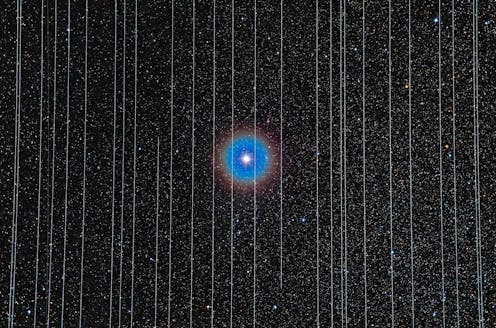
When I was a child in the 1970s, seeing a satellite pass overhead in the night sky was a rare event. Now it is commonplace: sit outside for a few minutes after dark, and you can’t miss them.
Thousands of satellites have been launched into Earth orbit over the past decade or so, with tens of thousands more planned in coming years. Many of these will be in “mega-constellations” such as Starlink, which aim to cover the entire globe.
These bright, shiny satellites are putting at risk our connection to the cosmos, which has been important to humans for countless millennia and has already been greatly diminished by the growth of cities and artificial lighting. They are also posing a problem for astronomers – and hence for our understanding of the universe.
In new research accepted for publication in Astronomy and Astrophysics Letters, we discovered Starlink satellites are also “leaking” radio signals that interfere with radio astronomy. Even in a “radio quiet zone” in outback Western Australia, we found the satellite emissions were far brighter than any natural source in the sky.
An animation showing the increase in the number of satellites in Earth orbit, over the course of the space age, so far.A problem for our understanding of the universe
Our team at Curtin University used radio telescopes in Western Australia to examine the radio signals coming from satellites.
We found expected radio transmissions at designated and licensed radio frequencies, used for communication with Earth.
Starlink satellites emit bright flashes of radio transmission (shown in blue) at their allocated frequency of 137.5 MHz.However, we also found signals at unexpected and unintended frequencies.
We found these signals coming from many Starlink satellites. It appears the signals may originate from electronics on board the spacecraft.
Here we see constant, bright emissions from Starlink satellites at 159.4 MHz, a frequency not allocated to satellite communications.Why is this an issue? Radio telescopes are incredibly sensitive, to pick up faint signals from countless light-years away.
Even an extremely weak radio transmitter hundreds or thousands of kilometres away from the telescope appears as bright as the most powerful cosmic radio sources we see in the sky. So these signals represent a serious source of interference.
And specifically, the signals are an issue at the location where we tested them: the site in WA where construction has already begun for part of the biggest radio observatory ever conceived, the Square Kilometre Array (SKA). This project involves 16 countries, has been in progress for 30 years, and will cost billions of dollars over the next decade.
Huge effort and expense has been invested in locating the SKA and other astronomy facilities a long way away from humans. But satellites present a new threat in space, which can’t be dodged.
What can we do about this?
It’s important to note satellite operators do not appear to be breaking any rules. The regulations around use of the radio spectrum are governed by the International Telecommunications Union, and they are complex. At this point there is no evidence Starlink operators are doing anything wrong.
The radio spectrum is crucial for big business and modern life. Think mobile phones, wifi, GPS and aircraft navigation, and communications between Earth and space.
However, the undoubted benefits of space-based communications – such as for globally accessible fast internet connections – are coming into conflict with our ability to see and explore the universe. (There is some irony here, as wifi in part owes its origins to radio astronomy.)
Regulations evolve slowly, while the technologies driving satellite constellations like Starlink are developing at lightning speed. So regulations are not likely to protect astronomy in the near term.
Read more: How many satellites are orbiting Earth?
But in the course of our research, we have had a very positive engagement with SpaceX engineers who work on the Starlink satellites. It is likely that the goodwill of satellite operators, and their willingness to mitigate the generation of these signals, is the key to solving the issue.
In response to earlier criticisms, SpaceX has made improvements to the amount of sunlight Starlink satellites reflect, making them one-twelfth as bright in visible light as they used to be.
We estimate emissions in radio wavelengths will need to be reduced by a factor of a thousand or more to avoid significant interference with radio astronomy. We hope these improvements can be made, in order to preserve humanity’s future view of the universe, the fundamental discoveries we will make, and the future society-changing technologies (like wifi) that will emerge from those discoveries.
Authors: Steven Tingay, John Curtin Distinguished Professor (Radio Astronomy), Curtin University

















