

Climate adaptation projects sometimes exacerbate the problems they try to solve – a new tool hopes to correct that
- Written by: Ritodhi Chakraborty, Lecturer of Human Geography, University of Canterbury
When United States aid money was used to build a seawall on Fiji’s Vanua Levu island to shield the community from rising tides, it instead acted as a dam, trapping water and debris on its landward side.
In another example from Bangladesh, the World Bank is pouring US$400 million into expanding old flood barriers along the coastline to counter climate-induced floods and sea-level rise. But this, too, is causing new problems, including waterlogged fields and loss of soil fertility.
Across the globe, a “climate adaptation industry” sometimes imposes solutions that exacerbate the problems they aim to solve. Frequently, this comes at the cost of vulnerable communities.
This story plays out across the world, including in Aotearoa New Zealand, where top-down adaptation projects can increase climate vulnerability of communities. Our work seeks to fill a critical gap by establishing a monitoring and evaluation system to identify the risk of maladaption.
Maladaptation is a growing problem
Concern about unforeseen consequences of climate adaptation has emerged as a key issue in the latest report by the Intergovernmental Panel on Climate Change (IPCC). Authors noted that:
Evidence of maladaptation is increasing in some sectors and systems, highlighting how inappropriate responses to climate change create long-term lock-in of vulnerability, exposure and risks that are difficult and costly to change and exacerbate existing inequalities for Indigenous peoples and vulnerable groups.
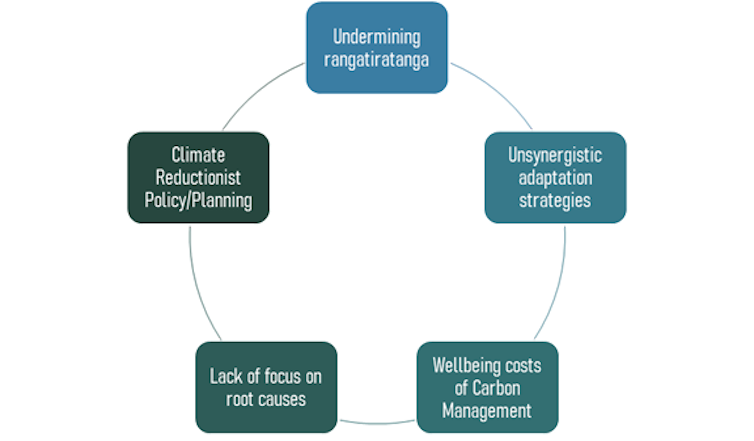
Maladaptation is usually understood as referring to the unintended consequences of well-meant measures to reduce climate vulnerability. But it also includes the fallout from decisions that favour technical fixes over more holistic approaches.
Read more: Getting ready for climate change is about people, not spreadsheets. Let's use our imaginations
Climate adaptation is not a neutral or apolitical process. It can perpetuate problematic approaches, including colonial land practices and the exclusion of Indigenous voices.
This can create tenuous resource distribution, erode democratic governance and compromise Indigenous sovereignty, exacerbating vulnerabilities. It can also subvert community-driven bottom-up adaptation, instead focusing on national agendas caught up in international politics.
Addressing these maladaptive strategies is pivotal for achieving climate justice.
The situation in Aotearoa New Zealand
In New Zealand, climate change adaptation research is still in its early stages.
Most adaptation projects are being designed and implemented in three key categories: flood protection (stop banks and erosion control), nature-based solutions (tree plantings and wetland restoration) and coastal hazard prevention (managed retreat and sea walls).
These efforts often follow a framework of “dynamic adaptation policy pathways” (DAPP). This means the planning process has to remain flexible to keep adjusting as new information comes to hand.
However, a recent symposium on the ten-year stocktake of this approach raised several critical points, including:
the need to involve Māori and local communities more throughout the process
share governance across all levels of government
address funding barriers for implementation
and avoid investments that lock in problems for the future.
Take for instance the stalled Clifton to Tangoio coastal hazards strategy in the Hawke’s Bay. This project aimed to identify the areas most at risk of coastal flooding and erosion.
It was hindered by policy ambiguity and funding issues. The region now faces decisions about managed retreat because land was classified as uninhabitable after Cyclone Gabrielle.
Others have noted the lack of synergy between planned and community-driven climate adaptation activities. Council-planned measures often exacerbated climate vulnerability, especially for communities already living in disadvantaged areas.
Addressing maladaptation
We came together as a group of Māori, Pasifika, Pākehā and tauiwi scholars and practitioners to develop a maladaptation assessment tool for New Zealand.
Its aim is genuine sustainability and justice. It evaluates the risk of maladaptation and serves as the foundation for a national monitoring system with both regulatory and educational roles.
Our goals are to illuminate and ideally correct overlooked social and ecological impacts of climate adaptation and to address the limitations of current audit systems. These often neglect local justice and wellbeing concerns in favour of centrally planned projects aimed at reducing risks identified by engineering and insurance industries.
Our preliminary findings from the analysis of 79 adaptation projects show that managed retreat, structural flood protection and climate-resilient development projects are most at risk of maladaptation.
To be just, climate adaptation requires a counter-intuitive approach. It should prioritise community wellbeing and examine the risks posed by both climate change and adaptation.
This perspective doesn’t diminish the reality of climate impacts. It contextualises them within a complex history of Indigenous displacement, forced landscape alteration and ongoing social crises.
Read more: Colonialism: why leading climate scientists have finally acknowledged its link with climate change
By addressing the threat of maladaptation, we hope to encourage thinking and planning that looks beyond mere technological fixes and begins to repair our broken relationships with the planet and each other.
Authors: Ritodhi Chakraborty, Lecturer of Human Geography, University of Canterbury


















