

how the crops we plant could help reduce the risk of wildfires on agricultural landscapes
- Written by: Tim Curran, Associate Professor of Ecology, Lincoln University, New Zealand
Destructive wildfires continue to threaten lives, property and the environment throughout the world.
Around 10% of all fires globally occur on agricultural land, causing damage to crops, infrastructure and nearby native vegetation.
But what if the properties of the plants grown on agricultural land could be harnessed to help mitigate fires?
Our research tested this idea and found that many common crops and pastures are low in flammability and could be used to redesign agricultural landscapes to help suppress wildfires.
Food crops, fires and biodiversity
Globally, 38% of the land surface is used for cropping or grazing. Agricultural produce is a key commodity of many countries.
Agricultural fields are a major source of wildfire, either through the escape of fires lit deliberately for agricultural purposes (stubble burning) or through accidents (ignited from machinery use). There is a clear need to better mitigate fires in agricultural landscapes.
Agricultural landscapes are also very important for native biodiversity. Diversification of agricultural systems could not only help mitigate wildfires, but also aid food production and promote biodiversity conservation.
However, to do this, we first need to understand the flammability of different crop species.
Read more: How invasive weeds can make wildfires hotter and more frequent
Crop and pasture species are likely to vary widely in their flammability. For instance, in Brazil, pineapple crops were much better at stopping fires than peanuts or grazing legumes. In Canada, a pasture mix of yarrow, white clover and Rocky Mountain fescue experienced less intense and slower-moving fires than those that burned through nearby grasslands.
A modelling study has even suggested that planting “edible fire buffers” of bananas might be useful to mitigate fires in California.
While these mostly field-based studies have been very useful, we still needed to compare the flammability of a wide range of crop and pasture species to identify which ones could be planted to help mitigate fire hazards. To do this, we turned to our “plant BBQ” method.
Testing plant flammability.Testing crop flammability
Our plant BBQ, based on an Argentinian design, measures the flammability of shoots and whole plants up to 70cm in length. Results from this technique were correlated with the observations made by fire managers when attending fires.
This is an approach used widely around the world, including in New Zealand, New South Wales, Queensland, South Africa, the United States and Brazil.
For our study, we identified 47 different plant species or varieties that commonly occur on farms in New Zealand’s Canterbury region. These included many crop and pasture species grown in temperate regions around the world, such as cereal crops (wheat, oats, barley, popcorn), forage crops (beet, kale, sweetcorn, rapeseed), fruit crops (apples, olives, pears, blueberries, raspberries), grazing herbs (chicory, plantain), various pasture grasses (cocksfoot, ryegrass) and pasture legumes (clovers, lucerne), vegetables (bell pepper, snow peas, potato, onion, squash) and several wine grape varieties.
Read more: Low flammability plants could help our homes survive bushfires
So, what did we find?
First, many species found on farms are low in flammability. Indeed, 24 (51%) of the varieties we tested did not ignite at all. These included many vegetable crops, pasture species (lucerne, clovers, some grasses) and wine grapes.
Second, there were also species with comparatively high flammability. As expected, cereal crops such as wheat and oats, which brown off late in their life cycle and retain a lot of dead material, were relatively highly flammable.
Unexpectedly, fruit crops, such as pears and two apple varieties, had the highest flammability. Raspberries had similar flammability to wheat and oats.
These results show there is large variation in the flammability of species found on farms. This suggests that planting fire-retardant crop and pasture species could be a useful tool to strategically redesign agricultural landscapes to help mitigate wildfires in an increasingly fire-prone world.
Fighting fire with food
How might we use these findings to mitigate wildfires in agricultural landscapes? First, we should recognise some caveats to our work. While our plant BBQ method likely provides good estimates of whole-plant flammability, many other variables will determine fire behaviour in the field. This includes weather and topography.
Hence, these findings should be tested using experimental burns of crops in paddocks. Modelling could help here, too. It is also important to repeat our testing in different locations, with different agricultural practices and across seasons to determine how these factors affect flammability.
With this knowledge on comparative plant flammability we can start to redesign agricultural landscapes.
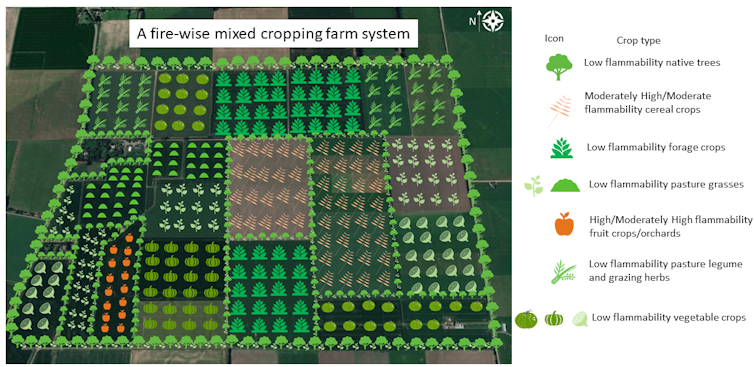
Green firebreaks comprised of low-flammability native species could be planted around the farm perimeter and around particularly important assets such as houses. Crops with higher flammability could be embedded among other paddocks planted with low-flammability crops.
Given the expanding use of the plant BBQ technique globally, we expect that such research can readily be conducted elsewhere, including in the tropics and other regions at risk of wildfires.
Authors: Tim Curran, Associate Professor of Ecology, Lincoln University, New Zealand


















