Speaking out about sexual violence on social media may not challenge gendered power relations
- Written by: Carol Harrington, Senior Lecturer in Sociology and Social Policy, Victoria University of Wellington
Feminists are celebrating a new generation of women who fearlessly share their stories of sexual violence on social media and other digital platforms, confronting established limits on talking about rape.
But as past analyses conclude, not all forms of speaking out challenge the gendered power relations that perpetuate sexual violence.
Politics of speaking out about rape
The feminist movement of the 1970s broke ground by publicly telling personal stories of sexual violence. Those women described the problem as one of patriarchal power and women’s oppression. Yet as public attention to sexual violence became increasingly common in the late 20th century, it came to be depoliticised as an issue of individual trauma, a starting point for personal self-transformation and empowerment that sat well with neoliberalism.
A new generation of sexual violence survivors have been speaking out on social media, most famously with the #MeToo movement, which gained mainstream media attention. However, ordinary people have been telling their sexual violence stories online, sometimes anonymously but in many cases not, in ways that have garnered less attention.
One trend I recently investigated is the “my rape story” genre of YouTube videos. I analysed 48 such videos by 40 individual creators, along with the creators’ YouTube channels and linked social media.
“My rape story” videos are typically produced by regular YouTubers who maintain a channel where they post stories about themselves, expound on various topics, and promote products or services while exhorting viewers to “click, comment, subscribe”. These videos mostly appear on channels where other posts seem designed to attract female viewers, with a focus on female fashion, shopping, and in some cases motherhood.
A few are on channels of aspiring singers, writers or actors. Most such YouTubers do not win huge followings or become celebrities, although many seem to hope to.
YouTubers’ rape stories
In one example, Esther’s (all names are pseudonyms) YouTube channel includes many reviews of cosmetics and links to her beauty website, which promotes various products. A vivacious speaker, Esther posts videos in which she tells stories about her life. Her rape story video begins by promoting one of her other videos and asking viewers to share her videos so her channel can grow. She concludes her story by reminding viewers she posts new content every day.
In another, Destiny’s YouTube channel markets her weight loss advice, including a self-published book on weight loss. She also offers advice on positive thinking and self-branding. She presents herself as healthy and resilient, referring to herself as a guru. She tells her rape story calmly, without tears, saying she is sharing it so others can learn from her experience.
In a third, Emogirl’s videos present her as vulnerable and in need of support. Pale, with heavy black eyeliner, her first ever YouTube video told of her rape as a teenager. She followed this up with videos telling of how she was bullied at school following her rape and how she started to self-harm and attempted suicide.
Rape stories and self-branding
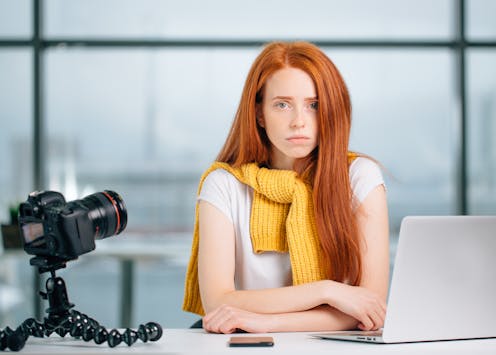
In their rape story videos, creators usually show their face and speak directly to the camera, although some like Emogirl use cue cards – holding up handwritten messages and telling their story a few words at a time.
Most film themselves at home, often from their bedroom. These videos share a DIY aesthetic, which characterises much YouTube vlog content. They appear as homemade productions, crafted by ordinary people with a simple digital camera. This aesthetic, now often imitated by corporate and mainstream media, lends the content a sense of authenticity.
The videos unfold in similar ways, with the storyteller describing how she knew the perpetrator, the events leading to the rape, the rape itself in varying levels of detail, and the aftermath of the rape. Only two of the videos I analysed told of a rape by a stranger. Most told of rape by someone close to the storyteller – a relative, friend or boyfriend. Some told of rape by someone they had recently met, typically a date.
Why do people tell such personal stories on YouTube? Social media incites self-disclosure by requiring users to self-consciously construct online personae through carefully curated personal sharing. Such personal sharing serves to construct an online personal brand by creating a particular emotional experience and connection with followers.
Both Destiny and Esther say they feel an obligation to share their rape story so their followers can know them better. Their stories serve Destiny’s self-positioning as a guru who can guide others in self-transformation, and Esther’s as a girlfriend who gives cosmetic and hairstyling tips while occasionally delving into deeper territory.
Emogirl’s rape story video was her first. In subsequent videos she tells followers how important their emotional support is for her, and encourages them to visit her Instagram, where she posts her artwork. Thus, the circulation of these stories speaks to the commodification of personal experience encouraged by social media.
Wrestling with self-blame
The rape stories YouTubers tell mostly treat rape as an individual trauma perpetrated by, in the words of one, “shitty people”. The videos’ main theme typically revolves around the storyteller’s efforts to “take back control” of her life. Many tell of how the experience made them stronger and situate it as part of their journey to wisdom and self-reliance.
Few link their experience with wider social patterns or treat sexual violence as a social problem with political solutions. Rather, they treat it as a risk women must manage. They urge other women to avoid drinking too much, to watch their drink when socialising, and to be cautious about trusting men – even those they think they know. Thus, these video creators often fall into self-blame and reiterate well-worn rape myths that suggest their own behaviour (drinking, trusting too easily) contributed to their rape.
Nevertheless, some feminist influence appears in these videos insofar as the creators push back against slut-shaming and victim-blaming. Most seem painfully aware of how others could blame them for their rape. They urge other women to speak out about their own rape and to not blame themselves, no matter how drunk they were or what they were wearing.
These videos thus intertwine a kind of female solidarity and resistance to rape myths with neoliberal therapeutic thinking and social media incitements to self-branding.
Authors: Carol Harrington, Senior Lecturer in Sociology and Social Policy, Victoria University of Wellington