The vocational education sector needs a plan and action, not more talk
- Written by: Ruth Schubert, Senior Fellow, LH Martin Institute, University of Melbourne
This article is part of a series on the Future of VET exploring issues within the sector and how to improve the decline in enrolments and shortages of qualified people in vocational jobs. Read the other articles in the series here.
Some 20 years ago, the Australian vocational education system was regarded as world class. Sadly, this is no longer the case when compared to systems in places such as Canada, the Netherlands, Germany and even China.
Australia’s vocational education system has been bedevilled by competing jurisdiction control, political ideology, chronic under-funding, piecemeal reforms, rampant rorting by a small number of corporate private providers, and a disappointing and surprisingly high level of policy confusion.
In February this year, Labor announced it would commit to a generational review of the VET sector in Australia if elected at the next election.
Read more: Learning from Victoria's TAFE mistakes
There is already a substantial list of research reports, reviews and inquiries into issues within the sector. A well-crafted plan can be distilled from this, which, combined with proactive leadership and action, is what the sector needs. Not yet another all-encompassing, long-winded review that will inevitably run aground due to the short-term federal political cycle.
The workforce is changing fast
Our society and economy rely on the vocational system to be highly effective and responsive. After all, just over 24% of our population aged between 15 and 64 years is actively engaged with vocational education every year. This figure is even higher for young people – 46% of 15 to 19-year-olds are involved with vocational education. It’s a system geared to cater for mass and equitable participation.
This is a good thing.
The speed of change for those in the workforce is rapid. This will remain a constant for the foreseeable future. We only have to look to the World Economic Forum and reports from the Foundation for Young Australians for independent advice on the kind of skills our workforce and enterprises will need in coming months and years.
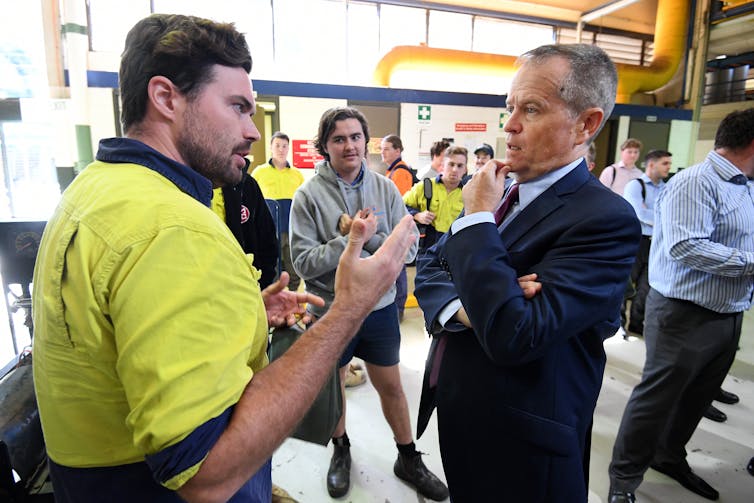 While Labor’s committment to a generational review of the VET sector is commendable, what we need is action, not more reviews.
from www.shutterstock.com
While Labor’s committment to a generational review of the VET sector is commendable, what we need is action, not more reviews.
from www.shutterstock.com
These reports suggest a new focus on technical and enterprise skills as being of equal importance. This is neatly captured by the idea of the “T-shaped graduate”. This is a term commonly used in Europe to capture the idea of a graduate having both specific technical skills and knowledge, and the enterprise skills of collaboration, digital literacy, critical thinking, complex problem solving and creativity.
Australia needs a workforce with a new set of skills and the flexibility and capacity to adapt to even more change. Vocational education can deliver this workforce, but for this to happen the sector needs to be given autonomy and political trust. Trying to change the system piece by piece will result in a camel instead of the thoroughbred Australia needs.
What change is most urgently needed?
First, identify the mature, comprehensive, low-risk providers and give them a new status, independence from government control, and operational autonomy so they can lead the change we need.
This new category could include many TAFEs or TAFE divisions of dual sector universities (which provide vocational and higher education, such as RMIT and Swinburne), a number of not-for-profit providers, and a smaller number of private registered training organisations (RTOs). This classification of provider should be highly prized, not awarded lightly, or in great numbers.
Victoria is fortunate to have a number of mature TAFEs ready to be recognised in this category. These include Holmesglen, Box Hill Institute and Chisholm Institute, to name a few. Arguably, a number of the whole-of-state TAFEs, such as TAFE QLD, should also be recognised in this category. These TAFEs already deliver across the gap between vocational education and higher education.
 The Box Hill Institute is an example of a TAFE that is mature, comprehensive, and low-risk.
from www.shutterstock.com
The Box Hill Institute is an example of a TAFE that is mature, comprehensive, and low-risk.
from www.shutterstock.com
Second, the group of providers should be given long-term equitable funding, based on an agreed framework with clear and measurable performance outcomes, as well as self-accrediting status to respond quickly to the changes in skills required of new and existing employees.
Performance outcomes would include student participation, progression and completion targets, and be tailored to institutional missions. Those outcomes should also to include specific regional innovation and development targets, with a clear focus on small and medium sized enterprises. Australia is largely a small and medium enterprise nation. Small to medium enterprises are a natural fit with highly responsive higher vocational education institutions.
Read more: Not all vocational training providers are stacking up
It’s this group of providers that will change the system and provide the service that business, communities and students need. Creating this new status of provider will enable education that delivers educational services across an increasingly blurry and arguably artificial divide between vocational education and higher education, with a focus on applied and work-integrated learning, and problem solving.
While we applaud the federal Opposition for committing to a generational review, they’re not the government (at least not yet), and we already know where the issues lie. Reports from the Mitchell Institute have provided compelling evidence of the need to restore funding for vocational education. Industry bodies such as the Business Council have called for a reinstatement of TAFE as a central part of the vocational system.
We don’t need more temperature-taking. We need to begin work on the actual implementation plan and action. This can begin now – not in three or four years’ time.
Authors: Ruth Schubert, Senior Fellow, LH Martin Institute, University of Melbourne