

Almost half the men surveyed think they could land a passenger plane. Experts disagree
- Written by Guido Carim Junior, Senior Lecturer in Aviation, Griffith University
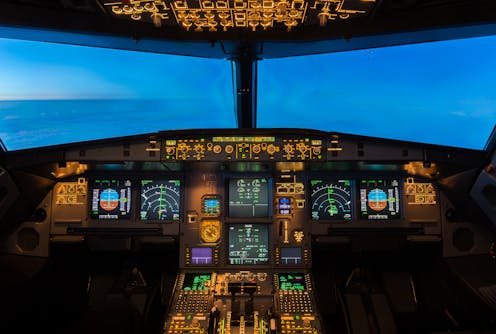
Picture this: you’re nestled comfortably in your seat cruising towards your holiday destination when a flight attendant’s voice breaks through the silence:
Ladies and gentlemen, both pilots are incapacitated. Are there any passengers who could land this plane with assistance from air traffic control?
If you think you could manage it, you’re not alone. Survey results published in January indicate about one-third of adult Americans think they could safely land a passenger aircraft with air traffic control’s guidance. Among male respondents, the confidence level rose to nearly 50%.
Can a person with no prior training simply guide everyone to a smooth touchdown?
We’ve all heard stories of passengers who saved the day when the pilot became unresponsive. For instance, last year Darren Harrison manged to land a twin-engine aircraft in Florida – after the pilot passed out – with the guidance of an air traffic controller who also happened to be a flight instructor.
However, such incidents tend to take place in small, simple aircraft. Flying a much bigger and heavier commercial jet is a completely different game.
You can’t always rely on autopilot
A pilot spends about 90% of their time monitoring autopilot systems and making sure everything is working as intended. The other 10% is spent managing problems, taxiing, taking off and landing.
Takeoffs and landings are arguably the most difficult tasks pilots perform, and are always performed manually. Only on very few occasions, and in a handful of aircraft models, can a pilot use autopilot to land the aircraft for them. This is the exception, and not the rule.
For takeoff, the aircraft must build up speed until the wings can generate enough lift to pull it into the air. The pilot must pay close attention to multiple instruments and external cues, while keeping the aircraft centred on the runway until it reaches lift-off speed.
Once airborne, they must coordinate with air traffic control, follow a particular path, retract the landing gear and maintain a precise speed and direction while trying to climb.
Landing is even more complicated, and requires having precise control of the aircraft’s direction and descent rate.
To land successfully, a pilot must keep an appropriate speed while simultaneously managing gear and flap configuration, adhering to air traffic regulations, communicating with air traffic control and completing a number of paper and digital checklists.
Once the aircraft comes close to the runway, they must accurately judge its height, reduce power and adjust the rate of descent – ensuring they land on the correct area of the runway.
On the ground, they will use the brakes and reverse thrust to bring the aircraft to a complete stop before the runway ends. This all happens within just a few minutes.
Both takeoff and landing are far too quick, technical and concentration-intensive for an untrained person to pull off. They also require a range of skills that are only gained through extensive training, such as understanding the information presented on different gauges, and being able to coordinate one’s hands and feet in a certain way.
Training a pilot
The journey from student to commercial pilot is a long one. It normally starts with a recreational licence, followed by a private licence, and then a commercial licence (which allows them to fly professionally).
Even before stepping into a cockpit, the student must study aerodynamics, air law and flight rules, meteorology, human factors, navigation, aircraft systems, and performance and flight planning. They also need to spend time learning about the specific aircraft they will be flying.
Once the fundamentals are grasped, an instructor takes them for training. Most of this training is conducted in small, lightweight aircraft – with a simulator introduced briefly towards the end.
During a lesson, each manoeuvre or action is demonstrated by the instructor before the student attempts it. Their attempt may be adjusted, corrected or even terminated early in critical situations.
The first ten to fifteen lessons focus on takeoff, landing, basic in-flight control and emergency management. When the students are ready, they’re allowed to “go solo” – wherein they conduct a complete flight on their own. This is a great milestone.
After years of experience, they are ready to transition to a commercial aircraft. At this point they might be able to take off and land reasonably well, but they will still undergo extensive training specific to the aircraft they are flying, including hours of advanced theory, dozens of simulator sessions and hundreds of hours of real aircraft training (most of which is done with passengers onboard).
So, if you’ve never even learned the basics of flying, your chances of successfully landing a passenger aircraft with air traffic control’s help are close to zero.
Yet, flying is a skill like any other
Aviation training has been democratised by the advent of high-end computers, virtual reality and flight simulation games such as Microsoft’s Flight Simulator and X-Plane.
Anyone can now rig up a desktop flight simulator for a few thousand dollars. Ideally, such a setup should also include the basic physical controls found in a cockpit, such as a control yoke, throttle quadrant and pedals.
Flight simulators provide an immersive environment in which professional pilots, students and aviation enthusiasts can develop their skills. So if you really think you could match-up against a professional, consider trying your hand at one.
You almost certainly won’t be able to land an actual passenger plane by the end of it – but at least you’ll gain an appreciation for the immense skill pilots possess.
Authors: Guido Carim Junior, Senior Lecturer in Aviation, Griffith University

















