

the legacy of colonisation is driving a decline in traditional Christian beliefs
- Written by Masoumeh Sara Rahmani, Lecturer Study of Religion, Te Herenga Waka — Victoria University of Wellington
Religious beliefs among Māori have shifted significantly over the past two decades.
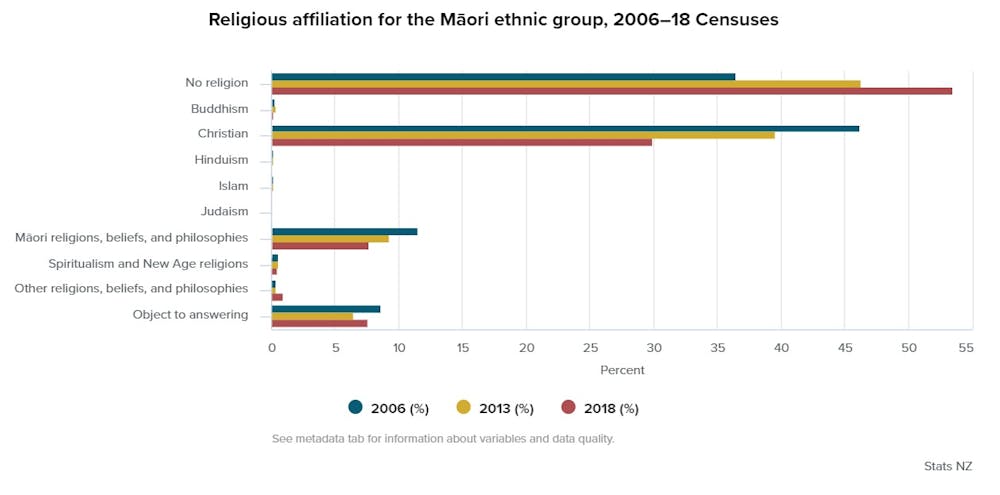
The number of Māori identifying as having “no religion” in the census between 2006 and 2018 increased from 36.5% to 53.5%. Māori affiliation with Christianity has fallen from 46.2% to 29.9%.
Are Māori simply rejecting Christianity? Or are they rejecting all supernatural phenomena, including traditional Māori beliefs?
Our research examined the apparent rise of Māori atheism. We found the colonial history of religion was a driving force for Māori who identified as atheist or having no religion.
We also found Māori atheists said they experienced discrimination for their lack of religion, and their “Māoriness” was questioned within their community or work.
The “no religion” category in the census captures a range of worldviews, including people who say they are spiritual but not religious; agnostics – people who are uncertain about the existence of a higher power; and atheists – people who do not believe in the existence of god(s).
Multiple reasons for leaving religion
As part of our research, we spoke with 16 Māori aged 30 to 65 who did not believe in god(s). All but four were raised in religious households.
Some emphasised lingering intellectual doubts as the reason for rejecting religion. As one participant explained:
If I’m being intellectually honest and consistent, I should put all my beliefs on the table and I should examine all of them. I shouldn’t keep some safe from scrutiny just because they’re mine, they’re Māori.
Read more: When is being Māori not enough? Why Māori politics are always personal
Others said they left for moral reasons. These included a perceived hypocrisy among churchgoers, immorality of religious leaders, and the role of religion in spreading harmful views about women and LGBTQ people.
Most participants, however, framed their rejection of religion as an expression of resistance against the colonial systems of belief.
In fact, participants’ ideas of “religion” were primarily shaped by their experience of various Christian denominations and their knowledge of the Christian missionary history in Aotearoa New Zealand.
Accordingly, most of the people we spoke with viewed religion as a colonial tool for the oppression of Māori people and culture. Another participant noted:
I’ve only become very angry against religion over the last five years after I found out what they’ve done to my culture […] We’ve lost a lot of our culture from the Anglican missionary societies […] Removing one’s culture and then assimilating them into religion is […] like a double-edged sword of colonisation.
Some interviewees spoke about how Christianity had been used as a way to exert cultural superiority, labelling Indigenous beliefs and practices as “evil”.
Others argued that the God of the Bible is not indigenous to Aotearoa, but rather a creation myth from the Middle East and therefore inherently irrelevant to Māori people.
Dissatisfaction entwined with colonial history
The interview responses show Māori rejection of Christianity seems to be largely aligned with anti-colonial movements, Māori protest movements, and the decolonial feminist movement.
For most participants, “atheism” equated to non-belief in the existence of God and the rejection of monotheistic traditions, specifically Christianity.
In other words, being a Māori atheist did not necessarily mean the rejection of all supernatural beliefs.
While some individuals were confident in their non-belief in all supernatural phenomena, others were either ambivalent towards certain wairua (spirit, soul) beliefs or emphasised the need to understand Māori beliefs as metaphors for a way to live.
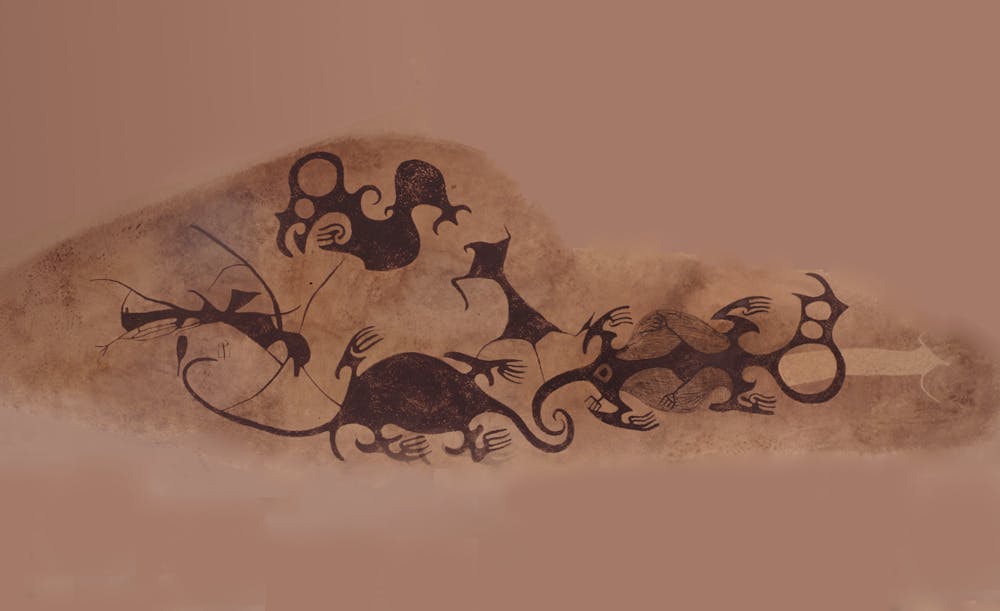 Some interviewees saw Māori myths as a way to live in harmony with the world.
Getty Images
Some interviewees saw Māori myths as a way to live in harmony with the world.
Getty Images
What it means to be Māori is changing
The emergence of “non-religious” as a growing sector of the Māori community poses both challenges and opportunities to the ideas of what it is to be Māori and the development of New Zealand.
If we see ourselves progressing as a “bi-cultural” Treaty/Tiriti-enhanced nation, it stands to reason we need to be able to identify the two cultures clearly.
But there is the opportunity to develop more quickly without identity “membership” based on religious affiliation or non-affiliation.
Within the community, there is a spectrum of views about the significance of religious or spiritual beliefs to Māori identity.
On one end, there are those who ask whether it is even possible to be Māori if one is not “religious” or “spiritual” in some shape or form.
At the other, there are those who distinguish between culture and religion, and argue Māori development can be more easily enhanced if one is freed from the constraints of religious belief.
Read more: Kiwiana is past its use-by date. Is it time to re-imagine our symbols of national identity?
The former speaks to a “traditional” and conservative view of being Māori; the latter to notions of changes in cultures, the impact of the colonial experience, modernisation, and different ways of being Māori.
Our research highlights the diversity of non-religion among Māori, which is neither reflected in representations of Māori (for instance in education), nor considered in Māori-Crown relations.
While there is little difficulty in identifying the Crown in Treaty negotiations, the emerging “no religion” sector of the Māori community adds new layers of complexity to who the Treaty partner is. Importantly, is being spiritual or religious a prerequisite to being a Māori?
Authors: Masoumeh Sara Rahmani, Lecturer Study of Religion, Te Herenga Waka — Victoria University of Wellington

















