Renewable projects are getting built faster – but there’s even more need for speed
- Written by Thomas Longden, Senior Researcher, Urban Transformations Research Centre, Western Sydney University
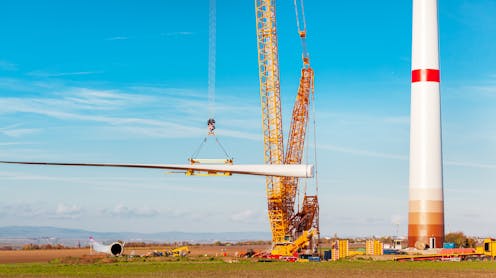
How long does it take to build a solar or wind farm? It’s a simple question with wide implications. To reach our ambitious 82% renewable energy target by 2030, we have to build many new projects – and start them soon.
In 2022, renewables hit a new high of 36% of Australia’s total electricity production, double that of 2017. That’s good – but there’s a long way to go.
Hitting the national target will require building about 40 wind turbines (7 megawatts) every month, and 22,000 solar panels (500 watt) every day.
At the start of the year, climate minister Chris Bowen called on all levels of Australian government to speed up planning decisions for renewable energy projects.
Reaching our target depends on one little-researched factor: completion time.
Solar and wind projects are built much faster than large fossil-energy plants. But the pre-construction approval process can be complex and slow projects down. In new research, my colleague and I found completion times have fallen significantly in recent years. But we need to go even faster to achieve the 2030 target.
Read more: Renewables are cheaper than ever yet fossil fuel use is still growing – here’s why
How long does it take to complete renewable energy projects?
Very few studies have explored renewable energy lead times across a group of renewable projects in Australia or elsewhere. We investigated completion times for 170 onshore wind and solar projects completed in Australia between 2000 and 2023.
Using a data set we built, we found welcome news: Australian renewable projects are being built significantly faster.
Taking an onshore wind farm from idea to reality now takes about 53 months. This is substantially faster than wind farms started before 2016, which took more than 88 months. Obtaining pre-construction approvals and planning took up most of that time.
Solar projects now take about 41 months. It used to be double that, at up to 83 months before 2011.
Overall, there has been a decrease in solar lead times. Due to recent regulatory changes, the time taken for the construction and final stages has increased from 18 months to 21 months.
What does it take to build a solar or wind farm?
We break project lead times down into three stages:
1. Pre-construction – the developer designs the project and seeks approvals
2. Building and connecting – the time between starting construction and connecting to the grid to supply energy for the first time
3. Getting commissioned – this final stage involves obtaining a performance standard from the Australian Energy Market Operator. Essentially, a new renewable plant has to be able to perform as expected and pass a series of tests. In our study, this stage starts at the time of first generation and finishes when a site generates at least 80% of its total capacity.
Why can lead times differ?
Passing through all three stages can be smooth – or fraught. While build times are improving, some projects can get stuck in development for years, making it seem harder than it is.
Delays can come from seeking approvals from multiple authorities and difficulties in accessing and connecting to the grid.
As lead times are rarely tracked across a large number of projects, outliers can skew how long we expect things take to complete. These outliers can get a lot of publicity.
Even when lead times are monitored and compared, the raw data isn’t made public. A renewable energy pipeline database should be public and provide historical examples for comparison. It could learn from the Australia and New Zealand Infrastructure Pipeline and should track and compare lead times.
How did development speed up?
It wasn’t a single policy or process change that drove these faster build times. But the improvements in lead times were driven by faster pre-construction planning and approval stages.
We found clear evidence some states are faster than others. South Australia – Australia’s top renewable state – had notably lower pre-construction lead times for both wind and solar, likely due to streamlined approvals. We found some evidence of fast approvals for solar in Victoria.
Changes in project ownership occurred often (38% of projects) but this had little impact on how long they took to complete.
One issue that has increased lead times in Australia was a 2017 change to how renewables are tested, introduced as a response to the South Australia statewide blackout of 2016. One aspect of this – the controversial “do no harm” system strength assessment – has since been removed.
These changes added an average of three months of delay for projects commencing construction after 2017.
We can go faster still
Even though Australian renewable lead times have shortened significantly since 2010, we should do more. After all, there are now only 71 months until 2030, when Australia’s renewables targets must be met.
Government approvals could be sped up if renewable developers can clearly see the steps to follow and deal with one central agency. All authorities involved should have maximum response times for key stages of the approval process.
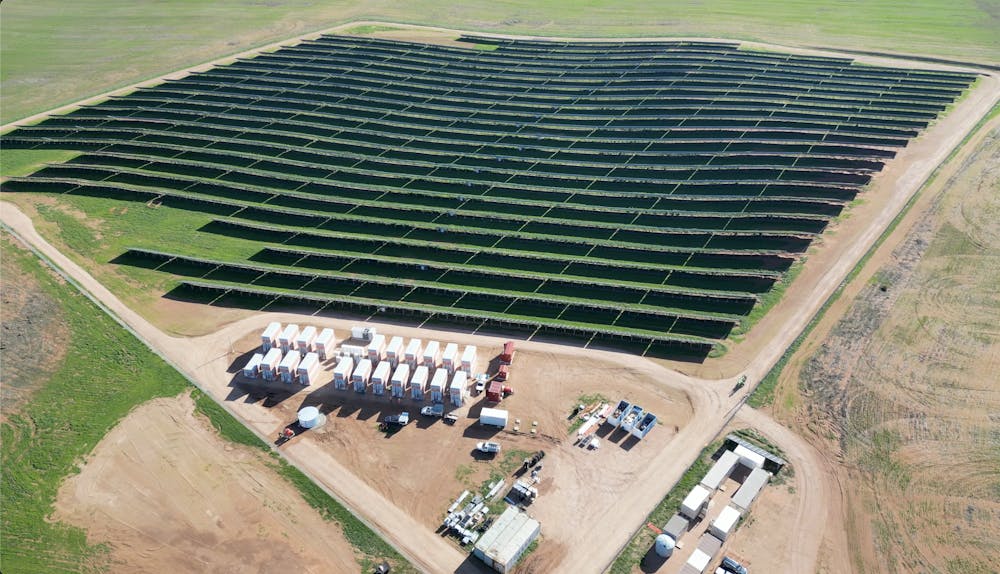
Suitable projects located close to existing projects could also be assessed as expansions and not new developments. This would notably streamline the process. Authorities are already allowing developers to do this when approving grid-scale batteries to be installed near solar farms.
Why do we need this data?
If you’re a renewable energy developer, it’s vitally important to know how long it normally takes to get a project up and running. It’s also a key piece of data for investors and policymakers.
That’s why we have provided clear detail of our data collection technique so it can be used by researchers, consultants, and government employees. Our data set is also available for download.
Is it still possible to hit 82% renewable energy by 2030? Yes – but based on our lead-time estimates, only if most projects start their planning phase in the next couple of years.
Read more: The road is long and time is short, but Australia's pace towards net zero is quickening
Authors: Thomas Longden, Senior Researcher, Urban Transformations Research Centre, Western Sydney University