

Why is everyone talking about natural sequence farming?
- Written by: Ian Rutherfurd, Associate Professor in Geography, University of Melbourne
On the eve of the recent National Drought Summit, prime minister Scott Morrison and deputy prime minister Michael McCormack visited Mulloon Creek near Canberra, shown recently on the ABC’s Australian Story. They were there to see a creek that was still flowing, and green with vegetation, despite seven months of drought.
Mulloon Creek was the legacy of a long collaboration between prominent agriculturalist Peter Andrews, and Tony Coote, the owner of the property who died in August. For decades they have implemented Andrews’ “natural sequence farming” system at Mulloon Creek.
Read more: Government to set up new multi-billion Future Drought Fund
Central to the system is slowing flow in the creek with “leaky weirs”. These force water back into the bed and banks of the creek, which rehydrates the floodplain. This rehydrated floodplain is then said to be more productive and sustainable.
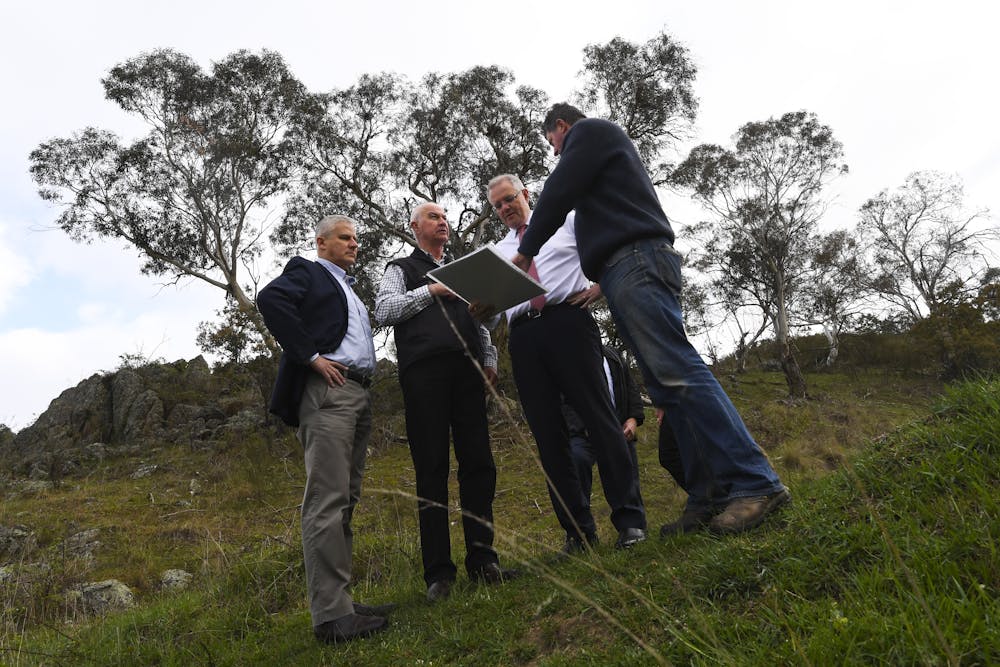 Scott Morrison and Michael McCormack speaking to Chairman of the Mulloon Institute Gary Nairn at the Mulloon Creek National Farm.
Lukas Coch/AAP
Scott Morrison and Michael McCormack speaking to Chairman of the Mulloon Institute Gary Nairn at the Mulloon Creek National Farm.
Lukas Coch/AAP
McCormack, who is also the minister for agriculture, was impressed and declared the success of Mulloon as a “model for everyone … this needs to be replicated right around our nation”. The ABC program suggested this form of farming could reduce the impact of drought across Australia. So, what is the evidence?
The promise of natural sequence farming
There are plenty of anecdotes but little published science around the effectiveness of natural sequence farming. What there is describes some modest floodplain rehydration, little change to stream flows, some trapping of sediment and some improvements in soil condition. These results are encouraging but not miraculous.
How much each of the different components of natural sequence farming contributes is not always clear, and the economic arguments for widespread adoption are modest. At present, there is not the standard of evidence to support this farming method as a panacea for drought relief, as proposed by the deputy prime minister.
Read more: Helping farmers in distress doesn't help them be the best: the drought relief dilemma
But if the evidence does emerge, why wouldn’t farmers simply adopt the methods as part of a sensible business model? Don’t all farmers want to do better in drought?
In the ABC show, and elsewhere, supporters of natural sequence farming argue that it is hard for farmers to adopt the methods because government regulations restrict use of willows, blackberries and other weeds, that they claim, are particularly effective in restoring streams.
Governments are correct to be wary of this call to use weeds, and some research suggests that native plants can do a similar job. This restriction on use of weeds might be galling for proponents of natural sequence farming but it should not be a fundamental impediment to adoption.
A more important frustration for natural sequence farming practitioners is how widely the approach can be applied. In Australian Story, John Ryan, a rural journalist, says:
I am sick of politicians, farmers groups, and government departments telling me that Peter Andrews only works where you’ve got little creeks in a mountain valley … I’ve seen it work on flat-lands, steep lands, anywhere.
Natural sequence farming arose in the attempt to restore upland valleys and creeks in southern NSW that were once environmentally valuable chains of ponds or swampy meadows. But these waterways have become deeply incised, degraded, and disconnected from their floodplains. Not only does this incision produce a great deal of sediment pollution, but it produces many agricultural problems.
Read more: Spring is coming, and there's little drought relief in sight
In reality, small and medium-sized stream systems across much of Australia have deepened after European settlement. If the leaky weirs of natural sequence farming are effective, then they could be applied across many gullied and incised streams across the country.
We’ve already been doing it
The good news is that landholders and governments have already been using aspects of natural sequence farming in those very gullies for decades to control erosion.
Since the 1970s, across the world, one useful method for controlling erosion has been grade-control structures. They were once made of concrete but are now usually made of dumped rock (called rock-chutes), and also logs.
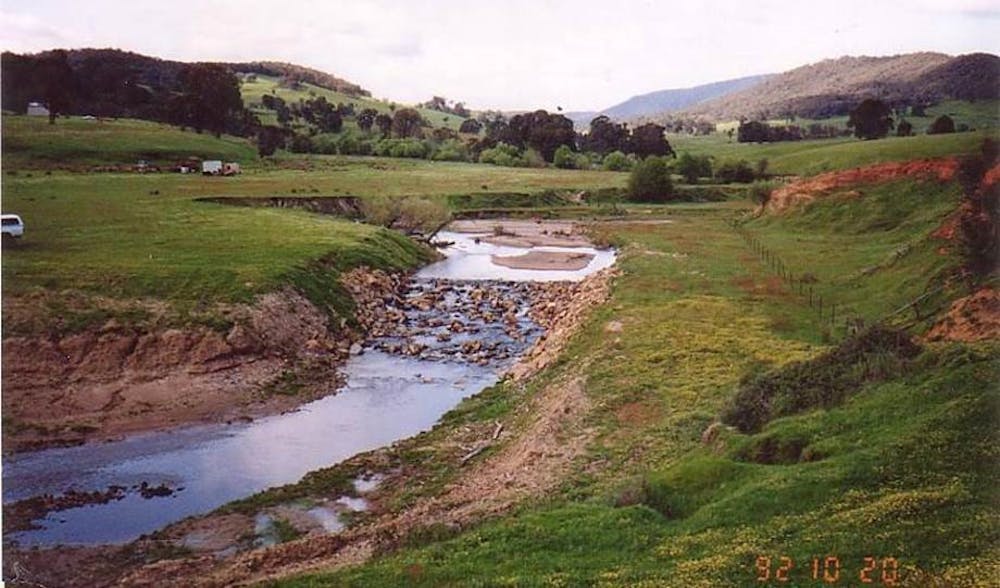 Rock chutes in Barwidgee Creek, 1992, Ovens River catchment, Victoria. Source: T McCormack NE Catchment Management Authority.
T McCormack NE Catchment Management Authority
Rock chutes in Barwidgee Creek, 1992, Ovens River catchment, Victoria. Source: T McCormack NE Catchment Management Authority.
T McCormack NE Catchment Management Authority
 The same creek in 2002. It is now heavily vegetated and has pools of water, just like Mulloon Park.
T McCormack NE Catchment Management Authority
The same creek in 2002. It is now heavily vegetated and has pools of water, just like Mulloon Park.
T McCormack NE Catchment Management Authority
These structures reduce the speed of water flow, trap sediment, encourage vegetation, and stop gullies from deepening. These are all goals of natural sequence farming using leaky weirs.
There are thousands of such structures, supported by government initiatives, across the Australian landscape acting as an unrecognised experiment in rehydration and drought protection.
Read more: We must strengthen, not weaken, environmental protections during drought – or face irreversible loss
Perhaps governments should already have evaluated these structures, but the rehydration potential of these works has not been recognised in the past. It is time that this public investment was scientifically evaluated.
We may find that natural sequence farming and the routine government construction of grade-control structures have similar effects on farmland and the environment.
But whatever the outcome, gully management is not likely to mark the end of drought in the Australian landscape.
Authors: Ian Rutherfurd, Associate Professor in Geography, University of Melbourne
Read more http://theconversation.com/why-is-everyone-talking-about-natural-sequence-farming-106232


















