

Australia wants navy boats with lots of weapons, but no crew. Will they run afoul of international law?
- Written by: Simon McKenzie, Lecturer in Law, Griffith University
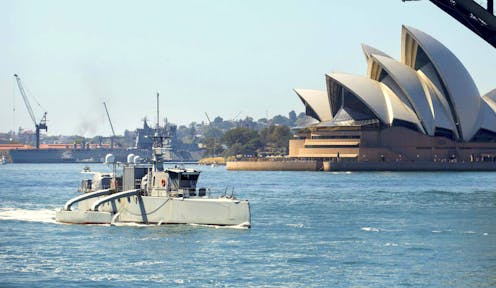
The Australian Navy is set to be transformed. On top of existing plans for nuclear submarines, the government yesterday announced a scheme for an “enhanced lethality surface combatant fleet” including six new “optionally crewed” vessels.
The advantages of these vessels, which can operate with or without a crew, are clear. They can operate for longer, with more stealth, and allow military personnel to avoid hostile environments.
Simple remote-controlled craft have been used since at least the 1920s, but increasingly sophisticated uncrewed vessels are becoming more common. Ukraine has used small uncrewed boats against Russian targets in the Black Sea, the United States plans to build a swarm of sea drones to protect Taiwan, and China is developing its own devices.
However, it is so far unclear how these vessels fit within existing international law. Unless their legal status becomes more clear, it may increase the risk of conflict with potentially serious consequences.
What’s the problem with uncrewed vehicles?
The key international treaty regulating the ocean – the United Nations Convention on the Law of the Sea – was negotiated in the 1970s and early 1980s, well before uncrewed vessels of the kind we see today were a realistic concern.
The convention balances the rights of coastal states with those of maritime powers by dividing the ocean into different zones, with different rules about what states can do in each zone. It’s a complicated system, but in general, states have more control over the use of the ocean closer to their own coasts.
Read more: Ukraine: how uncrewed boats are changing the way wars are fought at sea
Under the convention, foreign ships and vessels in waters close to the coasts of other states have certain navigational rights. These rights establish where ships can go in the ocean and what they can do when they are there.
Naval vessels also rely on these navigational rights to operate. In particular, where crucial sea lanes are very close to the coast – such as in the Malacca Strait between Singapore, Malaysia and Indonesia – ships or other vessels without navigational rights may not have a firm legal footing for passing through.
And in a crisis, it may not be feasible to avoid such waters by finding another route. If states had different views about what actions were permissible, it would increase the risk of conflict.
What counts as a ‘ship’?
So what does all this have to do with Australia’s “optionally crewed systems”?
The first problem is that the convention on the law of the sea gives navigational rights to “ships” and “vessels” without defining what they mean. There is an ongoing debate about whether these categories include uncrewed devices, or whether having people on board is required to qualify for navigational rights.

In my view, the more convincing argument is that uncrewed vessels like the ones Australia plans to purchase should count as ships and vessels.
The convention is designed to be the “constitution of the ocean”, with a very broad scope. This suggests we should also take a broad idea of what counts as a ship or vessel.
What counts as a ‘warship’?
However, uncrewed devices may face a more significant problem: can they be “warships”? This is a special legal category for vessels with the right to engage in belligerent activities – that is, engage in warfare and naval blockades.
Again, it is the lack of people on board that may cause issues. Unlike “ship” and “vessel”, the term “warship” is explicitly defined in the convention.
According to Article 29 of the convention, warships must be, among other things, under the command of a commissioned officer and manned by a crew under armed forces discipline. A plain reading of these requirements suggests that a vessel without people on board cannot be a warship and must stay out of conflict.
However, the reason “warship” is defined this way goes back to the 19th century, when states wanted to distinguish their own “warships” from the vessels of privateers. This is why the definition refers to the vessel being under command and with a crew that is part of the armed forces.
The point of the definition is to ensure the warship is controlled by a state. We should understand it as part of the effort by states to keep control of legally authorised violence, not an attempt to restrict certain rights to vessels with crews.
The future of uncrewed vessels and the law
How will this legal dilemma be resolved? The neatest solution – a revision to the convention to clarify the situation – is unlikely, because the political prospects of getting all 169 signatory states to agree to such a change are remote.
The stakes are high. The use of uncrewed vessels may plausibly lead to increased risk taking by states. It is easier to imagine the US sending a fleet of uncrewed vessels in a freedom of navigation operation close to the Chinese coast than risking a crewed fleet.
Read more: US military plans to unleash thousands of autonomous war robots over next two years
What can states do to reduce the risk of miscalculation and conflict?
States like Australia that plan to adopt this technology should look to develop international law in other ways. They can do this by putting their views about what uncrewed vessels are permitted to do on the record.
In doing so, they will contribute to the development of customary international law. Making Australia’s position on these devices more transparent will help create a legal regime that can cope with technological change.
Authors: Simon McKenzie, Lecturer in Law, Griffith University



















