

How a candidate's looks may be swinging your vote (without you even realising it)
- Written by: Rodrigo Praino, Senior Lecturer, College of Business, Government and Law, Flinders University
If someone asks you why you chose the election candidate you voted for, you will likely have a good answer. Maybe you agree with the candidate’s policy stances. Maybe you support his/her party. Maybe you are tired of the corruption, bad policies, or inaction of the people in power. These are all perfectly acceptable answers. One reason you probably will not mention is that you voted for this person because he or she is good-looking. Certainly not. This is not an acceptable answer.
Yet you probably did.
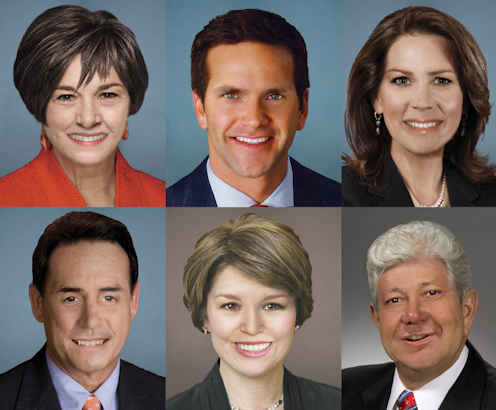
In a study just published by myself and Daniel Stockemer with the help of Victoria Police in Melbourne, we used data on elections to the US Congress to create the faces of six fictional candidates who were “ideal-looking” in terms of physical appearance. We then used statistical modelling and real election results to simulate what would have happened if the loser of some key races looked like one of our “ideal candidates”, but was otherwise identical to the real losing candidate.
In two-thirds of cases, the loser becomes a winner if he/she simply becomes better-looking. To put it simply, we find that if an election is competitive, candidate attractiveness can actually determine the result.
Research shows that candidate appearance travels across cultures, ignoring even racial and ethnic differences. It appears that there is a fairly standard idea around the world of what is an attractive candidate, and voters everywhere prefer good-looking politicians. Research has shown that beautiful politicians are advantaged in Australia, Germany, Finland, the United Kingdom and the United States.
But the story doesn’t end there. Scholars are still trying to understand all possible ramifications of the relationship between physical attractiveness and electoral success. But we know that ideology, institutions and voter behaviour all play a role in this fascinating relationship.
When it comes to ideology, recent research shows that conservative politicians benefit more from physical attractiveness. In other words, right-wing politicians are better-looking than left-wing politicians and, therefore, benefit more from the “beauty premium” at the ballot box.
In terms of institutions, a study published by Daniel Stockemer and myself last year shows that the electoral system plays a role in whether or not candidate attractiveness matters in elections.
In brief, candidate attractiveness matters in majoritarian electoral systems – that is, systems where voters cast their vote for a specific candidate. The impact of candidate attractiveness fades in list-based proportional systems, where voters are asked to cast a ballot for a political party.
We find no evidence that attractive candidates are placed higher in party lists, which means that political parties and their structures appear to be immune to the appeal of candidate attractiveness. The conclusion is that institutions play an important role in determining whether or not candidate attractiveness affects voters’ decision-making.
Finally, when it comes to voter behaviour, the “beauty premium” doesn’t manifest itself only as extra votes gained at the ballot box. In a study published last May, we found that attractive politicians get a “break” when they are involved in scandals. In particular, voters forgive attractive politicians involved in sex scandals, while politicians involved in financial scandals such as bribery or misappropriation of funds have a harder time at the ballot box after the scandal becomes public. Either way, this shows that voters not only generally vote for the most attractive candidate, but also are more willing to forgive those who look better.
So how about Donald Trump? This question pops up a lot, especially from people arguing that Trump is not the most physically attractive candidate to run for office. If we think hard enough, we can all think of numerous unattractive politicians who have been very successful at the ballot box all over the world. The key to understanding how this works is to focus on information.
Read more: President Trump will change the United States and the world, but just how remains to be seen
A few years ago, we ran an experiment using thousands of Canadian students at the University of Ottawa as research subjects. We found that if voters have adequate information about the candidates running for office, they tend to cast their ballot based on this information.
If, on the other hand, voters possess little or no information, then the better-looking candidate wins the election. We concluded that, in high-information elections, candidate attractiveness plays a smaller role than in low-information elections. This answers the Donald Trump question, in the sense that American presidential elections are high-information contests and, therefore, voters know more things about the candidates than their physical appearance, and thus vote accordingly.
The problem is that research also shows that voters all over the world have become less and less informed about politics. For instance, Australians seem to be incapable of answering basic questions about Australian politics; American university graduates in the 2000s knew less about politics than high school graduates in the 1950s; and European citizens do worse than chance in answering true-or-false questions about the European Union.
Read more: If it ain't broke, don't fix it: Australia should stay away from electronic voting
In other words, we should expect that candidate attractiveness will determine more and more electoral outcomes in the near future. Of course, the major issue with people voting for good-looking candidates is that physical appearance is completely devoid of any policy content. Voters have no guarantee whatsoever that they will end up with policies that they agree with and support if they vote for someone just because that person is attractive.
After years engaged in this line of research, I have never met someone who confessed to having voted for someone else because he/she was good-looking. At the same time, I am also convinced that people do exactly that, even if unconsciously.
The only solution to this problem is to educate voters about politics, institutions and current issues.
Authors: Rodrigo Praino, Senior Lecturer, College of Business, Government and Law, Flinders University
&media=https://www.modernaustralian.com/https://images.theconversation.com/files/247923/original/file-20181129-170232-1aogmk1.png?ixlib=rb-1.1.0&rect=14%2C3%2C2410%2C1992&q=45&auto=format&w=496&fit=clip&description=How%20a%20candidate's%20looks%20may%20be%20swinging%20your%20vote%20(without%20you%20even%20realising%20it) "Pin It")

















