

Modern Australian
The Times

West Antarctica’s ice sheet was smaller thousands of years ago – here’s why this matters today

  • Written by Dan Lowry, Ice Sheet & Climate Modeller, GNS Science
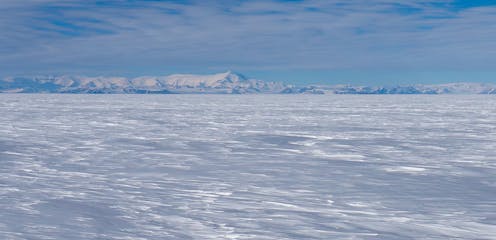
West Antarctica’s ice sheet was smaller thousands of years ago – here’s why this matters today

As the climate warms and Antarctica’s glaciers and ice sheets melt, the resulting rise in sea level has the potential to displace hundreds of millions of people around the world by the end of this century.

A key uncertainty in how much and how fast the seas will rise lies in whether currently “stable” parts of the West Antarctic Ice Sheet can become “unstable”.

One such region is West Antarctica’s Siple Coast, where rivers of ice flow off the continent and drain into the ocean.

This map shows the Siple Coast and its ice streams.
The Ross Ice Shelf holds back the flow of ice streams from West Antarctica’s Siple Coast. Journal of Geophysical Research, CC BY-SA

This ice flow is slowed down by the Ross Ice Shelf, a floating mass of ice nearly the size of Spain, which holds back the land-based ice. Compared to other ice shelves in West Antarctica, the Ross Ice Shelf has little melting at its base because the ocean below it is very cold.

Although this region has been stable during the past few decades, recent research suggest this was not always the case. Radiocarbon dating of sediments from beneath the ice sheet tells us that it retreated hundreds of kilometres some 7,000 years ago, and then advanced again to its present position within the last 2,000 years.

Figuring out why this happened can help us better predict how the ice sheet will change in the future. In our new research, we test two main hypotheses.

Read more: What an ocean hidden under Antarctic ice reveals about our planet's future climate

Testing scenarios

Scientists have considered two possible explanations for this past ice sheet retreat and advance. The first is related to Earth’s crust below the ice sheet.

As an ice sheet shrinks, the change in ice mass causes the Earth’s crust to slowly uplift in response. At the same time, and counterintuitively, the sea level drops near the ice because of a weakening of the gravitational attraction between the ice sheet and the ocean water.

As the ice sheet thinned and retreated since the last ice age, crustal uplift and the fall in sea level in the region may have re-grounded floating ice, causing ice sheet advance.

A graphic showing how Earth's crust uplifts and sea level drops near the ice sheet as it loses mass.
Earth’s crust uplifts and sea level drops near the ice sheet as it loses mass. AGU, CC BY-SA

The other hypothesis is that the ice sheet behaviour may be due to changes in the ocean. When the surface of the ocean freezes, forming sea ice, it expels salt into the water layers below. This cold briny water is heavier and mixes deep into the ocean, including under the Ross Ice Shelf. This blocks warm ocean currents from melting the ice.

A graphic showing the interaction between cold dense waters and warmer deep flows under the Ross Ice Shelf.
Top: Cold dense shelf water blocks warm circumpolar deep water from melting the ice. Bottom: Warm circumpolar deep water flows under the ice shelf, causing ice melting and retreat. AGU, CC BY-SA

Seafloor sediments and ice cores tell us that this deep mixing was weaker in the past when the ice sheet was retreating. This means that warm ocean currents may have flowed underneath the ice shelf and melted the ice. Mixing increased when the ice sheet was advancing.

We test these two ideas with computer model simulations of ice sheet flow and Earth’s crustal and sea surface responses to changes in the ice sheet with varying ocean temperature.

Because the rate of crustal uplift depends on the viscosity (stickiness) of the underlying mantle, we ran simulations within ranges estimated for West Antarctica. A stickier mantle means slower crustal uplift as the ice sheet thins.

The simulations that best matched geological records had a stickier mantle and a warmer ocean as the ice sheet retreated. In these simulations, the ice sheet retreats more quickly as the ocean warms.

When the ocean cools, the simulated ice sheet readvances to its present-day position. This means that changes in ocean temperature best explain the past ice sheet behaviour, but the rate of crustal uplift also affects how sensitive the ice sheet is to the ocean.

Three polar tents set up on the Ross Ice Shelf.
Changes in ocean temperature best explain the retreat of West Antarctica’s ice sheet in the past. Veronika Meduna, CC BY-SA

What this means for climate policy today

Much attention has been paid to recent studies that show glacial melting may be irreversible in some parts of West Antarctica, such as the Amundsen Sea embayment.

In the context of such studies, policy debates hinge on whether we should focus on adapting to rising seas rather than cutting greenhouse gas emissions. If the ice sheet is already melting, are we too late for mitigation?

Read more: We can still prevent the collapse of the West Antarctic ice sheet – if we act fast to keep future warming in check

Our study suggests it is premature to give up on mitigation.

Global climate models run under high-emissions scenarios show less sea ice formation and deep ocean mixing. This could lead to the same cold-to-warm ocean switch that caused extensive ice sheet retreat thousands of years ago.

For West Antarctica’s Siple Coast, it is better if we prevent this ocean warming from occurring in the first place, which is still possible if we choose a low-emissions future.

Authors: Dan Lowry, Ice Sheet & Climate Modeller, GNS Science

Read more https://theconversation.com/west-antarcticas-ice-sheet-was-smaller-thousands-of-years-ago-heres-why-this-matters-today-225670

Locksmith Services: Why Professional Security Solutions Matter More Than Ever

Security is a critical concern for homeowners, businesses, and vehicle owners alike. Whether it involves protecting a property, replacing damaged lo...

Why Tooth Fillings Are Important For Protecting Damaged Teeth

Cavities and minor tooth damage are common dental problems that can worsen if left untreated. Professional tooth fillings help restore damaged teeth, ...

The Connection Between Visibility and Driver Confidence

Operating a vehicle safely requires an immediate, uncompromised stream of visual information from the surrounding road environment. A driver's decis...

Important Things To Know Before Starting An SMSF Setup

Planning for retirement requires careful financial decisions, and many Australians are now looking for more direct control over how their superannua...

Why Retail Cleaning Plays a Key Role in Customer Experience and Business Success

Professional retail cleaning services are an essential part of maintaining a welcoming, safe, and professional environment for customers and staff...

Simple Ways to Make a Commercial Property More Appealing to Buyers

Selling or leasing a commercial property isn’t just about listing the square metres, taking a few photos and waiting for the right person to appea...

What Café Owners Should Know Before Upgrading Their Display Setup

A café display fridge does a lot more than keep cakes cold and sandwiches fresh. It quietly shapes the way customers browse, the way staff move beh...

Creating a Backyard That Feels Comfortable All Year Round

A great backyard doesn’t need to be huge, expensive or perfectly styled. Most of the time, the spaces people actually use are the ones that feel e...

How Homeowners Can Make Smarter Energy Decisions Before Upgrading

Energy upgrades used to feel like something you only looked into after a power bill gave you a nasty surprise. These days, though, more homeowners a...

Why Retail CX Breaks During Peak Sales Events and How to Prevent It

Retail customer experience has become one of the most important drivers of revenue growth, especially during high-intensity sales periods. However, ev...

15 South Indian Dishes Everyone Should Try

If your only experience of "Indian food" is butter chicken and garlic naan, South Indian cuisine is going to feel like discovering an entirely new c...

What Every Homeowner Should Know About Roof and Drainage Maintenance

A home's roof and drainage system work together every day to protect the property from water damage. While many homeowners focus on visible areas such...

From Plans to Priced Quote: The Estimating Workflow Most Builders Skip

For a small one-off job, an experienced builder can size up the materials in their head. The problem is that most jobs are not small one-off jobs, and...

Organisational Experts Share Their Tips for Achieving a Clutter-Free Kitchen

They say the kitchen is the heart of a house which means a clutter-free kitchen not only makes your home in general look nicer, it also makes cookin...

10 Creative Ways AI Image Extenders Are Transforming Digital Content Creation in 2026

Introduction Artificial intelligence continues to reshape the digital landscape, and one of the most exciting innovations in 2026 is the rise of AI i...

What to Do When You're Arrested in Victoria

Most people have thought about this in the abstract. A knock at the door, a hand on the shoulder, a car pulled over on the Hume. In the abstract, th...

Common Financial Disputes During Separation

Separation hits on many levels, not just emotionally. When a partnership ends, untangling the financial side — assets, debts, and everything built t...

Why Posting More Content is Killing Your Brand

More content. More often. More platforms.Most brands have been running this playbook for three years. Most brands have nothing to show for it.Not be...
















