

Longer-lasting ozone holes over Antarctica expose seal pups and penguin chicks to much more UV
- Written by: Sharon Robinson, Distinguished Professor and Deputy Director of ARC Securing Antarctica's Environmental Future (SAEF), University of Wollongong, University of Wollongong
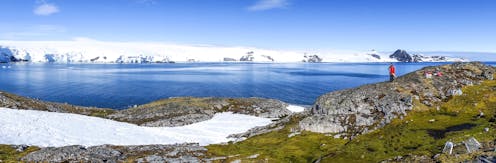
Over the last 25 years, the ozone hole which forming over Antarctica each spring has started to shrink.
But over the last four years, even as the hole has shrunk it has persisted for an unusually long time. Our new research found that instead of closing up during November it has stayed open well into December. This is early summer – the crucial period of new plant growth in coastal Antarctica and the peak breeding season for penguins and seals.
That’s a worry. When the ozone hole forms, more ultraviolet rays get through the atmosphere. And while penguins and seals have protective covering, their young may be more vulnerable.
Why does ozone matter?
Over the past half century, we damaged the earth’s protective ozone layer by using chlorofluorocarbons (CFCs) and related chemicals. Thanks to coordinated global action these chemicals are now banned.
Because CFCs have long lifetimes, it will be decades before they are completely removed from the atmosphere. As a result, we still see the ozone hole forming each year.
The lion’s share of ozone damage happens over Antarctica. When the hole forms, the UV index doubles, reaching extreme levels. We might expect to see UV days over 14 in summers in Australia or California, but not in polar regions.
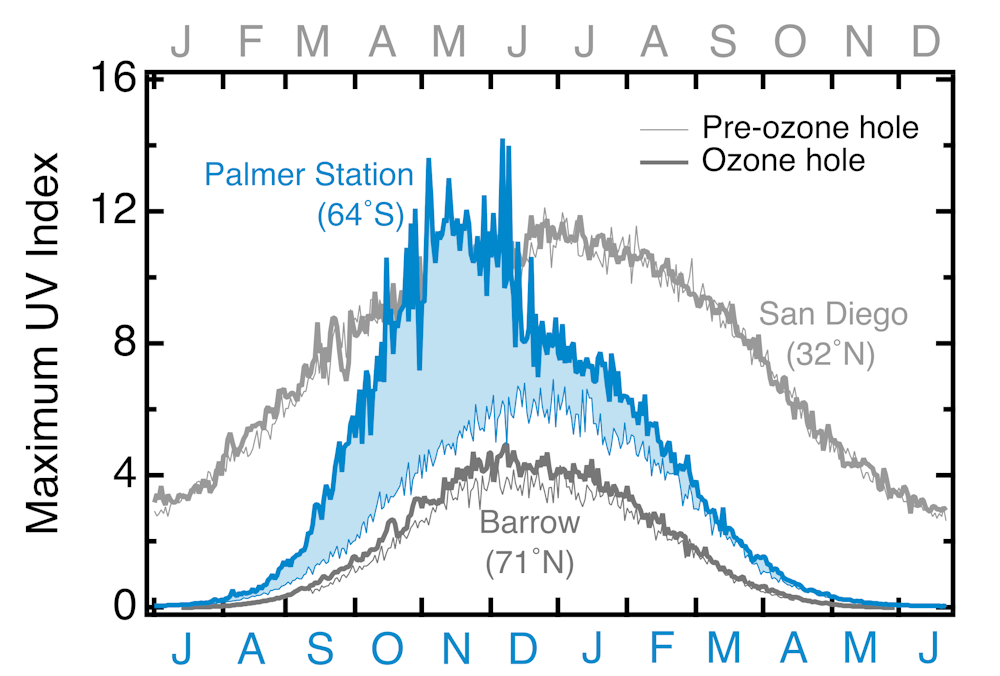
Luckily, on land most species are dormant and protected under snow when the ozone hole opens in early spring (September to November). Marine life is protected by sea ice cover and Antarctica’s moss forests are under snow. These protective icy covers have helped to protect most life in Antarctica from ozone depletion – until now.
Read more: Photos from the field: spying on Antarctic moss using drones, MossCam, smart sensors and AI
Unusually long-lived ozone holes
A series of unusual events between 2020 and 2023 saw the ozone hole persist into December. The record-breaking 2019–2020 Australian bushfires, the huge underwater volcanic eruption off Tonga, and three consecutive years of La Niña. Volcanoes and bushfires can inject ash and smoke into the stratosphere. Chemical reactions occurring on the surface of these tiny particulates can destroy ozone.
These longer-lasting ozone holes coincided with significant loss of sea ice, which meant many animals and plants would have had fewer places to hide.
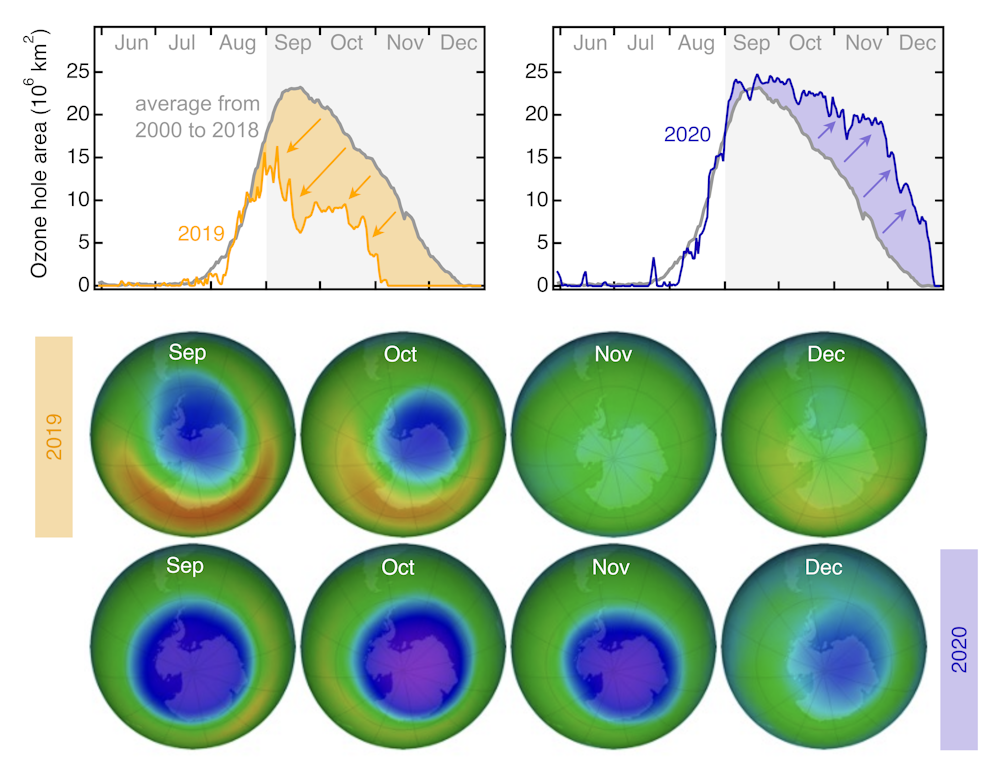 You can see how the size of the ozone hole in 2019 (top left) and 2020 (top right) differs from the mean ozone hole area between 1979 and 2018. Maps of ozone area for September to December show how the ozone hole disappeared early in 2019 (November, middle panel) but extended into December in 2020 (lower panel)
NASA Ozone Watch, CC BY-NC-ND
You can see how the size of the ozone hole in 2019 (top left) and 2020 (top right) differs from the mean ozone hole area between 1979 and 2018. Maps of ozone area for September to December show how the ozone hole disappeared early in 2019 (November, middle panel) but extended into December in 2020 (lower panel)
NASA Ozone Watch, CC BY-NC-ND
What does stronger UV radiation do to ecosystems?
If ozone holes last longer, summer-breeding animals around Antarctica’s vast coastline will be exposed to high levels of reflected UV radiation. More UV can get through, and ice and snow is highly reflective, bouncing these rays around.
In humans, high UV exposure increases our risk of skin cancer and cataracts. But we don’t have fur or feathers. While penguins and seals have skin protection, their eyes aren’t protected.
Is it doing damage? We don’t know for sure. Very few studies report on what UV radiation does to animals in Antarctica. Most are done in zoos, where researchers study what happens when animals are kept under artificial light.
Even so, it is a concern. More UV radiation in early summer could be particularly damaging to young animals, such as penguin chicks and seal pups who hatch or are born in late spring.
As plants such as Antarctic hairgrass, Deschampsia antarctica, the cushion plant, Colobanthus quitensis and lots of mosses emerge from under snow in late spring, they will be exposed to maximum UV levels.
Antarctic mosses actually produce their own sunscreen to protect themselves from UV radiation, but this comes at the cost of reduced growth.
Trillions of tiny phytoplankton live under the sea ice. These microscopic floating algae also make sunscreen compounds, called microsporine amino acids.
What about marine creatures? Krill will dive deeper into the water column if the UV radiation is too high, while fish eggs usually have melanin, the same protective compound as humans, though not all fish life stages are as well protected.
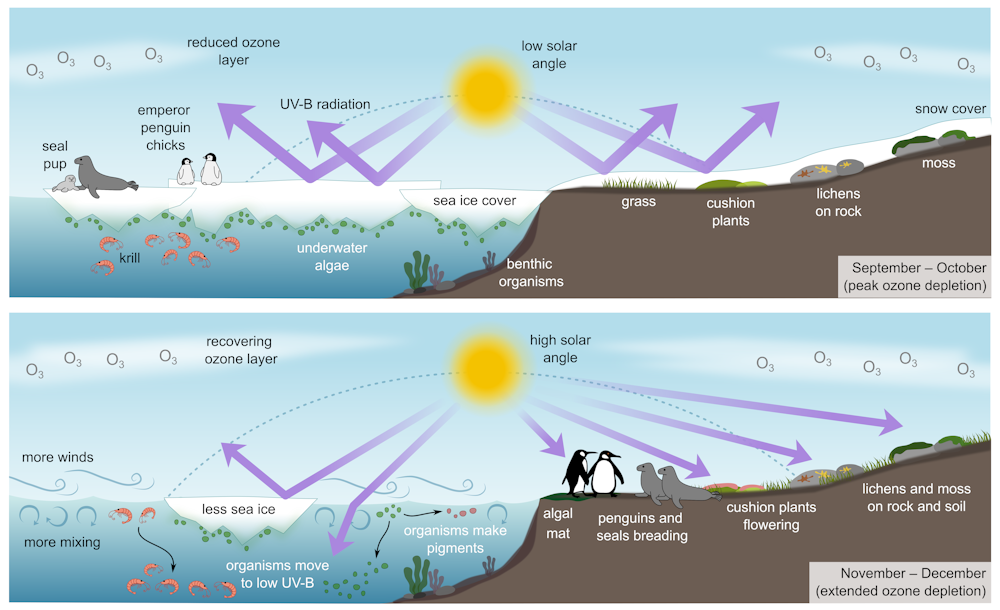 If the ozone hole peaks in October, most Antarctic wildlife is protected by snow or sea ice cover which helps reflect the UV rays (top panel). But if the ozone hole persists into December (lower panel) the snow and ice will have melted, and more animals and plants are present and exposed to UV.
Global Change Biology
If the ozone hole peaks in October, most Antarctic wildlife is protected by snow or sea ice cover which helps reflect the UV rays (top panel). But if the ozone hole persists into December (lower panel) the snow and ice will have melted, and more animals and plants are present and exposed to UV.
Global Change Biology
Four of the past five years have seen sea ice extent reduce, a direct consequence of climate change.
Less sea ice means more UV light can penetrate the ocean, where it makes it harder for Antarctic phytoplankton and krill to survive. Much relies on these tiny creatures, who form the base of the food web. If they find it harder to survive, hunger will ripple up the food chain. Antarctica’s waters are also getting warmer and more acidic due to climate change.
An uncertain outlook for Antarctica
We should, by rights, be celebrating the success of banning CFCS – a rare example of fixing an environmental problem. But that might be premature. Climate change may be delaying the recovery of our ozone layer by, for example, making bushfires more common and more severe.
Ozone could also suffer from geoengineering proposals such as spraying sulphates into the atmosphere to reflect sunlight, as well as more frequent rocket launches.
If the recent trend continues, and the ozone hole lingers into the summer, we can expect to see more damage done to plants and animals – compounded by other threats.
We don’t know if the longer-lasting ozone hole will continue. But we do know climate change is causing the atmosphere to behave in unprecedented ways. To keep ozone recovery on track, we need to take immediate action to reduce the carbon we emit into the atmosphere.
Authors: Sharon Robinson, Distinguished Professor and Deputy Director of ARC Securing Antarctica's Environmental Future (SAEF), University of Wollongong, University of Wollongong


















