

Species living closely together in symbiosis is far older and way more common than you might think
- Written by: Gregory Moore, Senior Research Associate, School of Ecosystem and Forest Sciences, The University of Melbourne
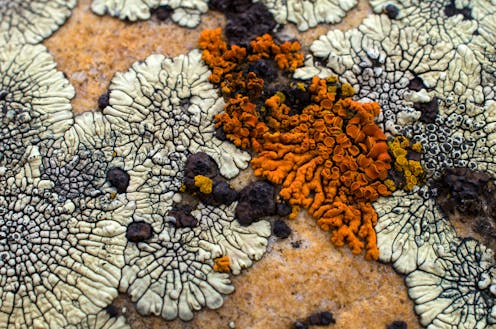
Once known only to those studying biology, the word symbiosis is now widely used. Symbiosis is the intimate relationship of different species living together. It’s much more common and older than many of us might realise.
One of the most common symbiotic relationships is between various species of algae and fungi, or between cyanobacteria (commonly known as blue-green algae though it’s not algae) and fungi. These paired species take the form of lichens.
The term symbiosis was first used in the 19th century to describe the lichen relationship, which was thought to be highly unusual. Since then, we’ve discovered symbiosis is the norm, rather than the exception. In fact, it has shaped the evolution of most life on Earth.
Read more: More than coral: the unseen casualties of record-breaking heat on the Great Barrier Reef
Symbiosis is almost everywhere we look
Lichens are diverse. They grow on tree trunks, on roof tiles and on ancient rocks.
The symbiosis of two different species allows both to survive in environments they might not be able to colonise otherwise. The fungus provides a suitable environment for its partnering species of algae or cyanbacteria to grow – it might otherwise be too exposed or dry, for example. In return, the fungus gets to share some of the carbohydrates produced by photosynthesis.
This is an example where both partners benefit from their relationship. It’s called mutualistic symbiosis.
Lichens are often very good indicators of air quality and more general ecosystem health. Their absence can indicate poor air quality. Because they absorb air pollutants such as heavy metals they can be used as biomonitors.
Read more: Mosses and lichens come to the rescue in battle against air pollution
In another very common example of mutualistic symbiosis, most plant species live in a close relationship with fungi in the soil. It’s known as a mycorrhizal association.
The plants harness the energy in sunlight to make sugar from water and carbon dioxide in the process called photosynthesis. The plants share this food with the fungus, which relies on them for survival. In return, the fine threads of the fungus greatly increase the surface area of the plant roots for absorbing water and nutrients.
Not all partners benefit
Not all symbiotic relationships benefit both partners.
In parasitic symbiosis, one partner benefits at the expense of the other. Examples include the fungi Phytophthora, Fusarium and Armilleria, which often kill their plant hosts.
In cases of commensalism, one organism benefits and the other neither gains nor loses. Small birds, for example, sometimes perch on large herbivores, eating insects disturbed by the larger animals.
As in any relationship, it’s possible things can change over time. For example, a mutualistic symbiosis between a tree and its mycorrhizal fungus might change to parasitism as the tree ages and declines, or if environmental conditions change.
Read more: At a time of giving and receiving, our many Australian mistletoes do it too
Symbiosis has driven evolution
Symbiosis has played a huge role in the evolution of life. The cells that make up the bodies of animals and plants are the result of symbiotic relationships.
Cells are complex. They contain structures called organelles, such as the nucleus (the control centre of the cell) and mitochondrion (involved in cellular respiration, which uses oxygen to break down food molecules to make energy available). Plant cells also contain chloroplasts, the sites of photosynthesis.
These complex cells evolved from much simpler, ancient forms of life that came together symbiotically.
The organelles of complex cells were once single-celled life forms that survived being engulfed by other simple cells. They formed a more complex and efficient cell, which has become the basic cell type for large multicellular life forms.
All large multi-cellular organisms living on Earth – animal and plant – possess this type of cell. It’s proof of how successful this evolutionary symbiotic strategy has been.
Cell respiration in both plant and animal cells involves mitochondria, which indicates they were engulfed early in evolutionary history. Later a cell type already containing mitochondria engulfed the chloroplast. This led to the evolution of complex plants.
Read more: Explainer: why can't humans photosynthesise?
When two become one
The incorporation of one cell type into another is called endosymbiosis. It allowed cells and parts of cells to become highly specialised. This specialisation improved their efficiency and capacity to survive under a wider range of conditions.
When I was a postgraduate botany student in the late ’70s, colleagues one day brought samples of common sea lettuce, Ulva latuca, to the laboratory, where I was studying photosynthetic physiology. Sea lettuce is a seaweed found in many shallow waters around the Australian coast.
We noticed a little marine slug grazing on the plant, so we popped it into our system for studying photosynthesis. To our surprise the slug was photosynthesising! We discovered the slug partly digested the sea lettuce cells, but some chloroplasts passed through the lining of the slug’s gut and continued to photosynthesise.
We thought we had made an important discovery, only to learn others had published similar work. After that I never doubted the validity of endosymbiosis, which was still a controversial theory at the time.
Symbiosis turns out to be the norm
We now know symbiosis is the norm for most organisms, including humans.
Our gut flora represent symbiosis on a massive scale. The diversity and huge numbers of bacteria living happily in our gut can have a huge impact on our general health and wellbeing. In the case of a healthy gut, both the person and the bacteria do well out of the relationship: a nice example of mutualistic symbiosis.
COVID focused public attention on viruses. But not all viruses are harmful; many actually benefit the organisms they infect. Some viruses even protect us from disease-causing viruses. For example, in people who are HIV-positive the disease progresses more slowly in those who are also infected with GB virus C (GBV-C).
Of course, the full range of symbiotic relationships with viruses is possible, from mutual benefit to an infected host suffering great harm. And, as with bacteria, there is accumulating evidence viruses have helped many species evolve, including our own.
An organism must live within a complex set of relationships to survive and thrive in any environment. Some relationships will be more positive than others, but it should not surprise that mutualistic symbiosis is so often the key to success.
Authors: Gregory Moore, Senior Research Associate, School of Ecosystem and Forest Sciences, The University of Melbourne


















