

how student protests shaped Australian universities
- Written by: Hannah Lewi, Professor, Architecture, The University of Melbourne
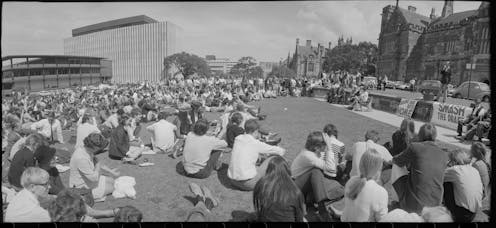
Australian university students are beginning to set up encampments on campus, in solidarity with college protesters in the United States. Protesters are calling for the divestment of funding from weapons manufactures and Israeli universities. But these protests are just the latest in a decades-long history of political action on Australian campuses.
We have been researching the legacy of protest and activism on campuses in the 1960s and ‘70s as part of a broader study on the building of Australia’s modern universities in the post-WWII decades.
Australian universities have long been sites of protest. These have encompassed issues directly impacting students and their learning, such as assessments and curriculum, to broader concerns resonating with international politics and social movements. And while Australian students engaged with international political issues, one specific feature of the postwar countercultural protest movement revolved around the perceived shortcomings of the new university campuses being built.
Today’s students join this legacy of activists who helped shape higher education and the Australian cultural landscape.

A 'breeding ground’ for social protest
News of international student protests in 1968 spread rapidly to Australia. Dramatic scenes of 20,000 students marching in Paris against capitalism and American imperialism and violent escalations at Berkeley in California on civil rights, free speech and the Vietnam war were watched intently.
Read more: Be realistic – demand the impossible: the legacy of 1968
Local activism in the early 1970s was equally transformative. Young Australians were engaged in debates around seismic social issues such as Vietnam, the weaponising of world conflicts, anti-capitalism, feminism, gender and race rights.
The Australian tertiary sector was experiencing rapid change. Just seven universities teaching 30,000 students in the late 1940s increased to more than 200,000 students by the early 1970s.
This expansion strained establishment aspirations of higher education as an elite preserve. Surges in student numbers and new campus building only helped to fuel dissatisfaction with perceived outmoded teaching, governance and pastoral care.
Bleak new campuses were characterised by some students as claustrophobic and impersonal. These concerns intersected with growing animosity towards functionalist “concrete architecture”, carrying associations of alienation and the destruction of what came before. This concern was shared by US, UK, French and Canadian students on new universities were experiencing similar expansion.
 Student fees and education protests, Sydney, March 1987.
Mitchell Library, State Library of New South Wales and Courtesy SEARCH Foundation, CC BY
Student fees and education protests, Sydney, March 1987.
Mitchell Library, State Library of New South Wales and Courtesy SEARCH Foundation, CC BY
In the face of more prevalent campus surveillance – alongside outdated gender segregation, curfews in colleges and prosaic matters like free car parking – new buildings and spaces were co-opted in unintended and uncontrolled ways. Students barricaded themselves into offices and disrupted lectures. Blank building facades and empty paved areas became backdrops for impromptu happenings, banners and protest artworks. Campus perimeters defined marching routes out into the neighbouring communities.
Campuses gained notoriety in the popular press as settings for transgressive social behaviours and a “breeding ground” for social protest movements, including the pivotal Aquarius Festival staged at Australian National University in 1971.
Protests across the country
The location of Australian universities had an impact on the nature and intensity of their social action.
At the older, more traditional sandstone campuses, protests were often enacted away from the campus and filtered into the surrounding urban areas.
In Brisbane in 1967, more than 4,000 rallying students and staff left the St Lucia campus and headed to the city to demonstrate against draconian laws curtailing public gatherings without a permit. This ended with an estimated 120 arrests.
From 1968 onwards, students in Sydney and Melbourne marched into city centres. These actions peaked with the Vietnam Moratorium rallies in Melbourne involving an estimated 70,000 people.
New postwar Australian campuses on the urban fringes were host to many actions. Monash University became known as Australia’s equivalent flashpoint to the modernist Nanterre campus in Paris.
Monash’s Forum, adjacent to the new slab blocks of the student union and administration buildings, was one of the more notorious and inhospitable open spaces. It was the site of mass sit-ins, temporary stages, lampooning of academic leadership and the odd Kombi van on the lawns.
La Trobe University was a potent site for action on its raw campus, created out of ex-agricultural and industrial areas in Melbourne’s north.
Today, it features extensive gardens and inspired landscape reserves. Before this masterplan matured, the reality of life was very different. The first 480 students commenced on campus with just the library administration and one residential college completed in 1967.
Spaces such as the university’s central Agora and the colleges saw ongoing protests and rallies, fuelled by reportedly heavy-handed policing.
A series of sit-ins occupied administration offices in July 1971. Students barricaded the entrances to deliver their deputation to the university council. They rallied against internal governance, the conditions in the new colleges (including the standard of food), alongside shared external issues amid competing political ideologies.
At the University of New England in New South Wales, protests coalesced over challenges to segregation in campus colleges. There was a growing gulf of social and religious attitudes between university authorities and the new student body.
 Students protesting as Senator Carrick, Minister for Education, visits the University of Wollongong, 1976.
University of Wollongong Archives/flickr, CC BY-NC-SA
Students protesting as Senator Carrick, Minister for Education, visits the University of Wollongong, 1976.
University of Wollongong Archives/flickr, CC BY-NC-SA
At Flinders University in South Australia, the central Registry Building was occupied in an epic month-long siege in 1974, sparked in part by a divisive Vice Chancellor accused of “working for the interests of US domination of Australia”.
Other complaints focused on exam assessments and out-of-touch academics. One resident of the new Flinders’ University Hall building wrote:
The Hall was designed on the basis that it should be as functional and inexpensive as possible. The result reminds one more of a prison than a college; long corridors with little cells on either side, grey brick walls wherever you go.
 Student protests at the University of Technology Sydney, 1988.
Mitchell Library, State Library of New South Wales and Courtesy SEARCH Foundation, CC BY
Student protests at the University of Technology Sydney, 1988.
Mitchell Library, State Library of New South Wales and Courtesy SEARCH Foundation, CC BY
The campuses of today
These and many other episodes of resistance, protest and activism on Australian campuses rapidly deescalated by the mid-1970s.
However, these events produced a new generation of voices that demanded a response, not only politically, economically and culturally, but also physically in terms of tempering the stark reality of many new campuses.
 Pro-Palestinian protesters at the University of Sydney. April 24, 2024.
AP Photo/Mark Baker
Pro-Palestinian protesters at the University of Sydney. April 24, 2024.
AP Photo/Mark Baker
Today, in the face of increasing financial pressures on students, renewed political, social and environmental tensions and escalating international conflicts, we are witnessing campuses again as potent settings for physical actions.
Authors: Hannah Lewi, Professor, Architecture, The University of Melbourne


















