

Wondering what Australia might look like in a hotter world? Take a glimpse into the distant past
- Written by: Tim Flannery, Honorary fellow, The University of Melbourne
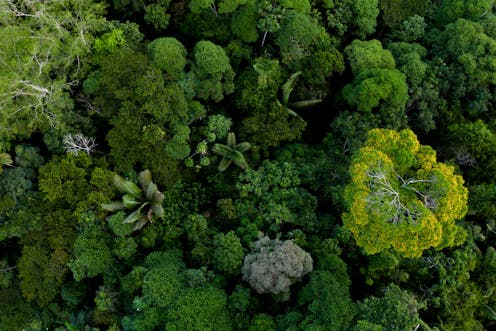
Current concentrations of carbon dioxide (CO₂) in Earth’s atmosphere are unprecedented in human history. But CO₂ levels today, and those that might occur in coming decades, did occur millions of years ago.
Wouldn’t it be useful to go back in time and see what Australia looked like during those periods in the distant past? Well, scientists – including us – have done just that.
These studies, which largely involve examining sediments and fossils, reveal a radically different Australia to the one we inhabit.
The continent was warmer and wetter, and filled with unfamiliar plant and animal species. It suggests Australia may be much wetter, and look very different, in centuries and millennia to come.
Then and now: measuring CO₂
Atmospheric CO₂ is measured in “parts per million” – in other words, how many CO₂ molecules are present in each million molecules of dry air.
The concentration of CO₂ influences Earth’s climate. The more CO₂ present, the warmer it gets.
Right now, atmospheric CO₂ is about 420 parts per million. This concentration last occurred on Earth between 3 million and 5 million years ago – a period known as the Pliocene.
If humanity keeps burning fossil fuels at the current rate, by mid-century CO₂ concentrations will be around 550 parts per million. This level was last approached 14 million to 17 million years ago, in the mid-Miocene period.
In both these periods, Earth was warmer than it is today, and sea levels were far higher.
In the Pliocene, research shows CO₂ was the cause of about half the elevated temperatures. Much of the rest was due to changes in ice sheets and vegetation, for which CO₂ was indirectly responsible.
In the mid-Miocene, the link between CO₂ and warmer temperatures is less certain. But climate modelling does suggest CO₂ was the primary driver of temperature increases in this period.
By examining the plants and animals that lived in Australia during these epochs, we can gain insight into what a warmer Australia might look like.
Obviously, the Pliocene and mid-Miocene far predate humans, and CO₂ concentrations in the atmosphere in those periods increased for natural reasons, such as volcanic eruptions. Today, humans are causing the CO₂ increases, and it’s happening at a much faster rate than in the past.
Read more: Humanity is compressing millions of years of natural change into just a few centuries
Australia in the Pliocene
The fossil and sediment record from the Pliocene period in Australia is limited. But the available data suggest much of the continent – and Earth generally – was more humid and warm than today. This helped determine the species that existed in Australia.
For example, the Nullarbor Plain, which stretches from South Australia to Western Australia, is today extremely dry. But studies of fossilised pollen show during the Pliocene it was home to Gymea lilies, banksias and angophoras – plants found around Sydney today.
Similarly, the western Murray-Darling Basin is today largely saltbush and grassland. But fossil pollen records show in the Pliocene, it was home to araucaria and the southern beech – rainforest trees found in high-rainfall climates.
And preserved remains of marsupials dating back to the Pliocene have been found near Hamilton in western Victoria. They include a dorcopsis wallaby – the nearest living relative of which lives in New Guinea’s ever-wet mountains.
Hot and moist in the mid-Miocene
A rich fossil and sediment record exists from the mid-Miocene. Marine sediments off WA suggest the west and southwest part of Australia was arid. In contrast, the continent’s east was very wet.
For example, the Riversleigh World Heritage area in Queensland is today a semi-arid limestone plateau. But research has found in the mid-Miocene, seven species of folivorous ringtail possums lived there at the same time. The only place more than two ringtail possum species coexist today is in rainforests. This suggests the Riversleigh plateau once supported a diverse rainforest ecosystem.
Similarly, McGraths Flat, near Gulgong in New South Wales, is today an open woodland. But mid-Miocene fossils from the site include rainforest trees with pointed leaves that help shed water.
And mid-Miocene fossils from the Yallourn Formation, in Victoria’s Latrobe Valley, also include the remains of rainforest plants. Before colonisation it supported eucalypt forests and grasslands.
This evidence of rainforest suggests far wetter conditions in the mid-Miocene than exist today.
An uncertain future
You may be wondering, when climate change projections tell us Australia will be drier in future, why we are suggesting the continent will be wetter. We concede there is a real contradiction here, and it requires further research to unravel.
There’s another important point to note. While conditions in the Pliocene or Miocene can help us understand how Earth’s systems respond to elevated CO₂ levels, we can’t say Australia’s future climate will exactly replicate those conditions. And there are lags in the climate system, so while CO₂ concentrations in the Pliocene are similar to today’s levels, Earth hasn’t yet experienced the same extent of warming and rainfall.
The uncertainty comes down to the complexities of the climate system. Some components, such as air temperature, respond to increased CO₂ levels relatively quickly. But other components will require centuries or millennia to fully respond. For example, ice sheets over Greenland and Antarctica are kilometres thick and as big as continents, which means they take a long time to melt.
So, even if CO₂ levels remain high, we shouldn’t expect a Pliocene-like climate to develop for centuries or millennia yet. However, every day we add CO₂ to Earth’s atmosphere, the climate system moves closer to a Pliocene-like state – and it cannot be easily turned around.
Authors: Tim Flannery, Honorary fellow, The University of Melbourne


















