

There are lessons to be drawn from the cracks that appeared in Sydney's Opal Tower, but they extend beyond building certification
- Written by: Geoff Hanmer, Adjunct Lecturer in Architecture, Univeristy of NSW, UNSW
The reasons for the cracked concrete that triggered the evacuation – twice – of residents from Sydney’s Opal Tower over Christmas and the New Year are unknown and will take time to properly establish. Many commentators are jumping to the conclusion (yes that includes you, Senator Carr) that the problem is the result of the privatisation of building certification. Instead of being done by government or council inspectors, certification is now done by private contractors engaged by the developer.
It might well be a contributing factor, but what went wrong at Opal Tower is is much more complex than that. Making certification a government responsibility again won’t solve it.
Opal is unusual. Very few residential buildings in Australia have ever been evacuated due to construction defects, and fewer still because of structural cracking. The vast majority of construction defects in multi-unit residential buildings are waterproofing failures. Rather than creating short-term alarm, they create long-term misery. Because misery does not generate headlines, the problem of quality in multi-unit housing continues to be ignored by governments.
Most strata buildings are defective
Strata title allows each resident to own the space in which they live as well as a share of the common property including pipes and walls. It’s the way apartments are usually sold after they are developed.
We don’t have definitive, current data on the extent of defects in strata title buildings. Researchers from UNSW’s City Futures Research Centre have begun collecting the information for Sydney. But there are clear indications that defects are significant and widespread.
A 2012 study by City Futures surveyed 1,020 strata owners across NSW, and found 72% of all respondents (85% in buildings built since 2000) knew of at least one significant defect in their complex.
In 2017 a City of Sydney survey identified defects and maintenance as the top concern of owner occupiers of apartments, along with short-term letting through organisations such as Airbnb.
Unfortunately for those keen to leap to conclusions about certification, studies showed the same thing back in the early 1990s when certification was largely in the hands of local governments. In fact, studies have found the same thing ever since speculative housing became common in Australia, from the end of World War One.
In fact, ever since speculative housing development and investment has become common (after World War I in Australia), residential construction defects have been a concern both here and overseas.
The market for residential buildings is extremely competitive, and controlling the cost of construction is one of the key factors in making a profit. Sometimes, the urge to maximise profit dominates to the extent that both short and long-term construction failures are inevitable.
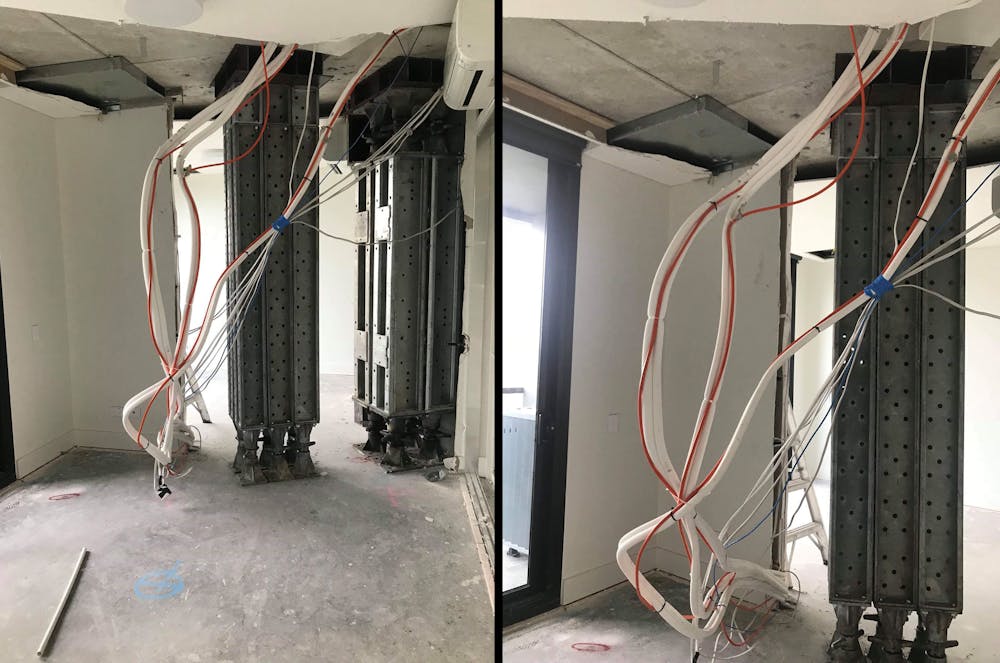 An apartment in Sydney’s Opal Tower with the ceiling and flooring removed and propping equipment installed. Supplied/AAP
It’s the consequence of cost control
There are, of course, reputable developers and builders, but reputation usually finishes last, undercut by less-reputable players who produce buildings that are slightly cheaper.
Defects in single-storey speculative houses with pitched roofs are probably just as common as defects in multi-unit dwellings with flat roofs, but they are much easier to fix because the houses are close to the ground and no strata committee is involved.
They are also much easier to find; a competent building inspection initiated by a purchaser is normally enough to protect the buyer. On the other hand, a building inspection of a single unit in a multi-unit development is highly unlikely to find defects which are located elsewhere in the common property of a building.
There are 653 apartments in the Meriton-developed Regis Towers, for example, which was the subject of a long-running legal action for defects.
Intervening at certification is too late
The only practical way to make multi-unit dwellings a good investment for the residents and a decent place to live is for government to take a pro-active role in driving quality throughout the design and construction process, not just at the end when the building is certified for occupation, or at the beginning when it gets a development approval.
It is a simple reality that no other actor in the construction process has the capacity to take this role. It is also simpler and cheaper to build in quality than to rectify defects.
Often, a $1 detail realised for fifty cents will cause endless grief and cost thousands of dollars to fix.
Reducing the amount of rectification required will improve sustainability outcomes by containing the amount of embodied carbon incorporated in the building.
If the building performs well, it will have a longer life and that will reduce the need to eventually replace it with a new building; again saving materials and improving the outcome for embodied carbon. It is worth remembering that 20 million tonnes of construction and demolition waste are produced in Australia each year.
Governments have been reluctant to intervene early
Governments have as good as ignored the problem of defects in multi-unit residential construction even though they have been aware of it for years.
This is particularly concerning because the state governments in NSW and Victoria have been busy spruiking this type of accommodation as the solution to the pressures of rising populations in Sydney and Melbourne. Given this, the protections for apartment owners under existing legislation are ludicrously slight.
Unfortunately, compliance with the National Construction Code (NCC) in its current form is no guarantee. There are so many ambiguities and grey areas in the NCC and in the way that it is applied that it is a guarantee of almost nothing, particularly when it comes to waterproofing.
Read more: Why investor-driven urban density is inevitably linked to disadvantage
A simple example is the construction of balconies with flat slabs, which is perfectly acceptable under the NCC. The floor slab is constructed as a single plane from the interior to the exterior of the building with the waterproof barrier at the balcony being provided by a masonry wall or a concrete ridge on top of the slab.
This design almost always leaks within a few years. The reliable solution is to cast the slab with a step, but this is more expensive and as a consequence is rare. Cut-price membranes under tiled terraces are also common, causing leaks, mould and misery, despite arguably complying with the provisions of the NCC.
Fortunately, there is plenty that government could do to improve quality of multi-unit construction without affecting prices much.
Five stars. Information could drive standards
One clear way forward is to make the construction quality of a building more transparent to buyers.
This could be achieved by introducing a similar sort of quality assurance scheme to the one government runs to improve safety in cars; a five-star rating.
People are free to buy a two-star car, but for obvious reasons, not many do, even if they are cheap. Similarly, it is unlikely that many people would buy a two-star unit.
It would be perfectly possible to star rate multi-unit housing for construction quality using an independent assessment body against a transparent set of criteria.
It’s been tried before
Such a quality assurance scheme was introduced by the now defunct Building and Construction Council (BACC) in NSW during the 1990s, but unfortunately foundered due to a lack of funding and will from Bob Carr’s government. This was a pity, as the scheme was designed to drive quality through the whole of the building process, from design to completion.
It still provides a perfectly valid model for a policy that would actually do something to improve multi-unit construction quality at a cost which is minimal in relation to the value of the benefits produced. If a building is built correctly in the first place, then owners will not need to rely on shonky fly-by-night builders and developers for rectification works nor need to claim against complex insurance policies.
If the NSW and Victorian governments are serious about having a greater proportion of people live in multi-unit developments, they have a responsibility to do something about their quality before we are left with a overhang of misery, leaks and failures. Just ask the residents and owners of Opal Tower.
Authors: Geoff Hanmer, Adjunct Lecturer in Architecture, Univeristy of NSW, UNSW


















