

What just happened to Bonza? Why new budget airlines always struggle in Australia
- Written by: Ian Douglas, Honorary Senior Lecturer, UNSW Aviation., UNSW Sydney
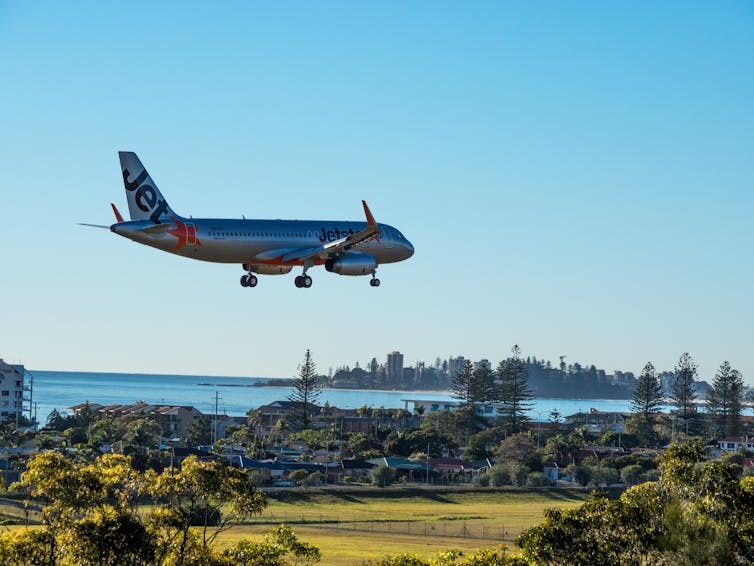
The history of budget jet airlines in Australia is a long road littered with broken dreams. New entrants have consistently struggled to get a foothold.
Low-cost carrier Bonza has just become the industry’s latest casualty, entering voluntary administration on Tuesday after abruptly cancelling all flights.
Losing the airline would be heartbreaking for the 24 regional Australian locations that were not connected directly by any other airline. It would also mean even less competition in a heavily concentrated domestic air travel market. Over 85% of routes are operated by just three airline groups.
But Bonza hasn’t just fallen into this situation by chance. Strategic missteps likely played a key role from the very beginning.
What went wrong
First, running an airline is an expensive business – any cost savings airlines can find are extremely valuable.
Bonza chose to enter the Australian market with a very small fleet of Boeing B737 jet aircraft. But these had no operating cost advantage over the B737s already flown by Qantas, Virgin and Rex. Bonza’s small fleet also lacked any scale advantage in scheduling aircraft or crew.
Second, to sell tickets, Bonza adopted a radically different “app first” approach. The only place customers could search for and book tickets directly was the official Bonza app. But this meant potential customers using conventional search tools – such as search engines or booking websites – often couldn’t find Bonza flights.
The fact Bonza struggled to gain traction on its routes to Gold Coast airport, which handles a sizeable 250,000 domestic passengers each month, underscores this issue with the company’s approach.
And third, although it served a unique range of locations, Bonza’s flight schedule across its network was far from optimal. In some cases, routes were flown only once weekly, compared to much more frequent gateway city services on Rex and QantasLink.
For European airlines like easyJet or Ryanair, less-than-daily flights to smaller tourist destinations might be viable. But these airlines have the scale and connectivity to offer customers alternative pathways across their networks. Unlike Bonza, small regional routes are not at the core of their business model.
Making an airline succeed
Bonza isn’t the first Australian budget carrier to fail, and likely won’t be the last. Why are so many new entrants doomed to fail?
Making a jet airline succeed hinges on optimising three key factors – market scale, airport access, and geography. For would-be budget airlines, Australia offers a brutal starting ground on all three.
Market scale
Low-cost carrier and ultra low-cost carrier airlines have successfully gained strong footholds in Europe, the US, and Southeast Asia. But these markets are orders of magnitude larger than Australia.
The US, for example, offers airlines a market of large cities across a large area. New York’s population is approaching 20 million, Chicago 9.6 million, Houston 7.1 million, and Miami 6.1 million.
The population of the European Union is close to 450 million. And if you include the UK, there are over 30 cities in Europe with populations over 1 million. Australian carriers have only a handful of cities on that scale.
Australia lacks both the population density of Europe, and the range of secondary airports that European low-cost carriers have leveraged to access nearby markets and to drive down operating costs.
After more than a year of operation, Bonza had only achieved an overall market share of about 2%.
Airport access
Airport access is the next key barrier facing low-cost and ultra low-cost market entrants. The main routes between large Australian cities are all in a corridor along the east coast, and the largest flow into Sydney.
Use of Sydney airport is heavily constrained, both by the incumbent operators who hold most of the slots, and by regulations that artificially limit the flow of aircraft at peak times to just 80 movements (take-offs or landings) per hour.
In contrast, London Heathrow, another constrained two-runway airport, delivers a capacity of 88 movements per hour.
Completion of the new Western Sydney Airport will provide some relief from this capacity constraint. But it will not alter the fact Sydney Airport operates under an imposed constraint on operations.
Geography
Geography is the third constraint in Australia. Unlike Europe, the US, or Southeast Asia, most of our major cities are in a line on the east coast. There is no hub to connect our major cities with smaller regional points.
Towns that are too distant for convenient rail or road links often have populations that are too small to support viable – let alone frequent – flights to the larger centres.
Some regional routes are successfully serviced by small “turboprop” aircraft. Operating these incurs a higher cost per passenger than the passenger jets connecting the major cities. But it makes no sense to fly larger aircraft on these routes if the planes are half empty.
A big loss for regional Australia
The combination of Australia’s small population, the capacity constraints imposed on Sydney Airport, the presence of strong incumbent airlines, and our linear east coast market make new entry difficult.
Virgin Blue occupied the space created by the collapse of Ansett. But Impulse, Tiger, Air Australia, Ozjet, and two versions of Compass were unsuccessful market entrants. Even Air New Zealand – which has the fleet, brand strength, and market access to support entering the market – chooses not to operate domestically in Australia.
Understanding why new entrants fail offers little consolation to underserved regional towns in Australia. But given Bonza’s small footprint, capital city travellers looking for more competition on the major east coast routes will hardly notice a change.
Authors: Ian Douglas, Honorary Senior Lecturer, UNSW Aviation., UNSW Sydney


















