An American writer with a European sensibility, Paul Auster viewed his society from an oblique angle
- Written by: Paul Giles, Professor of English, Institute for Humanities and Social Sciences, ACU, Australian Catholic University
With the passing of Paul Auster, who died of lung cancer on April 30 at the age of 77, the aesthetics of postmodernism retreated another significant step back into the past tense of history.
Auster became closely associated with postmodern style because of his highly self-conscious and self-reflexive fiction. In 2017, he wrote that he “wanted to turn everything inside out”.
Born into a Jewish family in New Jersey, Auster studied literature at Columbia University in New York, but then spent several years working as a translator in Paris. He was influenced not only by fellow Paris exile Samuel Beckett, but French exponents of the nouveau roman, or “new novel”, such as Alain Robbe-Grillet. Indeed, Auster’s own fiction, with its labyrinthine twists and turns, eventually became more popular in France than in the United States.
His first work, The Invention of Solitude, was published in the US in 1982. It was a memoir about his father, and the ironies involved in getting to know more about the circumstances of his father’s difficult life only after his death.
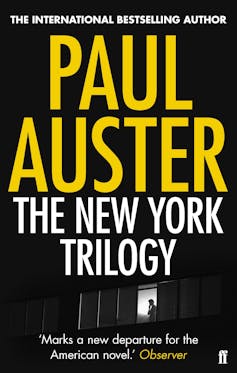
Auster’s career took off in the late 1980s, after the small Sun and Moon Press in Los Angeles persuaded Faber to reprint his New York Trilogy in 1987. This is still probably Auster’s best-known work. Cast in the form of a noirish detective story, like a pastiche of Raymond Chandler, it features a protagonist in New York trying to solve mysteries by deciphering the city’s maps.
But it also explicitly addresses larger questions of coherence. The detective here says “the world is in fragments” and “it’s my job to put it back together again”.

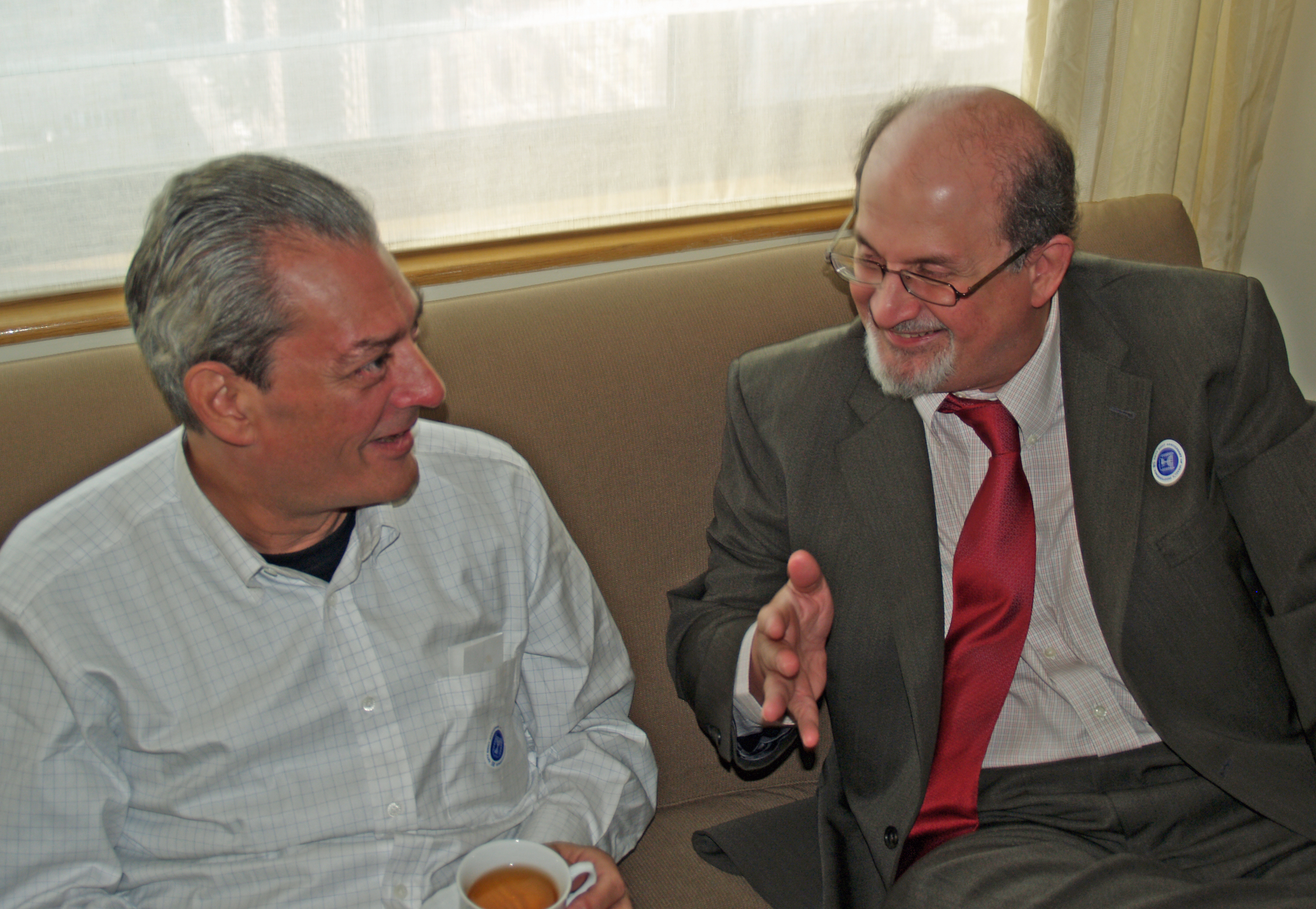
 Paul Auster, wife Siri Hustvedt, Colum McCann and Gay Talese at an event to support Salman Rushdie.
Sarah Yenesel/AAP
Randomness, chaos and nihilism
Perhaps the American writer to whom Auster was most indebted is Edgar Allan Poe.
Quinn, the detective in New York Trilogy, writes mystery novels under the pseudonym of William Wilson, the name of the main character in a Poe short story. There are many references in the New York Trilogy to other Poe works, such as The Narrative of Arthur Gordon Pym, in which the eponymous hero sets out for the Antarctic.
Like Auster, Poe enjoyed literary fame in France (where he was championed by the poet Charles Baudelaire) before being recognised as a serious writer in his native America. Auster also resembles Poe in the way he takes issue with the premises of the Transcendentalism that dominated American literature in the mid-19th century and is still influential today.
Ralph Waldo Emerson and Henry David Thoreau, both contemporaries (and enemies) of Poe, are cited plentifully throughout Auster’s work. But Auster’s “city of glass” (the title of the first story in his New York Trilogy) rotates Emerson’s “transparent eyeball” on its axis.
In The Poet (1844), Emerson writes: “As the eyes of Lyncaeus were said to see through the earth, so the poet turns the world to glass, and shows us all things in their right series and procession.”
Auster’s city of glass comprises not this kind of luminous transparency, but rather opacity, chance and contingency.
In an interview, Auster described the “seminal experience” of his life. He was 14 years old and at summer camp when he stood next to a boy who was killed by a lightning strike. The incident forever disrupted the sense of serendipitous “order” he grew up with in “postwar suburban New Jersey”.
He described himself as writing with a “very deep nihilism” informed by “the fact of our own mortality”, though this was countered to some extent by the “extraordinary happiness of feeling yourself alive”.
Paul Auster, wife Siri Hustvedt, Colum McCann and Gay Talese at an event to support Salman Rushdie.
Sarah Yenesel/AAP
Randomness, chaos and nihilism
Perhaps the American writer to whom Auster was most indebted is Edgar Allan Poe.
Quinn, the detective in New York Trilogy, writes mystery novels under the pseudonym of William Wilson, the name of the main character in a Poe short story. There are many references in the New York Trilogy to other Poe works, such as The Narrative of Arthur Gordon Pym, in which the eponymous hero sets out for the Antarctic.
Like Auster, Poe enjoyed literary fame in France (where he was championed by the poet Charles Baudelaire) before being recognised as a serious writer in his native America. Auster also resembles Poe in the way he takes issue with the premises of the Transcendentalism that dominated American literature in the mid-19th century and is still influential today.
Ralph Waldo Emerson and Henry David Thoreau, both contemporaries (and enemies) of Poe, are cited plentifully throughout Auster’s work. But Auster’s “city of glass” (the title of the first story in his New York Trilogy) rotates Emerson’s “transparent eyeball” on its axis.
In The Poet (1844), Emerson writes: “As the eyes of Lyncaeus were said to see through the earth, so the poet turns the world to glass, and shows us all things in their right series and procession.”
Auster’s city of glass comprises not this kind of luminous transparency, but rather opacity, chance and contingency.
In an interview, Auster described the “seminal experience” of his life. He was 14 years old and at summer camp when he stood next to a boy who was killed by a lightning strike. The incident forever disrupted the sense of serendipitous “order” he grew up with in “postwar suburban New Jersey”.
He described himself as writing with a “very deep nihilism” informed by “the fact of our own mortality”, though this was countered to some extent by the “extraordinary happiness of feeling yourself alive”.
 It is perhaps this sense of randomness and chaos, the perception that the world reverberates simply to what he called (in the title of a 1990 novel) “the music of chance”, that brought about Auster’s profound sense of alienation from the US reading public. He disliked the sentimental nostalgia for harmonious “closure” that he associated with mainstream America.
Though his writing is always lucid and affecting, it also incorporates a sense of the author “punning his world”, as he put it in his essay on the schizophrenic French writer Louis Wolfson. According to Auster, Wolfson looks out on his world “through a different lens” and translates it “into a different language”, so he “is able to see it with new eyes.”
Poe also experimented with the capacity of language to shift between alternative positions, reversing cause and effect. His sceptical materialism, at odds with the religious and philosophical idealism of Transcendentalists like Emerson and Thoreau, is one of the reasons why, even today, Poe is often regarded in the US as a renegade and marginal figure.
Auster’s oeuvre was broad and plentiful. It included a fine biography of the American writer Stephen Crane, several volumes of poetry, and the script for Smoke, a film about a Brooklyn cigarette-shop owner, which Auster also co-directed. He lived firmly within a literary and artistic milieu, both domestically and intellectually, and came to be closely associated with his home territory of Brooklyn.
But Auster also turned these artistic influences to productive ends. His work makes a virtue of indebtedness, drawing on the ideas and conceits of early writers, positioning itself carefully in relation to celebrated precursors. In this way, Auster made a genuine contribution to postmodern literature.
His overarching concern was always to question the philosophical as well as the nationalistic basis of self-styled individualism and originality. Challenging settled complacencies, his ludic, mordant and often very funny works of fiction exemplify the limitations as well as the capacities of the human imagination in an unredeemed world.
Authors: Paul Giles, Professor of English, Institute for Humanities and Social Sciences, ACU, Australian Catholic University
It is perhaps this sense of randomness and chaos, the perception that the world reverberates simply to what he called (in the title of a 1990 novel) “the music of chance”, that brought about Auster’s profound sense of alienation from the US reading public. He disliked the sentimental nostalgia for harmonious “closure” that he associated with mainstream America.
Though his writing is always lucid and affecting, it also incorporates a sense of the author “punning his world”, as he put it in his essay on the schizophrenic French writer Louis Wolfson. According to Auster, Wolfson looks out on his world “through a different lens” and translates it “into a different language”, so he “is able to see it with new eyes.”
Poe also experimented with the capacity of language to shift between alternative positions, reversing cause and effect. His sceptical materialism, at odds with the religious and philosophical idealism of Transcendentalists like Emerson and Thoreau, is one of the reasons why, even today, Poe is often regarded in the US as a renegade and marginal figure.
Auster’s oeuvre was broad and plentiful. It included a fine biography of the American writer Stephen Crane, several volumes of poetry, and the script for Smoke, a film about a Brooklyn cigarette-shop owner, which Auster also co-directed. He lived firmly within a literary and artistic milieu, both domestically and intellectually, and came to be closely associated with his home territory of Brooklyn.
But Auster also turned these artistic influences to productive ends. His work makes a virtue of indebtedness, drawing on the ideas and conceits of early writers, positioning itself carefully in relation to celebrated precursors. In this way, Auster made a genuine contribution to postmodern literature.
His overarching concern was always to question the philosophical as well as the nationalistic basis of self-styled individualism and originality. Challenging settled complacencies, his ludic, mordant and often very funny works of fiction exemplify the limitations as well as the capacities of the human imagination in an unredeemed world.
Authors: Paul Giles, Professor of English, Institute for Humanities and Social Sciences, ACU, Australian Catholic University