

how we brought Melbourne’s Merri Creek back from pollution, neglect and weeds
- Written by: Judy Bush, Senior Lecturer in Urban Planning, The University of Melbourne
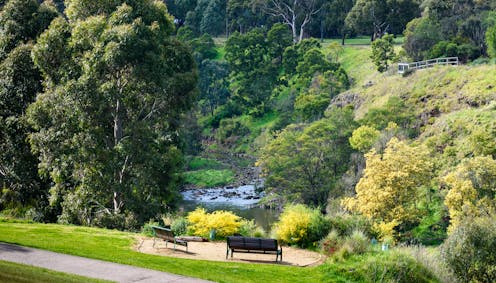
I met with a friend for a walk beside Merri Creek, in inner Melbourne. She had lived in the area for a few years, and as we walked beside the creek, past trees, native grasses, a small wetland echoing with frog calls, I talked about how it had looked before we started the site’s restoration around 25 years ago. She stopped in her tracks, astonished. “But I thought it had always been like this!” she said.
As we grapple with bad environmental news every day, we need to tell stories of ecological restoration – to speak of what’s possible, and also what’s not.
Merri Creek is not particularly long – just 70km. But because it threads through Australia’s largest city, linking the ecosystems of the Great Dividing Range with those of Port Philip Bay, it provides habitat of regional significance. The creek’s headwaters lie in the Great Dividing Range near Wallan. It flows through Melbourne’s northern suburbs to join Birrarung/Yarra River just upstream from Dights Falls in inner Melbourne. Its waters flow between rocky escarpment walls, through basalt plains clothed in native grasslands, and across a rocky creek bed.

From fishing grounds to industrial sewer
This is Wurundjeri Country. The region’s Traditional Custodians, the Wurundjeri, have cared for this Country for millenia, and their Custodianship continues. At the time of colonisation, the waterway was rich with biodiversity – woodlands, grasslands, billabongs and wetlands. The landscape was a cultural artefact, created and maintained by burning, digging, tending and harvesting.
Colonisation saw displacement, dispossession and disruption to Wurundjeri methods. As Melbourne grew, the creek’s fate worsened. Factories along its path dumped waste directly into its waters, while the sealed surfaces of the city caused flash flooding and washed litter into the water.
By the 1970s, the creek was weed-infested, polluted and threatened with further destruction from proposals to extend freeways and build culverts. Plans to connect the Hume Highway to the Eastern Freeway at Dights Falls would have completely obliterated the creek.
The beginning of restoration
It was these proposals that led people and communities to seek first to protect and then to restore the creek.
At first, these efforts were small. Friends groups and local citizen groups formed along the creek. In 1976, they came together with eight local councils to form the Merri Creek Coordinating Committee.
As interest and activity along the creek grew, the individual friends groups came together in 1989 to form Friends of Merri Creek, while the coordinating committee resolved to establish the Merri Creek Management Committee as an incorporated association of councils, the Friends of Merri Creek, Melbourne Water and the Victorian Department of Conservation and Natural Resources.
This coordinated approach gave the committee more resources, allowing it to employ a revegetation team and focus on ecological restoration. This was pioneering work in Australia.
The team worked to remove weeds such as prickly pear, African boxthorn, Chilean needle grass and Serrated tussock, replacing them with tubestock grown from locally collected seeds and cuttings of native grasses, wildflowers, shrubs and trees.
 This heavily weed infested site in North Coburg in 1990 has been transformed by weed control and replanting.
Merri Creek Management Committee, Author provided (no reuse)
This heavily weed infested site in North Coburg in 1990 has been transformed by weed control and replanting.
Merri Creek Management Committee, Author provided (no reuse)
Some areas along the creek required more drastic action, such as earthworks to restore the creek bank’s profile where rubbish dumping and building waste had destroyed the creek’s form.
 Once earthworks repaired the creek banks, plants could once again thrive.
Judy Bush, Author provided (no reuse)
Once earthworks repaired the creek banks, plants could once again thrive.
Judy Bush, Author provided (no reuse)
Volunteers and workers worked to restore wetlands away from the main channel to create habitat for pollution-sensitive frogs and aquatic insects such as damselflies. These creatures cannot survive the still-polluted water of Merri Creek’s main channel.
 Wetlands near the creek in Northcote have been restored.
Judy Bush, Author provided (no reuse)
Wetlands near the creek in Northcote have been restored.
Judy Bush, Author provided (no reuse)
Much restoration work relied on community involvement, with planting days organised up and down the creek so local residents could contribute to its restoration.
Today, the members of the committee are the six local governments covering its catchment, Friends of Merri Creek and the Wallan Environment Group.
Why has this partnership endured?
Efforts to restore Merri Creek have been largely successful – and have gone the distance. Why? There are several important reasons, as I have explored in my research.
For one, the management committee and the friends groups work in partnership, and often take complementary roles in protecting and advocating for the creek.
As volunteers, the Friends of Merri Creek take an active and vocal role in organising on-ground volunteer activities, monitoring biodiversity to contribute to citizen science efforts and acting politically by advocating and writing submissions to planning and decision-making processes.
 Kangaroo grass is the dominant species of Melbourne’s Western Basalt Plains. It’s returning to the creek as grasslands are restored.
Judy Bush, CC BY-NC-ND
Kangaroo grass is the dominant species of Melbourne’s Western Basalt Plains. It’s returning to the creek as grasslands are restored.
Judy Bush, CC BY-NC-ND
As an incorporated association, Merri Creek Management Committee employs skilled professionals such as the revegetation team, works with governments and agencies, and undertakes strategic planning and research.
Both the committee and the Friends have built links with the Wurundjeri’s Narrap natural resources team, as part of efforts to centre care for Country. They have both worked to build local connections and a sense of stewardship for communities near the creek, through community organising and collective action such as on-ground activities, planning and advocacy.
The result is palpable. If you go for a walk along Merri Creek these days, it’s hard to reconcile the reality now with its former life as an industrial sewer.
Frogs, birds, snakes, eels and insects are returning to the creek and the newly created wetlands. It’s even possible to glimpse a swamp wallaby, 5km from the heart of Melbourne. Locals show their love of the creek through painting, poetry and daily visits.
Job done? Not quite. There are always threats, ranging from design and construction of new suburbs in the creek’s northern reaches to inner-suburban dense development close to its banks. Floods bring litter and weed seeds directly into the creek’s environment. And industrial pollution flowing down drains or illegal clearing of vegetation require us to maintain active stewardship. Pollution in the creek’s sediments, including heavy metals, means true restoration is a long-term endeavour.
 Revegetation is well under way.
Judy Bush, Author provided (no reuse)
Revegetation is well under way.
Judy Bush, Author provided (no reuse)
Merri Creek is a peaceful place, an exciting place, a meditative place, a thriving place, a cultural place connecting to Wurundjeri custodianship and continuing care for Country, a place full of life, wonder and joy.
This story is part of Making a Difference, a new series on community efforts to restore nature. Read the other story here
Authors: Judy Bush, Senior Lecturer in Urban Planning, The University of Melbourne



















