

A ‘conservation conundrum’ – when rat control to conserve one species threatens another
- Written by: Victoria Florence Sperring, Research Officer, Monash University
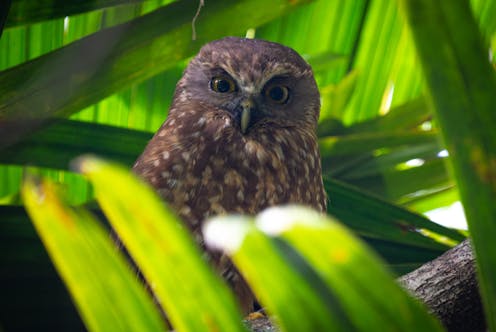
When pest rats and mice decimate populations of native species, pest control is a no-brainer. But what if baiting rats protects threatened songbirds, while poisoning critically endangered owls?
This is a question conservation managers are grappling with on tiny Norfolk Island, some 1,300 kilometres off the east coast of Australia. They’re not the only ones troubled by such conflicting priorities.
Rodents are implicated in the decline of at least 400 threatened species and 30% of bird, mammal and reptile extinctions worldwide. Unfortunately, the most effective rat baits can also kill birds of prey.
Our new research shows the critically endangered Norfolk Island morepork is eating even more rats and mice than previously thought. These birds of prey are being poisoned in the process. We clearly need a way to control or eradicate rodents without killing our native species.

The conservation conundrum on Norfolk Island
As its name suggests, the Norfolk Island morepork is found only on Norfolk Island. Just 25 birds are left in the world, with none held in captivity. The rate of successful breeding is extremely low.
In our new research, we examined the morepork’s diet in unprecedented detail.
We tracked seven owls, almost a third of the population, to collect their poo and pellets (coughed up like cats do with furballs) for analysis. First we studied the contents by sight, then we sent the samples off for DNA sequencing, to work out what they had been eating.
Every owl in our study had eaten rodents. Two owls had eaten house mice.
When a bird of prey such as a morepork or boobook eats a poisoned rodent, it can become very unwell or die. This is known as secondary poisoning.
During the course of our research, one sick morepork was found and rehabilitated. We named the owl Rashootin after Grigori Rasputin, the Russian mystic who was famously poisoned yet survived. But if Rashootin hadn’t been found by an islander, he would not have been so lucky.
Unfortunately we don’t know how many other moreporks suffer from secondary poisoning but there is anecdotal evidence it’s a problem. The Norfolk Island morepork chicks that hatched between 2011 and 2019 died from a case of suspected secondary poisoning. Elsewhere the incidence of secondary poisoning for boobooks, moreporks and larger Ninox species that eat rodents is well documented.
 One of two precious Norfolk Island morepork chicks that hatched in 2019.
Nick Bradsworth
One of two precious Norfolk Island morepork chicks that hatched in 2019.
Nick Bradsworth
An obvious solution would be to modify the use of rodent baits on Norfolk island. Perhaps baiting could be less frequent. Or less toxic baits could be used, to reduce the risk of killing non-target species.
But less toxic baits are not so good at killing rats.
Rat control is deemed necessary on Norfolk Island because the rats prey on other threatened species. In our previous research we found rats were the main cause of “nest failure” for all five songbirds found only on Norfolk Island. This means rats are typically responsible for the failure of these songbirds to rear chicks in any given breeding season. We found rats raided 39% of endangered Norfolk Island robin nests, eating either chicks or eggs.
Adding to the complexity of the challenge, the ranges of Norfolk Island moreporks and robins overlap almost completely at Norfolk Island National Park.
In summary, rat control is essential for the recovery of several threatened species on Norfolk Island, yet this same intervention poses a genuine threat to the tiny remaining morepork population.
How can land managers prioritise the conservation of one threatened species over another?
 Rats are known to prey on Norfolk Island robin Petroica multicolor eggs and young chicks.
Imogen Warren, Shutterstock
Rats are known to prey on Norfolk Island robin Petroica multicolor eggs and young chicks.
Imogen Warren, Shutterstock
A global issue
Introduced rats and mice cause problems everywhere. Rodent control is a common practice.
Most rat poisons are anticoagulants, which means they prevent blood clotting, causing the rodent to bleed to death internally.
Anticoagulants fall into two broad categories: first-generation and second-generation. First-generation baits need the rodent to eat multiple doses to prove fatal.
Second-generation baits are up to 1,000 times more toxic and can kill rodents after a single feed. But they take much longer to break down in the body and so are much more dangerous for animals that happen to eat the poisoned rodents.
The solution
We urgently need new methods to control or eradicate invasive rodents. These methods must also be effective and safe for non-target species.
In recognition of the threat to the morepork population, Norfolk Island land managers have already taken some measures to minimise the risk of secondary poisoning. Rat baiting during the morepork breeding season (October to February) has been restricted to first-generation and non-anticoagulant baits since 2015. Second-generation baits are used throughout the remainder of the year, but the quantity used and toxicity of the product has been reduced. Any further weakening of the baiting program would likely have serious consequences for the threatened songbirds.
Unfortunately our research shows moreporks are still finding lots of rats and mice to eat, year round. This could be putting the population at risk.
Outside of Norfolk Island, one alternative being investigated is baiting with cholecalciferol (vitamin D3), which raises blood calcium levels of the rats causing death through heart failure. This rodent control method has been shown to reduce the risk of secondary poisoning. However, further research is still required.
Non-toxic control methods such as traps can reduce rodent numbers in areas with large rodent populations. There are many different types of traps available now including models that reset themselves. These are also being trialled on Norfolk Island and elsewhere. But further development is required before this method can effectively keep rats at a low population size.
Emerging gene-drive technology promises to alter the DNA of the target population so they can no longer reproduce. Once perfected, this method would be highly effective and very safe for non-target species. However, it may be many decades before this approach is available. Many threatened species do not have decades to spare.
Our study shows further research is needed to find the optimal baiting strategy. We also strongly encourage land managers to continue exploring new approaches and innovative techniques to control rodents effectively and safely. Land managers everywhere need to think carefully about the side-effects of rodent control and use second generation anticoagulants only when necessary, for they may inadvertently be killing our beloved birds of prey.
Authors: Victoria Florence Sperring, Research Officer, Monash University


















