

First Nations imprisonment is already at a record high. Unless government policy changes, it will only get worse
- Written by: Thalia Anthony, Professor of Law, University of Technology Sydney
This article contains information on deaths in custody and the names of deceased people, and describes ongoing colonial violence towards Aboriginal and Torres Strait Islander people.
First Nations people in Australia are the most imprisoned people in the world. This unenviable record is consolidating rather than receding. In 2023, First Nations people accounted for 33% of the prison population – an all-time high.
This mass incarceration is highly disproportionate: Indigenous people make up only 3% of the country’s population, yet they are 17 times more likely than non-First Nations people to be imprisoned. We refer to this as “hyperincarceration”.
This situation is the culmination of centuries of racism, punitive policy and persistent failures to listen to Aboriginal and Torres Strait Islander people. But understanding the drivers of such high levels of incarceration is key to dismantling them. So how did we get here?
Colonial carceral legacies
Palawa Professor Maggie Walter notes that hyperincarceration of First Nations people can only be explained by properly exploring the state’s power relationship with First Nations people.
Hyperincarceration of First Peoples is a common feature of former British settler colonies such as Canada, the United States and New Zealand. This shared experience shows us First Peoples are not the problem. We should instead be paying attention to the colonial motivation for incarcerating First Peoples.

Of course, the mass imprisonment of First Nations people is not a new phenomenon. From the early 1800s to the mid-1900s, First Nations people were variously locked up in prisons (such as the infamous Rottnest Island (Wadjemup) prison in Western Australia), missions, reserves, orphanages and lock hospitals. The exclusion and control of First Peoples facilitated the colonial land grab and assimilated First Peoples who survived the massacres, diseases and deprivation of their food sources. Incarceration was a key tool in the colonial toolbox.
As the systems to control First Nations people under the various Aboriginal Protection Acts were dismantled and freedom of movement gradually provided from the 1960s, police ratcheted up arrests and detention of First Nations people. This was especially the case for public order offences and the trifecta of offensive language, resisting arrest and assaulting police.
Regulatory offences that otherwise warrant responses from the civil law, such as payment of a fine, also disproportionately result in criminal law enforcement against First Nations people. This is despite the Royal Commission into Aboriginal Deaths in Custody in 1991 identifying that mass penal incarceration of First Nations people was a direct contributor to deaths in custody.
The colonial tropes of First Nations deviancy and disorder have long been invoked to justify rule by the British, who considered themselves superior, civil and orderly. The application of discriminatory labels to First Nations people continues to inform police practices, demonstrated by an extensive 2022 report that highlighted endemic racism in the Queensland Police Force.
A failure of policy
The “law and order” mantra that has swept Australia since the 1990s has steadily driven up imprisonment rates. This is sometimes referred to as First Nations people being set up to fail. In reality, it’s policy that’s failing.
Challenges that ought to be dealt with through public health measures (the effects of trauma, mental illness and addiction) are instead criminalised. Coupled with systemic racism in criminal law processes, the state has created a perfect storm for increased First Nations imprisonment.
In 2017, the Australian Law Reform Commission forensically analysed racism at every stage of criminalisation. The data shows police are more likely to arrest and charge First Nations people, bail is more likely to be denied to First Nations people, all-white juries are more likely to convict First Nations people, and sentencing courts are more likely to imprison First Nations people.
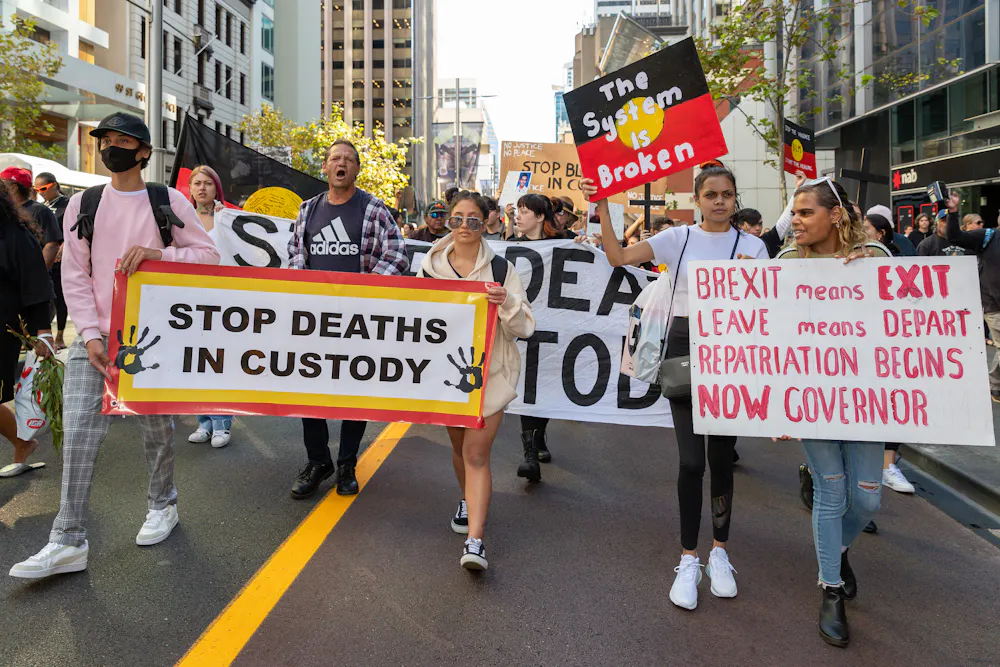 Protesters marked the 30th anniversary of the Royal Commission into Aboriginal Deaths in Custody in 2021.
Richard Wainwright/AAP
Protesters marked the 30th anniversary of the Royal Commission into Aboriginal Deaths in Custody in 2021.
Richard Wainwright/AAP
This coincides with a rapid growth of policing in Australia. In 2006, there were 44,809 police officers. Today there are 62,300.
The Northern Territory announced this month the recruitment of a further 200 officers. The NT Police Commissioner has indicated training hours will be reduced to support and accommodate the uptick.
Given recent evidence of senior officers in the NT police mocking Aboriginal people, the combination of police racism, an increase in police numbers and the lack of training is likely to make things worse. It’s already dire in the NT, with First Nations people constituting 88% of the imprisoned population, despite making up around 26% of the territory’s total population.
Jail instead of bail
Another major reason for such high rates of First Nations people behind bars is the dilution of the right to bail. A growing number of offences for which any accused is charged has a presumption against bail, including, for example, property crimes and drug crimes in Victoria. Couple these presumptions against bail with the higher level of policing of First Nations people, and the effect is a disproportionate number of First Nations people on remand without trial or sentence.
The inquest into the death in custody of Veronica Nelson found the bail laws contributed to her death and had a discriminatory effect. The inquest and campaigning of Nelson’s family has led to the dilution of some presumptions against bail but has not yet achieved the breadth of change required.
 Veronica Nelson’s sister, Belinda Atkinson, leaving the courtroom during the coronial inquest into Nelson’s death.
Diego Fedele/AAP
Veronica Nelson’s sister, Belinda Atkinson, leaving the courtroom during the coronial inquest into Nelson’s death.
Diego Fedele/AAP
Also contributing to imprisonment has been the introduction of more punitive sentencing laws since 2000. This has included mandatory prison sentences and the implementation of standard non-parole periods. When standard non-parole periods were introduced in New South Wales in 2003, sentences increased by up to 300%. These legislative changes have contributed to more prison sentences and longer prison terms for First Nations people.
Finally, in some jurisdictions, there are laws that explicitly discriminate against First Nations people in sentencing. For example, sections of the Commonwealth Crimes Act say a First Nations person’s cultural background and customary law obligations cannot be considered in sentencing decisions in the NT and Commonwealth jurisdictions. These restrictions are not placed on any other community in Australia.
When these provisions were initially brought in with the Northern Territory Intervention in 2007, they even required the suspension of the Racial Discrimination Act because it was a provision targeted at First Nations people. The discriminatory legislation remained in place until 2013. However, most provisions, including the discriminatory sentencing provisions, were siphoned into other legislation and continue to adversely impact First Nations people.
Beyond the statistics
While the numbers are alarming, the imprisonment of First Nations people predominantly a story of human cost.
In research with First Nations women in NSW prisons, we found women struggled with being separated from their children, and found it hard to fulfil cultural responsibilities and to stay well. One woman said “we’re not being treated as mothers”. She detailed how they are not valued as First Nations women and are instead treated as a problem.
Imprisonment impacts First Nations peoples’ access to health services, education and housing and is a major factor preventing the fulfilment of Closing the Gap measures. It also prevents First Nations people passing on culture and strengthening community ties.
 John Howard led the Northern Territory intervention in 2007.
Tara Ravens/AAP
John Howard led the Northern Territory intervention in 2007.
Tara Ravens/AAP
The impact of paternalistic control and the effect of discriminatory policy is currently on full display with the unrest in Alice Springs. Many of the challenges the community is facing, on top of chronically underfunded legal and community support services and decades of underinvestment, can be traced and directly attributed to the Commonwealth’s Northern Territory Intervention in 2007.
The intervention disbanded local Aboriginal community councils, enforced discriminatory policing powers in Aboriginal communities, restricted Aboriginal peoples’ rights to social security, diminished Aboriginal land rights and enforced a blanket prohibition of alcohol in Aboriginal communities.
Today’s challenges are the result of ongoing disruption and destruction of First Nations family and community structures by the criminal justice system. Long-term, locally based, and First Nations community-led solutions outside the criminal justice system are required. Without this, history will continue to repeat itself.
Moving away from imprisonment
Before colonisation, First Nations did not have a concept and practice of imprisonment. In that sense, prisons are a relatively new phenomenon that reflects the conditions of capitalism and colonialism. Research shows they do not work to prevent recidivism or reduce crime levels.
Prison doesn’t have to be the default. We can imagine other forms of social order. This may involve reprioritising health, housing and cultural infrastructure above punitive institutions.
Shifting government resources from funding prisons and law and order (which cost $23.2 billion in 2022–23) towards social housing (for which the government only spent $4.9 billion) or First Nations health (which has a $4.4 billion annual funding gap) could be a direct way to begin a movement towards abolishing prisons and strengthening First Nations health and wellbeing.
Authors: Thalia Anthony, Professor of Law, University of Technology Sydney


















