

Shankari Chandran’s Safe Haven, a gripping and persuasive novel of asylum seekers, reads like an open wound
- Written by: Jen Webb, Executive Dean (interim) Faculty of Arts and Design, University of Canberra
There have been many Australian publications about refugees and asylum seekers. Many are memoir or reportage. Perhaps the best known is Behrooz Boochani’s autobiographical No Friend But the Mountains (2018).
But there is also a body of such narratives written in the form of fiction. Think of Maxine Beneba Clarke’s Foreign Soil (2014), E. Lily Yu’s On Fragile Waves (2021), or Zaheda Ghani’s Pomegranate and Fig (2022).
Through what has been called “the emotional power of close-ups”, both the fiction and nonfiction written on this topic has the potential to interrupt public perceptions and official discourses on refugee issues. Such works restore names and faces and personalities to people who have been reduced by bureaucracy to merely a problem, a statistic.
Review: Safe Haven – Shankari Chandran (Ultimo Press)
Safe Haven, Shankari Chandran’s fourth novel and her first since winning the Miles Franklin Literary Award for Chai Time at Cinnamon Gardens (2022), is a new entrant to this body of work. Its often deeply harrowing narrative explores what it means to be a refugee subjected to Australia’s draconian legislation and processes, and the significance of the protests and struggles against those processes by many Australians.
Its prologue is in the form of a transcript of a mayday call from a sinking boat, (Suspected Illegal Entry Vessel) SIEV-25. A Norwegian cargo vessel, the Galakse, rescues the boat, saving 43 Sri Lankan Tamil asylum seekers and delivering them to Port Camden Detention Centre.
The scene has echoes of the 2001 Tampa incident, when another Norwegian vessel, MV Tampa, rescued asylum seekers fleeing war and oppression. Australia already had built a reputation for harsh treatment of asylum seekers. The incident ratcheted it up, leading to the implementation of the Pacific Solution.
Under this “solution”, refugees arriving by sea were exiled to offshore detention centres to await processing, at the mercy of a system that was staggeringly indifferent to their safety and wellbeing.

Living barbed wire
Chapter one of Safe Haven begins four years after the rescue, in a detention centre located on the fictional island of Port Camden, north of Darwin.
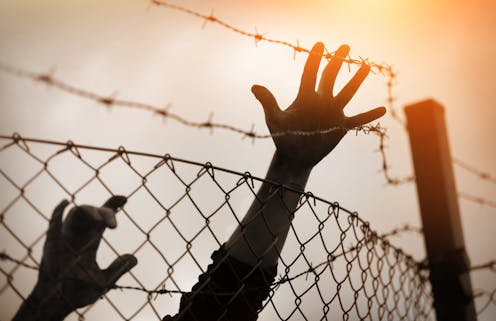
In just a few pages, we are provided views of the locale and an account of its history. The island is beautiful, lushly tropical, with a cliff rising above a red sand beach. It is also surrounded by a reef “like living barbed wire”. Hence its utility as a detention centre: it is almost unreachable, its reef threatening to “tear into the hull of any ship that dared to enter its waters”.
Port Camden is beautiful, but unfriendly. As an unnamed Border Force officer steps off the cliff and falls to the beach, we realise it is probably not survivable, even by those who have made it safely to shore.
Pause, breathe, and move to the remote New South Wales town of Hastings, population 500 families, and a hub for the Rural Australians for Refugees Association. Here we meet Sister Serafina “Fina” Daniels, the novel’s appealing, if enigmatic, central character: a nun deeply versed in Hindu traditions, who demonstrates high levels of medical competence and maintains a correspondence with the captain of the Galakse that is warm enough to suggest romantic entanglement.
Fina also corresponds regularly with Dr Henry Manners, the medical officer for the Port Camden detention centre. Manners supported her application for a Safe Haven Enterprise visa, which permits her to live in Hastings.
For a novel set in a small town, Safe Haven has quite a large cast of characters. There is Louisa, who runs the local hotel, and who is burdened with such grief for her lost husband that she is neglecting her son Cash, leaving Fina to pick up the pieces for the boy. There is Peggy, who does double duty for the school as sports teacher and librarian. And there is Jill, a former litigation lawyer turned school counsellor in her tree change, who now works as a migration agent for refugees.
There are others, too – neighbours, housemates, other refugees – who together build a community for Fina: one she serves with generosity and expertise, and from which she gains affection and care.
 Shankari Chandran’s Safe Haven is her first novel since winning the Miles Franklin Literary Award.
Ultimo Press
Shankari Chandran’s Safe Haven is her first novel since winning the Miles Franklin Literary Award.
Ultimo Press
Excoriating and generous
That’s half her life. The other half is spent on Port Camden, where Fina travels to support her fellow refugees and Dr Manners, and where she is reincarcerated for talking to a journalist about the suicide of a child detainee. The child, Kannen, survived the wreck of SIEV-25, but could not survive the detention centre.
Having broken the conditions of her highly conditional visa, Fina is told she will be returned to Sri Lanka, where her own chances of survival are distressingly slim.
Kannen’s suicide, following close on the heels of the apparent suicide we witnessed in chapter one, leads to an investigation of management and other practices in the detention centre. Fina’s violent arrest and rendition, which was observed, resisted and recorded by the Hastings community, also sets in motion a popular movement calling for her release, one that echoes the efforts on behalf of the “Biloela family” – the family of Sri Lankan asylum seekers who were eventually granted Australian residency after a protracted grassroots campaign.
The person appointed to conduct the investigation is Australian-born Sri Lankan Tamil, Lakshmi Dharman, who is called Lucky because, as she drily observes, “even simple Tamil names like Lakshmi are hard for you to say”. Though Lucky seems a skilled investigator, her chances of success are low. As her boss explains, the commanding officer “expects you to show up, tick some boxes and appease the human rights wankers … His words, not mine”.
 Lucky makes the long trek to Port Camden, and through her we meet a wider cast of characters. There is Candace, captain of the ferry from the mainland to Port Camden, who knows how to thread her way through the barbed wire reef and come safely to dock. There is the commanding officer, Brett Napier, and his pack of mercenaries. There is Ange, proprietor of the local hotel and bar, who seems to be holding a candle for one of the guards.
And there is a community of refugees, from babies to aged people, all of them living in hell.
No spoilers: I won’t pursue the plot. But I will say that the social-realism-cum-thriller narrative is unexpectedly gripping and persuasive. Brutally honest, though never gratuitously so, Safe Haven depicts the abuses authorities can mete out on the vulnerable, the breakdown of what counts as reasonable behaviour under the social contract, and what happens when strongmen are enabled to operate outside the bounds of human compassion or integrity.
There is tragedy, suicide, bullying, surveillance, rendition. Safe Haven reads like an open wound. But there is also a strong thread of tenderness, compassion and courage.
Chandran observes, in her author’s note, that in writing the novel she was “trying to understand what lies behind our detention policies, and the strength of Australians who fight against it”. This she achieves. Safe Haven is an important, if often distressing and excoriating account of a shameful period of Australian history, told in a generous life-affirming voice that imagines a more humane future.
Authors: Jen Webb, Executive Dean (interim) Faculty of Arts and Design, University of Canberra
Lucky makes the long trek to Port Camden, and through her we meet a wider cast of characters. There is Candace, captain of the ferry from the mainland to Port Camden, who knows how to thread her way through the barbed wire reef and come safely to dock. There is the commanding officer, Brett Napier, and his pack of mercenaries. There is Ange, proprietor of the local hotel and bar, who seems to be holding a candle for one of the guards.
And there is a community of refugees, from babies to aged people, all of them living in hell.
No spoilers: I won’t pursue the plot. But I will say that the social-realism-cum-thriller narrative is unexpectedly gripping and persuasive. Brutally honest, though never gratuitously so, Safe Haven depicts the abuses authorities can mete out on the vulnerable, the breakdown of what counts as reasonable behaviour under the social contract, and what happens when strongmen are enabled to operate outside the bounds of human compassion or integrity.
There is tragedy, suicide, bullying, surveillance, rendition. Safe Haven reads like an open wound. But there is also a strong thread of tenderness, compassion and courage.
Chandran observes, in her author’s note, that in writing the novel she was “trying to understand what lies behind our detention policies, and the strength of Australians who fight against it”. This she achieves. Safe Haven is an important, if often distressing and excoriating account of a shameful period of Australian history, told in a generous life-affirming voice that imagines a more humane future.
Authors: Jen Webb, Executive Dean (interim) Faculty of Arts and Design, University of Canberra 

















