

Rising risks of climate disasters mean some communities will need to move – we need a national conversation about relocation now
- Written by: Roslyn Prinsley, Head, Disaster Solutions, Australian National University
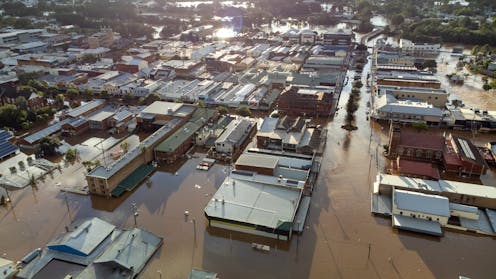
Many Australians live in areas increasingly exposed to climate change and associated extreme weather such as floods, fires, coastal erosion, cyclones and extreme heat. If we wait for disasters to happen, hundreds of thousands of people could be forced to flee.
The devastating 2022 floods in northern New South Wales demonstrate the dangers of failing to move communities from harm’s way. More than two years after the disaster, the city of Lismore is still recovering. Many people remain in temporary housing and cannot return home, re-open businesses or access funds to move elsewhere.
But there is an alternative. We can plan ahead, identify areas most at risk and permanently relocate communities before disaster strikes. Our recent paper outlines the pressing need for such a strategy and offers guidance on how to do it.
Crucially, we call for the establishment of a National Relocation Authority to spearhead the strategy. While the prospect of relocation can be unsettling and traumatic for residents, it offers new opportunities and long-term benefits. But we must act now.
Mounting climate-related risks
Evidence is mounting that climate change will damage homes and property values across Australia.
For example, thousands of inner-city Melbourne residents will be hit with higher insurance premiums and lower property values after Melbourne Water’s updated flood risk modelling placed them in a flood zone. Kensington Banks estate, east of the Maribyrnong River, was once an award-winning urban renewal project. Now the authorities are scrambling to protect high-risk properties and prevent future flood damage.
Sydney-based climate risk analysis company Climate Valuation recently assessed flood risks from swollen rivers to homes across Australia. It identified high-risk properties, where insurance may become unaffordable or unavailable by 2030.
Around one in 25 homes analysed will likely be uninsurable by 2030. That’s 588,857 homes out of 14,739,901. In the most affected regions, more than one in ten homes would be uninsurable.
These properties are most likely to be damaged from flooding, leaving owners with properties they cannot live in, afford to fix, or sell.
Already, one in ten homes within 150 metres of the coast are vulnerable to coastal erosion. It won’t be long before sea level rise makes parts of Australia uninhabitable.
Up to 250,000 residential buildings will be exposed to coastal inundation and erosion with a sea level rise of 1.1m. That is expected by 2100, under the higher emissions scenario. It’s worth noting a rise of nearly 2m by 2100 cannot be ruled out, due to deep uncertainty about melting of ice-sheets.
Meanwhile, parts of Australia are becoming too hot or increasingly bushfire-prone.
Updated flood zone modelling could leave some homes ‘uninsurable’ (7.30)Insurance companies raising the alarm
Climate change is forcing up insurance premiums, triggering a push from the industry to get community relocations onto the agenda.
Last year, Australia and New Zealand’s largest general insurer, IAG, commissioned a report into the factors that help or hinder planned relocation. The report explores involving communities in decision-making and makes recommendations for how governments can implement and manage planned relocation programs.
Suncorp Group and Natural Hazards Research Australia subsequently released a discussion paper to help “drive a national conversation about assisted relocations”. It urges authorities to map the risks of natural hazards, to inform a national conversation about priority natural hazard risk zones. This would incorporate data from the insurance industry.
A Senate inquiry is examining how climate risk affects insurance premiums and availability.
Hospitals, services and roads at risk
New South Wales is the first state to identify planned relocation in its State Disaster Mitigation Plan. Managed relocation is listed as one of the “tools to reduce hazard exposure”. However, the plan recognises:
the managed relocation of people from homes in high-risk areas (known as buy-backs or voluntary purchase) can be disruptive and traumatic due to longstanding connections to homes, places, communities, and Country.
When assessing disaster risks to communities, critical infrastructure also needs to be considered. The NSW plan identifies 64 police stations, 54 State Emergency Service facilities and 19 general hospitals at risk from a 1-in-100 year flood. It also says a 1m rise in sea level would affect more than 800 kilometres of local roads across the state, causing severe disruptions.
The NSW Reconstruction Authority, with the Department of Planning, Housing and Infrastructure, will develop state policy for managed relocation by mid 2025.
Relocation is already happening – after disasters
The Northern Rivers floods left more than 3,500 homes uninhabitable. About 1,100 properties were expected to receive a buyback offer through the state’s Resilient Homes fund. The Reconstruction Authority is working through 1,090 buyback applications.
Another 800 homes in Southeast Queensland may be bought back through the Queensland Reconstruction Authority.
However, buybacks are disruptive and hard to manage after a disaster. It is far better to plan ahead.
Spend on proactive relocation, to save on disaster recovery
If a community stays in place and a disaster occurs, Australian taxpayers share the cost of recovery. This will become increasingly unaffordable as the number of extreme weather events rises.
We need a National Relocation Authority to coordinate relocation efforts with states, territories, local authorities, communities and individuals.
The Commonwealth is uniquely positioned to coordinate and guide state and territory practices concerning relocation. It can ensure efforts are not duplicated, best practices are consistently adopted, and national resources for relocation are used to maximum effect.
Evidence-based, dynamic risk-mapping would identify high priority sites, especially those exposed to multiple climate-related risks – for instance, where sea-level rise coincides with river-flood risk in coastal areas, or where bushfires have exposed the soil and reduced the landscape’s capacity to absorb water, raising the flood risk.
The authority would keep registers of resources in the public and private sector such as infrastructure, available land to relocate to, machinery and equipment, supply chains and expertise.
Communities with a deep sense of belonging and place attachment often resist relocation. The potential loss of place can have significant psycho-social impacts, so careful community engagement is essential.
As climate-related disasters intensify, more people will be find their homes unlivable or uninsurable. Australia needs to start planning now, to relocate our most at-risk communities before it’s too late. The long-term benefits are incalculable.
We would like to acknowledge our co-authors of the issues paper on which this article is based, including experts from The Australian National University, University of Tasmania, University of Canberra, the University of Sydney and Mather Architecture.
Authors: Roslyn Prinsley, Head, Disaster Solutions, Australian National University


















