

Fetal monitoring can be essential during labour – but many women don’t realise they have choices
- Written by: Kate Levett, Research Fellow University of Notre Dame Australia; Adjunct Fellow (National Institute of Complementary Medicine), Western Sydney University, University of Notre Dame Australia
So, you’re about to have a baby. You’ve been to the birth classes – you learned how being upright and moving around can help you be as comfortable as possible. Perhaps you’ve even learned some acupressure or hypnotherapy to help with pain management.
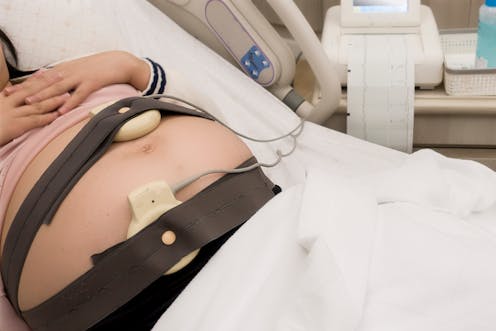
You’re feeling ready for birth – but then things start to get real. The hospital is discussing induction of labour, or maybe you went into spontaneous labour – but they tell you they need to monitor the baby. Health workers attach electrodes, straps and wires. “It’s for the wellbeing of the baby” they say – but nobody has talked about monitoring in any of the classes or visits.
Does everybody have monitoring, you wonder? Are there different ways to check the baby’s heart rate? And do you have a choice?
The answer is yes. Women do have choices about fetal monitoring during childbirth, but few realise it.
What is fetal monitoring?
Fetal monitoring is used during labour to listen to the baby’s heart sounds and measure the contractions of the uterus.
Despite debates and major concerns about the proven ability for fetal monitoring to detect issues, most women will be monitored in some way during labour as part of routine care.
But, different types of fetal monitoring, can impact comfort and pain management, and can drive medical interventions. These can include increased use of pharmacological pain management due to restricted movement. A series of interventions can affect labour progress and increase the likelihood of caesarean section. So, understanding your options is important.
For women considered at low risk of complications and where labour is progressing normally, monitoring is recommended on an intermittent basis. This is usually via a handheld device every 15–30 minutes throughout labour.
However, if there are complexities or greater risks, or labour has been artificially induced, continuous monitoring is recommended.
When labour is induced, contractions are brought about by a synthetic form of the hormone Oxytocin. This can accelerate the labour and produce contractions that increase in intensity more quickly. Close monitoring of fetal wellbeing in relation to the contractions is recommended – usually via electronic fetal cardiotocography, where devices have transducers attached to the woman’s abdomen.
Transducers are attached in a variety of ways – and the different methods impact the birth experience.
Wired or wireless
Wired monitoring is where the transducers are strapped to the women’s abdomen, attached with elastic belts and 1.5-metre-long wires to a machine. These effectively tether women to a monitor, restricting their ability to move.
There are also wireless transducers (telemetry), with straps around the woman’s abdomen, but no wires, giving more freedom of movement. These can often be used in the shower and bath too. Despite being available for about 20 years in Australia, uptake is still limited, despite the comparable accuracy and reliability.
Then there are the relatively new stick-on monitors, which use non-invasive fetal electrocardiograph technology. These monitor the mother’s and baby’s heart rates, and uterine muscle contractions through the mother’s skin.
Sometimes, if there is difficulty getting an external trace, a fetal scalp electrode can be used. This means a wire is inserted into the baby’s scalp (using a wire and electrode inserted via the vagina and through the cervix) using ECG technology to monitor the fetal heart rate.

What we studied
We don’t know much about how women experience these different monitoring types – the information they receive, or choices they have. An Australia-wide survey – the Women’s experiences Of Monitoring Baby (WOMB) study set out to answer these questions.
Our 2023 survey of more than 800 women, found despite less invasive wireless telemetry being available, women mostly received wired monitoring. This was particularly true for first-time mothers, and those giving birth in private metropolitan or public regional hospitals.
Women reported receiving inadequate information, from childbirth education or routine antenatal visits, to make an informed decision. For example, many were not informed that if they had a medical induction of labour, continuous monitoring would be recommended, even if they were considered to have a low-risk pregnancy.
Importantly, women who had an induced labour were also more likely to receive continuous wired monitoring. These women were also more likely to have an epidural, and a caesarean section. With induction of labour becoming more routine, the likelihood of further intervention increases. This is called the “cascade of interventions”, where one intervention trips the wire for each subsequent intervention. We know from our previous research women do not feel adequately prepared for the realities of an induced labour.
What the survey found
Women who experience handheld or wireless devices report greater comfort, ability to move around and use of non-pharmacological strategies.
Freedom of movement is a key strategy for managing pain in labour, and reducing medical interventions. Women report feeling restricted with wired monitoring, saying it was uncomfortable and impacted their labour negatively. In our study over 70% said they wouldn’t choose it again.
Qualitative analysis highlights women’s feelings clinicians were “tending to the machine”. This sense that staff were often preoccupied with the monitoring technology, suggested they were giving less attention to the personalised care and support women needed during labour.
Women expressed a strong preference for handheld and intermittent monitoring. Where continuous monitoring was recommended, telemetry monitoring was reported to be far more comfortable. It allowed greater mobility, access to water and non-pharmacological pain-relief methods. However, in some hospitals many women are not offered telemetry.
Where to from here?
Monitoring is important, and women’s experiences vary significantly depending on the type of monitoring they receive. However, few women receive sufficient information about the choices available to them.
Health professionals have a responsibility to provide personalised information around fetal monitoring. That way every woman can make an informed choice and experience person-centred care.
Authors: Kate Levett, Research Fellow University of Notre Dame Australia; Adjunct Fellow (National Institute of Complementary Medicine), Western Sydney University, University of Notre Dame Australia


















