

Traditional owners and scientists worked together on ‘coral IVF’ projects. Here’s what we found
- Written by: Carly Randall, Senior Research Scientist, Benthic and Restoration Ecology, Australian Institute of Marine Science
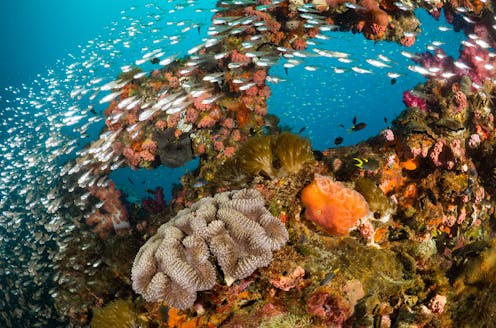
The Great Barrier Reef, which supports an estimated 64,000 jobs and has a social and economic value of around A$6.4 billion, is under threat due to human-induced climate change.
Scientists have begun “biobanking”, which involves gathering coral sperm from the reef during annual spawning. These samples are held in special repositories and can be used in future to create baby corals via “coral IVF”.
Until now, much of this research has been done without consultation with, or permission from, the traditional custodians of the sea Countries of origin.
But our recent research looked at how we can do things in a different and more respectful way by involving traditional custodians in decision-making and action.

What we did and what we found
More than 70 groups of First Nations peoples are traditional custodians of the Great Barrier Reef.
In the summer of 2022, scientists and First Nations peoples gathered on Konomie (North Keppel Island) in Woppaburra sea Country in Central Queensland. We were there for the annual mass coral spawning.
Scientists from the Australian Institute of Marine Science (AIMS) and Taronga Conservation Society trained the Woppaburra people and neighbouring Indigenous Rangers in gathering coral spawn, larval rearing and cryopreservation methods for biobanking.
 Scientists trained the Woppaburra people and neighbouring Indigenous rangers in gathering coral spawn, larval rearing, and cryopreservation methods.
Gemma Molinaro/AIMS, Author provided (no reuse)
Scientists trained the Woppaburra people and neighbouring Indigenous rangers in gathering coral spawn, larval rearing, and cryopreservation methods.
Gemma Molinaro/AIMS, Author provided (no reuse)
During the training, it became clear the current scientific approach overlooked some key cultural considerations.
Woppaburra people believe all things living and non-living, including coral samples, are spiritually connected to Country and people.
By sending these samples to a land-based facility, the “biobanking” process removes them from Country, breaking this vital connection. (The samples are held in biorepositories at Taronga CryoDiversity Bank sites on Cammeraygal and Wiradjuri lands, in New South Wales).
Holding samples from another group’s Country also creates cultural concerns for the traditional custodians of the lands on which the samples are stored, and for First Nations staff and visitors to those sites.
As traditional custodians, Woppaburra people are charged with looking after Country. Maintaining an enduring link to these samples is vital for cultural safety.
This realisation led to collaborative brainstorming about the ways in which these goals could be met. We wanted biobanking samples to support reef resilience while also maintaining links to the samples’ rightful custodians.
It also raised new questions, such as:
- which group(s) hold custodianship over corals bred via IVF, using sperm and eggs from two different sea Countries?
- what if those corals are seeded to a third sea Country?
- how can we do this work more respectfully?
 During the training, it became clear the current scientific approach overlooked some key cultural considerations.
Gemma Molinaro/AIMS, Author provided (no reuse)
During the training, it became clear the current scientific approach overlooked some key cultural considerations.
Gemma Molinaro/AIMS, Author provided (no reuse)
A different approach
We don’t have all the answers. But we started by drafting new protocols to guide the custodial stages. This includes:
- how we gather coral spawn for scientific use
- how we eventually return coral larvae to Country
- how we transfer custodianship of samples to other parties.
We are also building cross-cultural, cross-institutional collaborations to continue working together towards the same goals. These include protecting, preserving and supporting adaptation of corals in the face of climate change.
In a world first, the Woppaburra people worked with the Taronga Cultural Programs team, the AIMS Indigenous Partnerships Team, and Gamay traditional custodians, to transfer custodianship of cryopreserved coral samples.
The Woppaburra and Gamay peoples share the same totem, the humpback whale, and are seen as sister clans. This made the ceremony accompanying the acceptance especially meaningful.
 By working together, Western science and Indigenous knowledge were shared and new traditions were born.
Gus Burrows/AIMS, Author provided (no reuse)
By working together, Western science and Indigenous knowledge were shared and new traditions were born.
Gus Burrows/AIMS, Author provided (no reuse)
While the samples will always be part of Woppaburra Country, cultural custodianship and guardianship has been transferred to the Gamay Rangers.
By working together, Western science and Indigenous knowledge were shared and new traditions were born.
As we describe in our journal paper:
An unexpected and profound outcome that emerged during the nights of spawning was a new cultural practice whereby rather than simply being discarded, the gametes remaining after sperm were sampled were combined in a small bucket and fertilised.
At the end of the night, the Woppaburra women released these early embryos and leftover gametes into the receiving waters around Konomie to ensure their return to Country.
The purpose of this practice was to respect the life potential of these embryos and gametes, either as future coral recruits on surrounding reefs or simply as part of the biocultural ecosystem of Country.
Getting it right is in everyone’s best interests
Traditional owners are increasingly re-asserting their role in managing sea Country.
As climate change continues to affect the Great Barrier Reef and new methods for reef restoration are developed, this blueprint will ensure that cultural safety remains at the forefront of restoration activities.
It is crucial organisations genuinely engage with traditional owners through the process of free, prior and informed consent. This right is recognised by the United Nations Declaration on the Rights of Indigenous Peoples.
This UN declaration sets out the processes for how traditional custodians engage with other parties in their sea Countries, for reef research and restoration.
New practices such as the protocols set out in this project give the Woppaburra people confidence their traditional cultural values are being considered and applied in a respectful manner and will remain so, into the future.
Sadly, the reef is under immense pressure from ocean warming and human-induced stress. Better partnerships between scientists, resource managers and traditional custodians of sea Countries are in everyone’s best interests.
Authors: Carly Randall, Senior Research Scientist, Benthic and Restoration Ecology, Australian Institute of Marine Science


















