

a nuclear push by allies at COP29 poses a sticky problem for Albanese
- Written by: John Quiggin, Professor, School of Economics, The University of Queensland
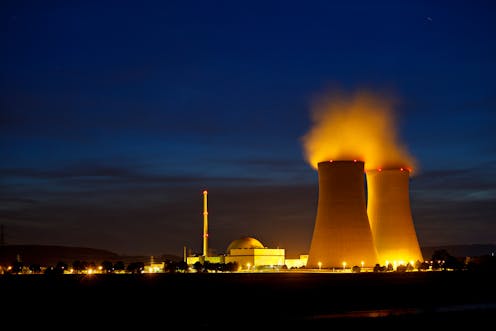
Prime Minister Anthony Albanese didn’t see this coming. At the global COP29 climate talks in Baku, the Australian government was indirectly criticised by two allies, the United States and the United Kingdom, over its refusal to sign onto the goal of tripling nuclear power globally by 2050.
The UK’s original press release said Australia was “expected” to sign on to the nuclear push, under the umbrella of a long-running nuclear research pact known as the Gen IV Forum. Australia signed up to this pact in 2016, under a previous government, and in 2021 signed onto the AUKUS security pact to procure nuclear submarines from the US. This is perhaps why UK leaders assumed Australia would back the broader push to promote nuclear power around the world.
Not so. While Australia has signed up for nuclear submarines, it has not made any effort to adopt nuclear power. But nuclear power is shaping up as a major election issue, with the Coalition pushing for Australia to go nuclear and Labor pointing out the improbable economics of nuclear in a sun and wind rich country.
“As Australia does not have a nuclear energy industry, and nuclear power [is] illegal domestically, we will not be signing up to this agreement,” a government spokesperson said.

What exactly is this nuclear initiative?
The US and UK initiative announced at Baku is intended to supersede the Generation IV Forum set up in 2001 to produce designs for fourth-generation nuclear reactors and eventually replace the Gen III designs currently running in many countries. More than 20 years later, there is only one prototype Gen IV reactor, which began operating in China this year. Plans for a larger successor appear to have been shelved for the moment.
The US and UK have had nuclear power since the late 1950s. But the goal of tripling nuclear capacity in 25 years is wildly unrealistic, certainly as far as the US and UK are concerned.
In 2023, about 9% of the world’s electricity came from the roughly 400 nuclear reactors producing power. In recent years, nuclear growth has been concentrated in Asia – especially China, which has 30 reactors under construction – followed by Russia and Eastern Europe. Tripling the world’s nuclear power output would be a herculean feat.
Since the US completed the Vogtle plant in 2023, years behind schedule and billions over budget, there have been no commercial nuclear plants under construction in the country. A handful of proposals approved during the much-touted “nuclear renaissance” of the early 2000s could in theory be commenced, but there is no sign of that happening. The idea of building any substantial number of plants by the mid 2030s, as is proposed in the US strategy, is a fantasy.
The UK has two nuclear reactors under construction at Hinkley Point, both massively overdue and over-budget. A number of other projects announced in the early 2000s have been abandoned, leaving only the Sizewell C plant, a 3.2-gigawatt power station proposed in England.
Sizewell C was officially approved in November 2022 but financing has proved problematic. The UK government has repeatedly deferred a final decision, currently planned for early next year. Assuming a positive outcome, Sizewell C might be in operation by 2035. After that, there are no large-scale plants in the pipeline.
With no large-scale nuclear on the horizon, attention has switched to the idea of “small modular reactors”, ranging from 70 to 300MW in size. This category includes truly modular designs, built in a factory and shipped to the construction site, as well as cut-down versions of existing large reactors. A notable example is the Westinghouse AP300, which is based on the AP1000 used at Vogtle.
Although no SMRs have yet been constructed (or perhaps precisely because there have been no real-world tests of ambitious claims), advocates suggest they can be constructed in five to seven years at a lower cost per megawatt than existing large models. But in Australia, CSIRO modelling suggests power from SMRs will actually be more expensive than large nuclear – which is much more expensive than renewables firmed with storage and transmission.
There has been a recent burst of enthusiasm for the idea of using SMRs to power data centres for cloud and AI systems.
But a closer look suggests caution. Big tech giants such as Amazon, Google and Microsoft have announced plans for delivery in the early 2030s, but in each case, the proposed capacity is 1GW or less.
As a result, it’s highly unlikely they will amount to more than 5GW of new capacity over five years.
By contrast, renewables are only gaining strength. In the second half of 2024 alone, the US is expected to install more than 40 GW of utility-scale capacity, including 10GW of battery storage. China is installing renewables at truly prodigious rates, with around 330 GW installed or under way.
Doesn’t the AUKUS deal pave the way to nuclear power?
Many commentators have this week drawn a line between this nuclear announcement and AUKUS. But this contradicts previous assurances that the submarine deal was not linked to the legalisation of nuclear energy
When the nuclear submarine pact was first announced, even strong nuclear advocates moved to distinguish between nuclear subs and nuclear plants. As Liberal-National MP Ted O’Brien said in 2021, the AUKUS deal was not related to nuclear power:
They are two entirely different offerings. The nuclear-propelled submarines do not require a change in Australian law. So legally they are completely different issues for the parliament to deal with. There is no moratorium that needs to be lifted
The US and UK proposal to triple nuclear power involves a large amount of wishful thinking and very little reality.
 The AUKUS pact between Australia, the US and the UK would see Australia own nuclear submarines.
Leon Neal/AP
The AUKUS pact between Australia, the US and the UK would see Australia own nuclear submarines.
Leon Neal/AP
But that doesn’t help the Albanese government much. Opposition Leader Peter Dutton, whose party now has a platform of creating a domestic nuclear power industry in Australia, can fairly claim that his ideas are consistent with the announced positions of our AUKUS allies.
The government is also open to attack from the Greens and other critics of AUKUS. With a recently announced decision to store AUKUS-related nuclear waste at submarine shipyards, it’s becoming increasingly arguable that, contrary to earlier assurances, participation in AUKUS will lock Australia into the full nuclear fuel cycle, potentially including reprocessing and nuclear energy generation.
Then there’s the Trump factor. Donald Trump’s return as US President could render all these calculations irrelevant. Although Trump is strongly pro-nuclear in his rhetoric, he is likely to abandon the green industrial policy of Biden’s Inflation Reduction Act which provides US government support for nuclear power. And, if the AUKUS deal begins to look troublesome, he will have no hesitation in repudiating it or demanding a renegotiation on unfavourable terms.
Authors: John Quiggin, Professor, School of Economics, The University of Queensland


















