

Build to Rent will produce more homes for tenants, but not for those most in need
- Written by: Hal Pawson, Professor of Housing Research and Policy, and Associate Director, City Futures Research Centre, UNSW Sydney
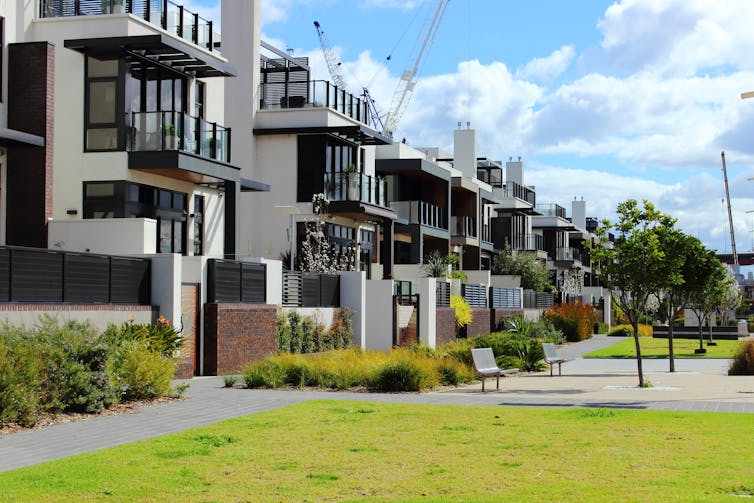
Part two of the government’s stalled housing legislation finally passed federal parliament on Thursday. The Build to Rent tax reform bill aims to boost investment in apartment blocks designed and constructed for rental occupancy and retained in single ownership.
Other than as purpose-built student accommodation, this form of development remains rare in Australia.
Instead, our private rental market continues to be dominated by small-scale “mum and dad investors”. Only since around 2017 have Build to Rent projects begun to appear in some Australian capital cities.
By mid-2024, just 5,000 units had been completed with 11,000 under construction.
Australian governments now see expanding this form of housing as appealing. In the long term, that might bring Australia more into line with countries such as the United States and Canada, where large-scale institutional investment in rental housing is long-established.
How does the bill work?
Under the new bill, the 30% withholding tax rate for foreign funders of residential Build to Rent developments is equalised with that for commercial and industrial property, at 15%.
At the same time, the Build to Rent capital works tax deduction rate is increased from 2.5% to 4%. This allows expenses to be depreciated for tax over a 25-year span, rather than 40 years as at present. This brings Build to Rent into line with the Australia Tax Office’s treatment of serviced apartments, making projects more viable.
In attempting to step up Build to Rent development, high significance is attached to enabling overseas investment.
Because they already invest at scale in Build to Rent development in other countries, many large international players are already familiar with this type of development. Pension funds, insurance companies and sovereign wealth funds are attracted by its low risk and reliable returns.
More housing that’s more secure
As argued in a recent official report, Build to Rent housing could help fulfil several significant housing policy objectives.
First, when developers can diversify away from solely focusing on building to sell, there could be an overall increase in housing supply.
Second, homes are likely to be more secure for tenants. This is because the prime motivation of Build to Rent investors is often long-term rental income.
Small landlords, on the other hand, are usually motivated by capital gain that can be realised only through sale.
Third, multi-unit buildings commissioned to be kept by a single owner should incentivise utility, durability and energy efficiency in design and construction.
Finally, Build to Rent could be relatively resistant to housing market downturns. This benefits both the development industry and the national economy.
It’s not that simple
At the same time, Build to Rent does not inherently contribute to affordable housing.
At least in its initial form in Australia, it is typically a “premium product”, mainly in well-connected locations and targeted at moderate to high income earners.
In early 2024, for example, two bedroom apartments were advertised in Sydney and Melbourne at weekly rents in the $800-$950 range, according to my own survey at that time.

But eligibility for the new (and lower) rate of withholding tax offered in the Build to Rent bill is conditional on a proportion of apartments in qualifying projects being made available as “affordable prices” – that is, a rent discounted from the market rate.
While appealing in principle, the detailed proposal sparked controversy around the proposed definition of “affordable housing”, the projects that would be covered and the way that designated “affordable” units would be managed.
As amended in the Senate, qualifying developments will need to include 10% affordable tenancies, with rents set at 74.9% of market value or no more than 30% of household income, whichever is the lower.
Affordable units (including a minimum proportion rented to low income earners) will be managed by community housing providers for at least 15 years.
Given the Property Council’s estimate that the new framework could yield a total of “over 80,000” Build to Rent apartments over the next decade, this could generate 8,000 good quality units affordable to moderate income earners.
The government also agreed to the retrospective application of the new tax regime for projects already under construction or recently completed.
But this is not a free gift. It’s similarly conditional on 10% of the units being designated as affordable. These will form an “advanced package” of around 1,200 sub-market price tenancies coming online over the next 12 months.
Last-minute negotiations also saw the addition of the pledge that all units – affordable and market price – will come with five-year tenancies and a ban on no grounds evictions.
More could be done
Like the Help to Buy initiative, when viewed within the context of the wider housing crisis, this scheme is another micro-measure.
It has little or no relevance to headline concerns around home ownership affordability, low-income rental stress and homelessness.
But, in combination with significant state tax changes enacted in recent years, it should help in establishing a new component in our rental market. One that – at least for moderate to high income tenants – will widen choice and improve quality.
And, if proponent boasts are valid, could be a more customer-centric form of market rental than the traditional Australian norm.
However, the requirement for including affordable units in this new and, as yet, financially marginal form of development raises other possibilities. Why don’t such obligations exist for the vast bulk of housing constructed as build to sell? A proposal for just such a framework, sometimes known as “mandatory inclusionary zoning”, is in development.
Even if imposed at an extremely low rate (like 5%) on homes built in high land value areas (Sydney and Melbourne, for example) this could generate a vastly greater affordable housing gain.
Authors: Hal Pawson, Professor of Housing Research and Policy, and Associate Director, City Futures Research Centre, UNSW Sydney


















