

More than 1,300 Hajj pilgrims died this year when humidity and heat pushed past survivable limits. It’s just the start
- Written by: Emma Ramsay, Research Affiliate in Climate Adaptation, Monash University
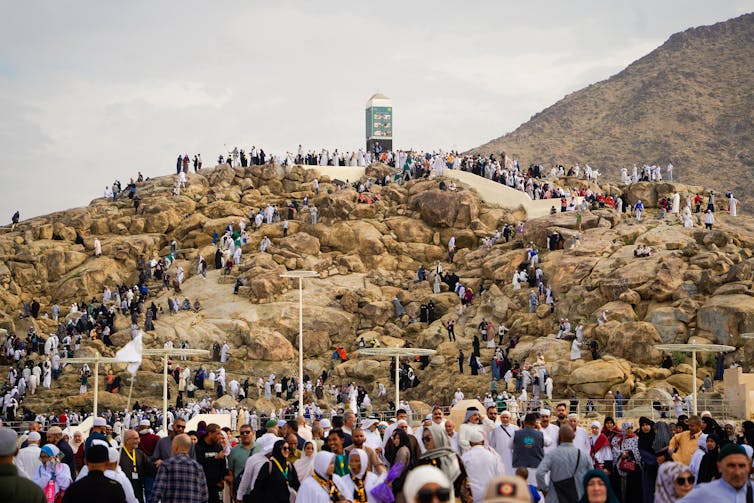
Every year, hundreds of thousands of Muslims undertake the Hajj –the sacred pilgrimage to Mecca. In 2024, the pilgrimage took place in mid-June, the start of the Saudi summer.
But this year, more than 1,300 pilgrims never made it home. Lethal heat combined with humidity proved deadly.
Our new research shows the upper limits of human heat tolerance were breached for a total of 43 hours over the six days of Hajj. During these periods, heat and humidity passed beyond the point at which our bodies are able to cool down.
Scientists are increasingly worried about the death toll caused by humid heatwaves, and how it will escalate in the near-term. This year is now the hottest year on record, overtaking the previous hottest year of 2023.
So why was the pilgrimage so deadly? And what does it mean for us as the climate changes?

What happened in Mecca?
As the planet gets hotter, it is also becoming more humid in many places, including arid Saudi Arabia. Since 1979, periods of extreme humid heat have more than doubled in frequency globally, increasing the chance of lethal events like this.
To do the Hajj, you have to walk between six and 21 kilometres each day. Many pilgrims are older and not in good health, making them more vulnerable to heat stress.
This year’s pilgrimage started on June 14. Over the next six days, the temperature topped 51°C, while “wet-bulb temperatures” (the combination of temperature and humidity) rose as high as 29.5°C.
June is typically the driest month in Saudi Arabia with average relative humidity around 25% and wet-bulb temperatures averaging 22°C. But during this year’s Hajj, humidity averaged 33% and rose as high as 75% during the most extreme periods of heat stress.
Our research shows heat tolerance limits for older adults were breached on all six days of Hajj, including four prolonged periods of more than six hours. On one ferocious day, June 18, humid heat hit levels considered dangerous even for young and healthy pilgrims. The points at which wet-bulb temperatures enter the lethal zone depend on the exact combinations of temperature and humidity, because our bodies respond differently to dry or humid heat.
Saudi authorities have installed air-conditioned shelters and other cooling methods. But these are only available to pilgrims with official permits. Most of those who died did not have permits, meaning they could not access cool relief.
The pilgrimage will be even more dangerous in the future. In 25 years time, the timing of Hajj will cycle back to peak summer in August and September. At 2°C of warming, the risk of heatstroke during Hajj would be ten times higher.
Pilgrims died in their hundreds at the 2024 Hajj.How much heat and humidity can we handle?
In 2010, researchers first proposed a theoretical “survival limit”, which is a wet-bulb temperature of 35°C.
But we now know the true limit is actually much lower. Experiments testing human physiological limits inside controlled heat chambers, backed up by sophisticated models, have revealed new heat tolerance limits.
These limits vary depending on your age and how humid it is. For example, the tolerance limit for young people is around 45°C at 25% humidity but only 34°C at 80% humidity. For older people, the limits are lower still – 32.5°C at 80% humidity is dangerous.
These limits are the point at which it is too hot and humid for your body to cool itself down, even at rest. Sustained exposure leads to your core body temperature rising, heatstroke and after a number of hours, death.
Many of us are familiar with air temperatures of 34°C and above. But we tolerate dry heat far better than humid heat. Humid conditions make it far harder for us to use our main way of shedding heat – sweat.
We rely on air to evaporate the sweat from our skin and take the heat with it. But humidity changes this. When there’s more water in the air, it’s harder for sweat to evaporate.
Humid heat is a rising threat worldwide
Heat is a quiet killer. It’s not a visible threat, unlike fires, floods, droughts and other climate-fuelled extreme weather. Heat-related deaths are difficult to track and are likely underestimated. But what we do know indicates heat is the deadliest climate hazard in many parts of the world. Until now, much research has focused on one variable – the air temperature. It’s only recently scientists have begun to untangle the lesser known threat of lethal humidity.
Humidity comes from evaporation off oceans and large bodies of water. As climate change heats up the oceans, they produce more moisture. That means coastal regions – home to many of the world’s largest cities – are vulnerable. That’s why arid Saudi Arabia and other nations on the Arabian Peninsula are particularly at risk – they are surrounded by shallow, warming seas.
But humidity can also travel far inland, through the phenomenon known as “atmospheric rivers”, airborne rivers of moisture. This is how episodes of lethal humidity can strike landlocked areas such as northern India.
The threat of humid heat is set to worsen sharply. We are already seeing lethal humid heat in the Arabian Gulf, across Bangladesh, northern India and parts of Pakistan, and in Southeast Asia.
People are dying from these events, but the extent is poorly documented. Heatwaves this year closed schools in the Philippines, India and Bangladesh and killed dozens during India’s election.
Without a rapid phase out of fossil fuels, we could see lethal humid heat hit multiple times a year in every major economy, including the United States, India, China, South America, Europe and large parts of Africa.
 India is one of the nations likely to be hard hit by dangerous levels of humid heat.
Arrush Chopra/Shutterstock
India is one of the nations likely to be hard hit by dangerous levels of humid heat.
Arrush Chopra/Shutterstock
There is a limit to adaptation
We like to think we can adapt to change. But there is a hard limit to our ability to adapt to lethal humidity and heat.
Technological adaptations such as air-conditioning do work. But they are not available to all. Nor are they fail-safe.
During a heatwave, many of us turn on the aircon at the same time, using lots of power and raising the chance of blackouts. Blackouts during heatwaves can have deadly consequences.
In the famous first chapter of Kim Stanley Robinson’s novel, The Ministry For The Future, an American aid worker struggles to survive an intense humid heatwave in India, which kills millions. The book is set just a few years into the future.
The deaths during the Hajj warn us that lethal humid heat is not fiction. It’s yet another reason to rapidly reduce greenhouse gas emissions by ending our reliance on fossil fuels.
Authors: Emma Ramsay, Research Affiliate in Climate Adaptation, Monash University


















