

How does franchising work?
- Written by: Andrew Terry, Professor of Business Regulation, University of Sydney
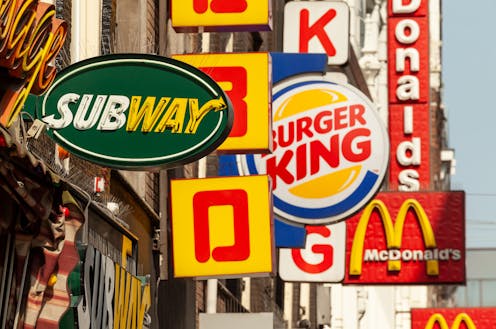
Even if you’ve no idea how the business model underpinning franchises works, there’s a good chance you’ve spent money at one.
Franchising is essentially a strategy for cloning a branded business by replicating proven management and business systems.
McDonald’s, KFC, Pizza Hut, Dominos, and Taco Bell are prominent multinational examples. But franchising isn’t limited to fast food, and not all franchise systems are American.
The model has transformed the business landscapes of most countries. Not least Australia, which has more franchising outlets per capita than any other country except New Zealand.
It can have some real benefits for both the franchisor – the entrepreneurial enterprise looking to expand, and the franchisee – the aspiring owner-operator seeking to enter an industry.
But it can also pose some unique challenges, including what might happen to you as a franchisee if the brand you’ve partnered with is sold.
What is franchising?
Franchising is essentially a strategy for marketing and distribution.
A small company with a successful business that is seeking to expand will face real financial and management challenges in scaling up organically. Franchising provides an increasingly popular alternative.
Under the franchising model, a company’s expansion is, in effect, outsourced to legally and financially independent operators called franchisees.
Franchisees are granted the right to develop and operate their own business using the brands, systems and know-how of the parent company, called the franchisor.
In return, franchisees pay franchisors a fee (usually a percentage of turnover) and enter an agreement for a fixed term.
The rights and obligations of the parties are recorded in a franchise agreement – a complex and lengthy document which addresses the intricate commercial relationship between both parties over the life of the agreement.
What are the benefits?
As noted by a 1990 US House of Representatives Committee, franchising provides a means for:
merging the seemingly conflicting interests of existing businesses with those of aspiring entrepreneurs in a single process that promotes business expansion, entrepreneurial opportunity and shared cost and risk.
The franchisor, looking to grow their business, benefits from more rapid market expansion than would be possible through organic growth.
Outlets are financed and managed by the franchisees, who provide them with a regular source of income. Most commonly, through the payment of fees based on a percentage of turnover.
The franchisee benefits from participating in a proven brand with established recognition, reputation and goodwill. They also receive training and ongoing support.
Beyond fast food
Australia’s franchise systems operate across virtually all consumer goods and services. Many business-to-business services are also offered through franchised systems.
An independent review of the Franchising Code of Conduct in 2023 recorded that Australia’s franchise sector comprised 1,144 franchise systems and more than 70,000 franchisees.
Collectively, the entire sector employed more than half a million people and generated about A$135 billion in annual revenue.
The expansion of the US fast food giants to Australia – McDonald’s, KFC, Pizza Hut – in the early 1970s undoubtedly introduced Australian consumers to distinctive fast food concepts.
But it also introduced the franchising concept to local entrepreneurs who were quick to adopt and adapt it.
Today, according to the US Trade Commission, close to 90% of franchises operating in Australia are Australian-developed. US brands (not individual units) account for 3-5% of the market here.
Still relatively young
The remarkable success of franchising perhaps disguises its relative infancy as a method of business operation. Franchising in its contemporary business format only developed in the 1950s.
The expanding US Interstate Highway system, implemented by President Dwight Eisenhower in the mid-1950s, led to a demand for convenient and cheap food and accommodation offerings.
Franchise systems developed at that time took advantage of this opportunity. Harland Sanders adopted franchising in 1952 to expand his roadside fried chicken restaurant today known as KFC. Kemmons Wilson’s first Holiday Inn was franchised in 1954.
And in 1955 Ray Kroc developed a franchising strategy to exploit the massively successful hamburger stand developed by Richard and Maurice McDonald in San Bernardino, California.
Bigger and bolder
Franchising may have started as an expansion strategy for small businesses with a proven concept and the ambition to grow. But somewhere along the way, it got big.
The model has now evolved from its original form, where a national franchisor makes agreements with single unit franchisees, to increasingly innovative strategies.
Multi-unit franchising is where franchisees own and operate multiple units of the franchise system – for example, multiple stores.
Multi-brand franchising is where a company owns multiple franchise brands.
There’s even master franchising, where a franchisor grants an entrepreneur the rights to franchise the system in an entire country or territory.
However, these increasing complexities only deepen when companies list on the stock exchange – or when a franchise brand is sold.
Changing ownership
Changing ownership of a franchise brand will always present challenges.
When a franchisee running an individual store wants to transfer ownership of their business, they require their franchisor’s consent (although the mandatory Franchising Code of Conduct states this consent cannot be unreasonably withheld).
On the other hand, if a franchisor wants to sell the overarching brand, they aren’t required to get the consent of their franchisees, unless required under the franchise agreement (which would be highly unusual).
An announcement last month, that Queensland-based Retail Food Group would acquire boutique South Australian coffee franchise Cibo Espresso from its parent company, Retail Zoo, caused some controversy.
Cibo stores are set to be rebranded as Gloria Jean’s stores, one of Retail Food Group’s 11 franchise brands.
Retail Food Group expects to invest about $1.3 million into the Cibo network to help existing franchisees “accelerate their transition to Gloria Jean’s”.
Perhaps predictably, though, the announcement was not universally welcomed by all Cibo franchisees. Some expressed regret at the loss of a local South Australian brand.
Existing franchisees would face substantial financial hurdles in challenging the transition. In these and similar cases, experience suggests abundant goodwill is required on both sides for a workable commercial outcome.
This article is part of The Conversation’s “Business Basics” series where we ask experts to discuss key concepts in business, economics and finance.
Authors: Andrew Terry, Professor of Business Regulation, University of Sydney
Read more https://theconversation.com/how-does-franchising-work-243585


















