

Blinking radio pulses from space hint at a cosmic object that ‘shouldn’t exist’
- Written by Manisha Caleb, Senior Lecturer in Astrophysics, University of Sydney
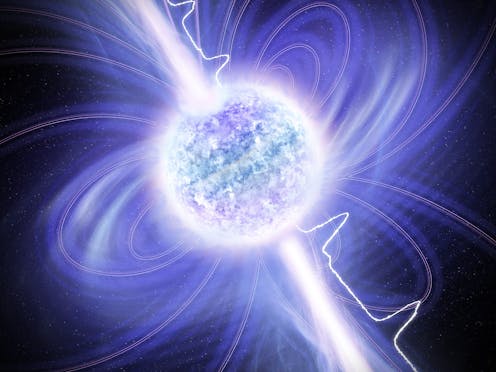
When some of the biggest stars reach the end of their lives, they explode in spectacular supernovas and leave behind incredibly dense cores called neutron stars. Some of these remnants emit powerful radio beams from their magnetic poles.
As the star spins, these beams sweep past Earth and produce periodic pulses of radio waves, much like a cosmic lighthouse. This behaviour has earned them the name “pulsars”.
Pulsars typically spin incredibly fast, often completing a full rotation in just seconds – or even less. Over the last three years, some mysterious objects have emerged that emit periodic radio pulses at much slower intervals, which is hard to explain with our current understanding of neutron stars.
In new research, we have found the slowest cosmic lighthouse yet – one that spins once every 6.5 hours. This discovery, published in Nature Astronomy, pushes the boundaries of what we thought possible.
Our slow lighthouse also happens to be aligned with Earth in a way that lets us see radio pulses from both its magnetic poles. This rare phenomenon is a first for objects spinning this slowly and offers a new window into how these stars work.
An object that shouldn’t exist?
We discovered the object, named ASKAP J1839-0756, using CSIRO’s ASKAP radio telescope, located in Wajarri Yamaji country in Western Australia.
During a routine observation, ASKAP J1839-0756 stood out because no previously known object had been identified at its position. Its radio emission appeared as a fading burst, with its brightness plummeting by 95% in just 15 minutes.
At first, we had no idea the source was emitting periodic radio pulses. Only a single burst had been detected during the initial observation.
To uncover more, we conducted more observations with ASKAP as well as CSIRO’s Australia Telescope Compact Array on Kamilaroi country in Narrabri, NSW, and the highly sensitive MeerKAT radio telescope in South Africa. A long ASKAP observation eventually revealed two pulses separated by 6.5 hours, confirming the periodic nature of the source.
But here is the real surprise: according to what we know about neutron stars, ASKAP J1839-0756 shouldn’t even exist.
Neutron stars emit radio pulses by converting their rotational energy into radiation. Over time, they lose energy and slow down.
Standard theory says that once a neutron star’s spin slows beyond a certain point (about one rotation per minute), it should stop emitting radio pulses altogether. Yet here is ASKAP J1839-0756, lighting up the cosmos at a leisurely pace of one rotation every 6.5 hours.
A tale of two poles
Most pulsars, the faster-spinning cousins of ASKAP J1839-0756, are like one-sided flashlights. The axis they spin around is closely aligned to the axis of their magnetic field, which means we only see flashes from one magnetic pole.
But in about 3% of pulsars, the rotational and magnetic axes are almost at right angles to one another, which lets us see pulses from both poles. These rare double flashes, called interpulses, provide a unique window into the star’s geometry and magnetic field.
Whether a pulsar’s magnetic and rotational axes become more aligned or less aligned as it slows down is still an open question.
The interpulse from ASKAP J1839-0756 could provide clues to this question. About 3.2 hours after its main pulse, it emits a weaker pulse with different properties, strongly suggesting we’re seeing radio light from the opposite magnetic pole.
This discovery makes ASKAP J1839-0756 the first slowpoke in its class to emit interpulses, and it raises big questions about how such objects work.
Magnetar or something new?
So, what is powering this cosmic anomaly? One possibility is that it is a magnetar — a neutron star with a powerful magnetic field that makes Earth’s most powerful magnets look like featherweights.
Magnetars generate radio pulses through a different mechanism, which might allow them to keep shining even at slower spin rates. But even magnetars have limits, and their periods are usually measured in seconds, not hours.
The only exception is a magnetar named 1E 161348-5055, which has a period of 6.67 hours. However, it only emits X-ray and no radio pulses.
Could ASKAP J1839-0756 be something else entirely? Some astronomers wonder if similar objects might be white dwarfs – the leftover cores of less massive stars.
White dwarfs spin much more slowly than neutron stars, but no individual isolated white dwarfs have been observed to emit radio pulses. And so far, no observations in other wavelengths have found evidence of a white dwarf at this location in the sky.
A cosmic puzzle
Whatever ASKAP J1839-0756 turns out to be, it is clear that this object is rewriting the rulebook. Its strange combination of slow rotation, radio pulses and interpulses is forcing astronomers to rethink the limits of neutron star behaviour and explore new possibilities for what lies at the heart of this enigma.
The discovery of ASKAP J1839-0756 is a reminder that the universe loves to surprise us, especially when we think we have got it all figured out. As we continue to monitor this mysterious object, we’re bound to uncover more secrets.
Authors: Manisha Caleb, Senior Lecturer in Astrophysics, University of Sydney

















